

Reinforcement Learning Explained: How Agents Learn Through Rewards
 Suyash Raizada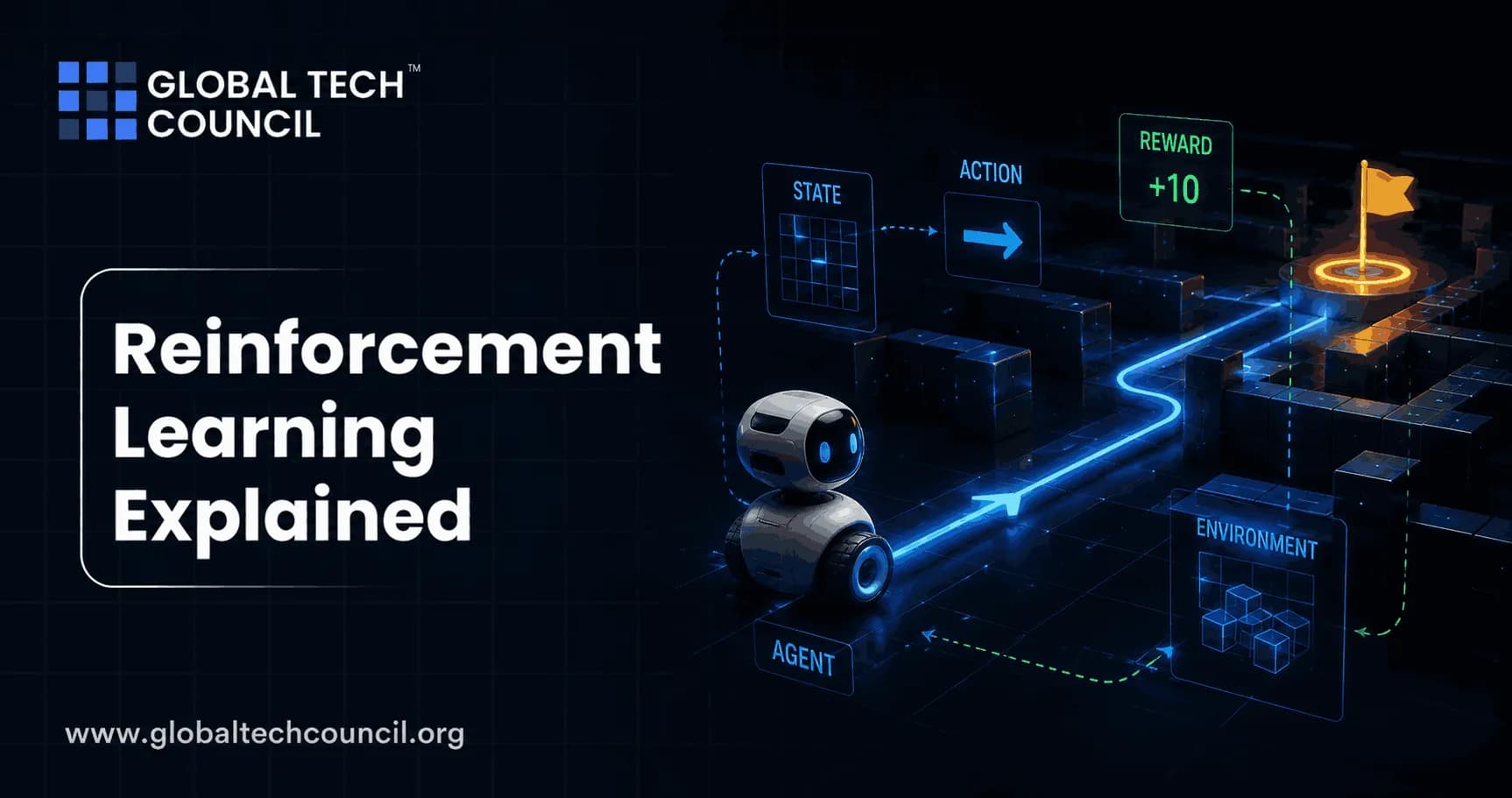
Reinforcement learning is the branch of machine learning where an agent learns what to do by trying actions, receiving rewards or penalties, and adjusting its behavior to earn better long-term results. If supervised learning is about learning from labeled examples, reinforcement learning is about learning from consequences.
You see this pattern in robot control, trading systems, traffic signals, recommendation engines, game-playing AI, and newer reasoning systems that score multi-step answers against verifiable goals. The idea is simple. The engineering is not.

Building effective reinforcement learning systems requires more than understanding rewards and algorithms. Professionals also need practical skills in data handling, model evaluation, simulation, deployment, and performance monitoring to create reliable AI solutions. A Certified Machine Learning Expert credential helps develop this foundation, preparing learners to apply machine learning techniques confidently across real-world environments.
What Is Reinforcement Learning?
Reinforcement learning, often shortened to RL, trains an agent to make a sequence of decisions inside an environment. At every step, the agent observes a state, chooses an action, receives a reward, and moves to a new state.
Richard Sutton and Andrew Barto, whose textbook Reinforcement Learning: An Introduction is still the standard reference, define the field around trial-and-error learning and delayed reward. That delayed part matters. A good action now may look bad immediately but pay off later. A bad action may give a quick reward and damage the final outcome.
That is why reinforcement learning fits decision problems where rules are hard to write by hand:
How should a robot arm grip an unfamiliar object?
When should a battery storage system charge or discharge?
What treatment schedule could reduce side effects while preserving clinical benefit?
How should a portfolio adjust risk over weeks, not seconds?
How Agents Learn Through Rewards
The basic RL loop has four moving parts. Keep these clear and most RL papers become less intimidating.
State: What the agent can observe. In a robot, this might include joint angles, camera images, force readings, and target position.
Action: What the agent can do. For example, move left, apply torque, increase price, allocate compute, or recommend an item.
Reward: A number that tells the agent whether the outcome was useful. Rewards can represent profit, accuracy, energy savings, safety, or task completion.
Policy: The strategy that maps states to actions. This is what the agent improves during training.
A common formal model is the Markov Decision Process, where the next state depends on the current state and action. In practice, many real systems are only partly observable, noisy, and messy. That is where deep reinforcement learning enters.
As reinforcement learning becomes part of broader AI applications, professionals benefit from understanding how decision-making models integrate with deep learning, intelligent automation, and modern AI systems. A Certified AI & Machine Learning Expert credential helps build this wider perspective, enabling practitioners to design AI solutions that combine technical performance with practical business value.
Value-Based Learning: Q-Learning
In value-based methods, the agent estimates how good an action is in a state. Q-learning is the classic example. The Q-value answers a practical question: if you are here and take this action, how much future reward should you expect?
Deep Q-Networks, or DQN, use neural networks to approximate Q-values when the state space is large. This was one reason RL became famous in Atari game research. Still, DQN is not magic. It can be brittle if reward scaling, replay buffer size, and exploration settings are poorly chosen.
Policy Gradient Methods
Policy gradient methods learn the policy directly. Instead of asking what an action is worth, the algorithm adjusts action probabilities to increase expected return. Proximal Policy Optimization, known as PPO, is widely used because it is relatively stable compared with older policy gradient methods.
In real training runs, tiny defaults can bite you. In Gymnasium, the successor to OpenAI Gym, version 0.26 changed the API so env.reset() returns (observation, info) and env.step(action) returns (observation, reward, terminated, truncated, info). If your old code expects four return values, it breaks. Many beginners blame PPO or DQN when the first bug is just an environment API mismatch.
Why Reward Design Is Hard
Reward design is where reinforcement learning becomes a product problem, not just a math problem. The agent optimizes what you measure. Not what you meant.
Give a cleaning robot a reward for collecting dirt and it may learn to dump dirt back on the floor so it can collect it again. Give a trading agent a reward for short-term profit and it may take dangerous tail risk. Reward hacking is not a theory problem. It shows up whenever the proxy metric is easier to optimize than the real objective.
Good reward design usually needs:
Primary rewards tied to the true business or task objective.
Safety constraints that block unacceptable actions, even if they look profitable.
Penalty terms for energy use, instability, rule violations, or unsafe states.
Evaluation metrics that are separate from the training reward.
For systems that produce code, proofs, or structured answers, RL with verifiable rewards has gained attention. Instead of asking a human to rate every answer, the system can run tests, check proofs, or validate outputs programmatically. This is one reason RL is now part of modern reasoning engines and not just robotics labs.
Where Reinforcement Learning Is Used
Robotics and Industrial Automation
Robotics is one of the strongest use cases for deep reinforcement learning. Robots can train in simulation, fail thousands of times safely, then transfer a learned policy to hardware. This sim-to-real workflow is now common in locomotion, grasping, drone racing, and warehouse automation.
Industrial process control is another serious area. Chemical plants, energy systems, manufacturing lines, and smart buildings all involve continuous decisions under uncertainty. RL can help tune control policies for efficiency, quality, and scheduling. Do not reach for RL first, though. If a PID controller or model predictive control solves the problem safely and cheaply, start there. RL earns its keep when the environment is too complex, adaptive, or nonlinear for simpler control methods.
Autonomous Vehicles and Transportation
In autonomous vehicles, reinforcement learning is studied for lane changes, route decisions, motion planning, and traffic interactions. It also shows up in traffic signal control, fleet routing, and energy-efficient driving. The safety bar is high. A policy that performs well in simulation but fails on rare edge cases is not production-ready.
Finance and Algorithmic Trading
Finance teams use reinforcement learning for portfolio optimization, execution strategies, risk-aware allocation, and market simulation. The appeal is obvious: markets are sequential, uncertain, and reward-driven. The danger is also obvious. Backtests lie when transaction costs, slippage, liquidity, and regime shifts are ignored.
To be blunt, RL trading demos are often overhyped. If you cannot beat a strong supervised baseline with proper walk-forward validation, adding RL will usually make the system harder to explain and easier to overfit.
Healthcare and Drug Discovery
Healthcare RL appears in treatment planning, radiotherapy scheduling, sepsis management research, clinical resource allocation, and molecular design. AstraZeneca's REINVENT framework is a known example of RL-driven molecular generation used in drug discovery workflows.
Healthcare is also where caution is mandatory. RL systems must meet clinical validation, privacy, safety, and governance requirements. In many cases, the right first deployment is decision support for clinicians, not an autonomous agent making treatment decisions.
Language Models and Dialogue Systems
RL is used to tune dialogue systems toward helpfulness, task completion, or human preference. Reinforcement learning from human feedback helped make large language models more usable, though it is not a cure for hallucination. Newer verifiable-reward methods are especially useful for coding tasks, math reasoning, and tool use because outputs can be checked automatically.
Market Momentum and Why Professionals Should Care
Market estimates vary, but several research firms place reinforcement learning among the fastest-growing AI segments, with adoption across robotics, financial services, industrial automation, healthcare, telecommunications, and autonomous systems. Some reports estimate a global RL technology market near 52 billion USD in 2024 and project annual growth above 28 percent in parts of the sector. Treat these figures as directional, since definitions and scope differ widely between reports.
The exact number matters less than the direction. RL is moving from research notebooks into optimization layers for real systems. Enterprises are using it with digital twins, IoT sensor streams, and edge infrastructure so decisions can happen closer to the data source.
Deploying reinforcement learning in enterprise environments also requires expertise in cloud infrastructure, MLOps, distributed computing, IoT integration, and scalable AI platforms. A Deep Tech Certification helps professionals strengthen these advanced technical capabilities, making it easier to build, deploy, monitor, and optimize reinforcement learning systems in production.
If you work in machine learning, data science, IoT, robotics, or AI engineering, reinforcement learning is worth learning after you understand Python, probability, neural networks, and model evaluation. Global Tech Council readers can pair RL study with related learning paths in artificial intelligence, machine learning, data science, programming, and IoT certification programs.
Common Reinforcement Learning Challenges
RL is powerful, but it is not the best tool for every prediction problem. Watch for these issues before you put an agent near production.
Sample inefficiency: Many algorithms need millions of interactions. That is fine in a simulator, not fine on a hospital patient or factory robot.
Unsafe exploration: The agent may try bad actions while learning. Safety layers are not optional in physical or financial systems.
Reward misalignment: A poorly written reward can produce clever but unwanted behavior.
Distribution shift: A policy trained in one market, building, road network, or simulator may fail elsewhere.
Interpretability: Deep RL policies can be hard to explain, which complicates audits and regulatory review.
Integration cost: Monitoring, rollback, retraining, simulation fidelity, and human override all need engineering time.
Governance frameworks such as the NIST AI Risk Management Framework are useful references when RL systems affect safety, financial decisions, or public services. For healthcare and finance, expect human oversight, model documentation, audit trails, and strict evaluation before deployment.
How to Start Learning Reinforcement Learning
Start small. Do not begin with a humanoid robot or a trading agent. Build a tabular Q-learning agent for FrozenLake in Gymnasium. Then implement DQN for CartPole or LunarLander. After that, try PPO with Stable-Baselines3 and inspect training curves, not just final scores.
Use this path:
Learn Markov Decision Processes, returns, discount factor, policy, and value functions.
Code tabular Q-learning from scratch in Python 3.12.
Train DQN and PPO using Gymnasium and Stable-Baselines3.
Change one hyperparameter at a time, especially learning rate, gamma, entropy coefficient, and reward scaling.
Test the trained policy on unseen seeds and failure cases.
Study safety, offline RL, and simulation-to-real transfer before touching high-risk domains.
Your next concrete step: build a small RL project with a clear reward function and a written failure analysis. Then strengthen the surrounding skills through Global Tech Council programs in AI, machine learning, data science, programming, or IoT, depending on whether your goal is model development, analytics, autonomous systems, or enterprise deployment.
Technical knowledge delivers the foundation for successful AI projects, but long-term success also depends on aligning intelligent systems with business objectives and measurable outcomes. A Marketing & Business Certification helps professionals develop this broader perspective, enabling them to connect reinforcement learning initiatives with organizational strategy, operational efficiency, and sustainable business growth.
FAQs
1. What is reinforcement learning?
Reinforcement learning (RL) is a type of machine learning in which an intelligent agent learns to make decisions by interacting with an environment. The agent receives rewards for desirable actions and penalties for undesirable ones, gradually learning a strategy that maximizes long-term rewards.
2. How does reinforcement learning work?
Reinforcement learning follows a cycle of observation, action, feedback, and learning. The agent observes the current state of the environment, selects an action, receives a reward or penalty, transitions to a new state, and updates its decision-making strategy based on the outcome.
3. What is an agent in reinforcement learning?
An agent is the decision-making component that interacts with its environment. Its objective is to choose actions that maximize cumulative rewards over time while adapting to changing conditions through experience.
4. What is the environment in reinforcement learning?
The environment represents the system or world in which the agent operates. It provides the current state, responds to the agent's actions, determines rewards, and defines the rules that govern the learning process.
5. What is a reward in reinforcement learning?
A reward is a numerical signal that indicates how beneficial or undesirable an action was. Positive rewards encourage behaviors that help achieve the objective, while negative rewards discourage actions that lead to poor outcomes.
6. What is a policy in reinforcement learning?
A policy is the strategy that determines which action an agent should take in a given state. During training, the policy is continuously improved so the agent can make better decisions as it gains more experience.
7. What is a state in reinforcement learning?
A state represents the current condition of the environment at a specific moment. The agent uses information about the current state to decide which action is most appropriate according to its learned policy.
8. What is an action in reinforcement learning?
An action is a decision or move made by the agent in response to the current state. Each action influences the environment, resulting in a new state and a corresponding reward or penalty.
9. What is the exploration versus exploitation trade-off?
Exploration involves trying new actions to discover potentially better strategies, while exploitation focuses on selecting actions that have previously produced good results. Balancing these two approaches is essential for effective reinforcement learning.
10. What are common reinforcement learning algorithms?
Widely used reinforcement learning algorithms include Q-Learning, SARSA, Deep Q-Networks (DQN), Policy Gradient methods, Proximal Policy Optimization (PPO), Advantage Actor-Critic (A2C), Deep Deterministic Policy Gradient (DDPG), and Soft Actor-Critic (SAC). The appropriate algorithm depends on the complexity of the environment and the learning objectives.
11. What are real-world applications of reinforcement learning?
Reinforcement learning is used in robotics, autonomous vehicles, game-playing AI, recommendation systems, industrial automation, traffic optimization, energy management, financial research, healthcare decision support, telecommunications, and resource allocation problems.
12. How is reinforcement learning different from supervised learning?
Supervised learning relies on labeled training data with known correct answers. Reinforcement learning does not require labeled outputs. Instead, the agent learns through interaction with its environment by maximizing rewards over time.
13. What are the advantages of reinforcement learning?
Reinforcement learning can solve complex sequential decision-making problems, adapt to changing environments, optimize long-term outcomes, and learn strategies without requiring large labeled datasets. It is particularly valuable where decisions influence future opportunities and rewards.
14. What are the limitations of reinforcement learning?
Training reinforcement learning models can require significant computational resources, extensive experimentation, carefully designed reward functions, and large numbers of interactions with the environment. Poorly designed rewards may also lead agents to learn unintended behaviors.
15. What challenges do reinforcement learning projects face?
Common challenges include reward engineering, sample efficiency, balancing exploration and exploitation, ensuring training stability, managing computational costs, transferring learned behavior to real-world environments, addressing safety concerns, and evaluating long-term performance.
16. How does deep reinforcement learning work?
Deep reinforcement learning combines reinforcement learning with deep neural networks to enable agents to learn from high-dimensional inputs such as images, audio, or sensor data. This approach has enabled major advances in robotics, autonomous systems, and complex strategy games.
17. What trends are shaping reinforcement learning in 2025-2026?
Key trends include reinforcement learning for large language models, human feedback techniques, multi-agent reinforcement learning, offline reinforcement learning, model-based reinforcement learning, robotics, edge AI, energy-efficient training, simulation-based learning, and responsible AI research.
18. What are best practices for reinforcement learning projects?
Clearly define objectives, design meaningful reward functions, build realistic simulation environments where appropriate, monitor training performance, validate policies before deployment, incorporate safety measures, document experiments, and continuously evaluate models as environments evolve.
19. What should beginners know before learning reinforcement learning?
Beginners should first understand fundamental machine learning concepts, probability, linear algebra, calculus, and programming with languages such as Python. Learning supervised learning before reinforcement learning often provides a stronger foundation because many core AI concepts carry over to more advanced decision-making systems.
20. What is the future of reinforcement learning?
Reinforcement learning is expected to become increasingly important in robotics, autonomous transportation, industrial automation, scientific discovery, intelligent assistants, and large-scale optimization problems. Continued advances in computing power, simulation technologies, foundation models, and responsible AI practices are likely to make reinforcement learning systems more efficient, reliable, and applicable across a wider range of industries. Teaching machines through rewards works surprisingly well, though convincing them that "don't crash into the wall" deserves a higher reward than "interesting experiment" still takes careful engineering.
Related Articles
View All
Machine Learning
Model Training Explained: How Machine Learning Models Learn
Model training explained with the learning loop, loss functions, backpropagation, gradient descent, mini-batches, validation, and practical debugging tips.

Machine Learning
Model Deployment Explained: Moving Machine Learning from Notebook to Production
Learn what model deployment means, how models move from notebooks to production, and which MLOps practices keep systems reliable after release.

Machine Learning
XGBoost Explained: Why It Wins Machine Learning Competitions
XGBoost explained for practitioners: learn why gradient boosted trees still dominate tabular machine learning competitions and enterprise prediction tasks.
Trending Articles
The Role of Blockchain in Ethical AI Development
How blockchain technology is being used to promote transparency and accountability in artificial intelligence systems.
AWS Career Roadmap
A step-by-step guide to building a successful career in Amazon Web Services cloud computing.
Top 5 DeFi Platforms
Explore the leading decentralized finance platforms and what makes each one unique in the evolving DeFi landscape.