

Agentic AI Tech Stack Guide: Orchestration, Memory, Tooling, and Deployment
 Suyash Raizada
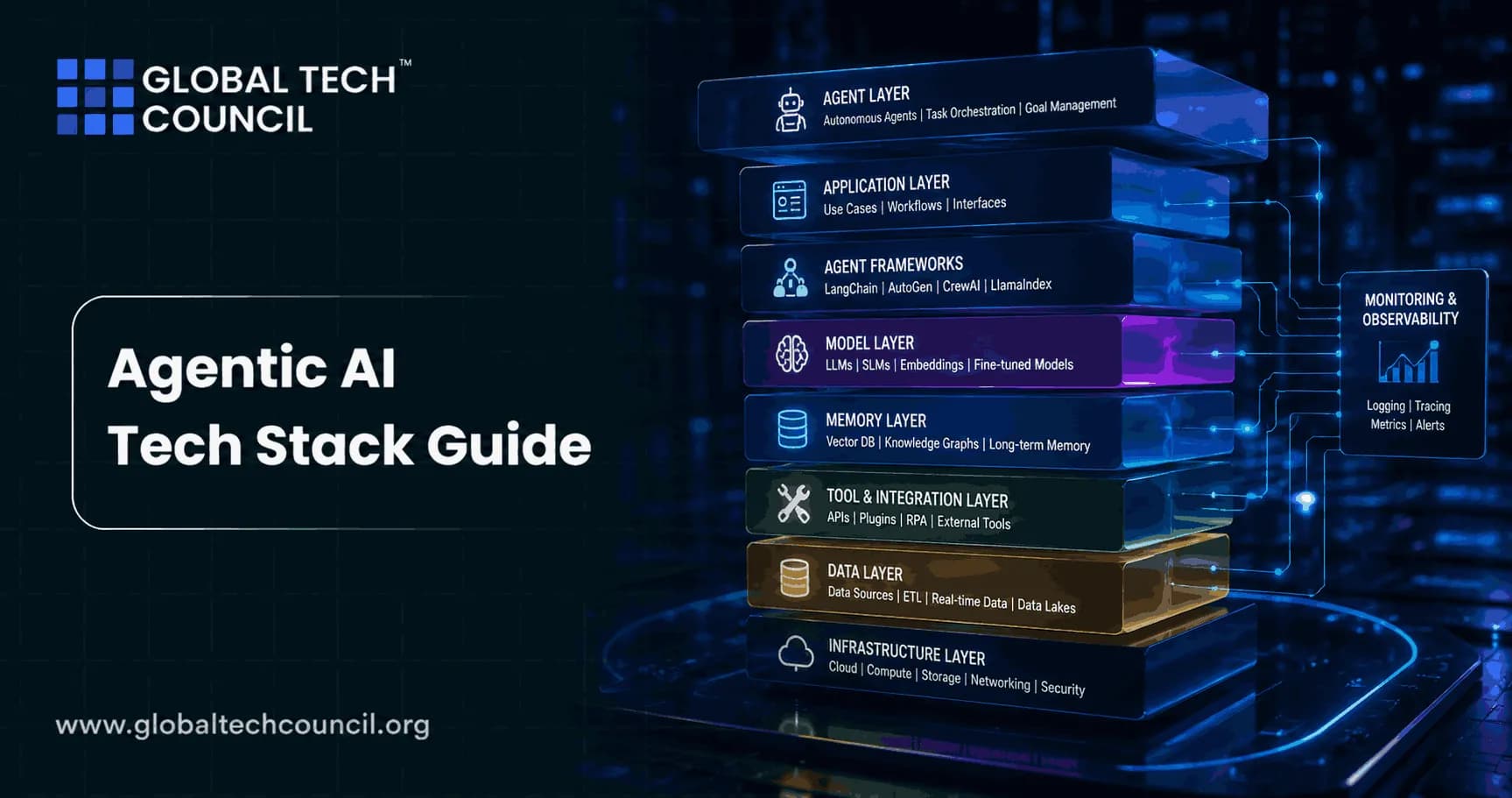
Agentic AI tech stack design is shifting from prototype LLM applications to layered, modular systems built for autonomy, safety, and enterprise integration. In production, goal-driven agents require more than a powerful model. They need orchestration to manage multi-step workflows, memory layers to retain context and ground decisions, tool interfaces to take real actions, and deployment practices that support observability, governance, and scale. Professionals seeking to develop expertise in this field can explore Certified Agentic AI Expert to build their understanding of agentic AI concepts and applications.
This guide breaks down the key layers in an agentic AI tech stack, compares orchestration frameworks, explains memory architectures, outlines tool-layer best practices, and summarizes deployment patterns used for enterprise-grade agents.

What Is an Agentic AI Tech Stack?
An agentic AI tech stack is a set of composable layers that enable an AI system to perceive context, plan, act through tools, and incorporate feedback over time. Unlike single-turn chatbots, agents operate in a perception-action loop: retrieve relevant context, determine the next step, execute a tool call, store outcomes, and repeat until the goal is reached or human intervention is required. Developers looking to deepen their practical knowledge can explore Certified Agentic AI Developer as a relevant learning resource.
Most modern stacks converge on these core layers:
Language and reasoning layer: LLMs combined with planning and control patterns.
Orchestration layer: manages multi-step workflows and multi-agent collaboration.
Memory and context layer: RAG, short-term context, and long-term memory.
Tooling and action layer: APIs, databases, RPA, and internal services with guardrails.
Observability and evaluation: traces, metrics, and offline and online evaluation.
Integration and environment: channels (Slack, email), runtime (Kubernetes, serverless), and compliance boundaries (VPC, on-premises).
Orchestration Frameworks: Choosing the Right Backbone
Orchestration is the control plane for an agent. It determines how steps are sequenced, how tools are selected, how errors are handled, and how multiple agents collaborate. The most practical selection criterion is not popularity, it is whether your use case genuinely requires multi-step autonomy and complex coordination.
Common Orchestration Frameworks
LangChain: widely adopted building blocks for chains, agents, tools, memory, and RAG, with strong support for modular workflows and tool integration.
AutoGen: optimized for multi-agent conversations where agents collaborate through messages and role specialization.
CrewAI: emphasizes role-based agent collaboration, suited to team-style execution with distinct roles such as researcher, planner, executor, and reviewer.
Semantic Kernel: an enterprise-oriented integration framework, particularly strong in .NET ecosystems, with support for skills, planners, and connectors.
Custom orchestration: minimal orchestrators can reduce latency and vendor dependency when requirements are well-defined and narrow.
Production Orchestration Patterns
Most deployed agent systems align to a small number of patterns:
Single-agent with tools: one agent uses function calling or tool calling to complete tasks.
Planner-executor: a planner creates steps and an executor runs them, which typically improves reliability and auditability.
Multi-agent crew: specialized agents handle research, drafting, verification, and execution independently.
Event-driven orchestration: agents are triggered by business events such as webhooks, message queues, or workflow engines.
Practical guideline: start with the simplest pattern that can work. If a single LLM call plus one or two tools solves the problem, avoid adding orchestration complexity until you have identified clear failure modes that require multi-step planning.
Memory Layers: Context, RAG, Episodic Memory, and Operational State
Memory is what allows an LLM-based system to behave consistently across time, users, and tasks. In an agentic AI tech stack, memory is rarely a single database. It is a set of distinct memory types with different lifecycles and access controls.
Key Memory Types in Agentic Systems
Short-term memory: the immediate conversation context and recent steps, often summarized or compressed to stay within token limits.
Knowledge memory (RAG): domain grounding via embeddings and retrieval over enterprise documents, policies, tickets, or code repositories.
Episodic or long-term memory: user preferences, past tasks, results, and histories across sessions, typically modeled as structured events.
Operational memory: agent state such as partial plans, pending approvals, tool outputs, and workflow metadata that supports continuity and recovery.
Common Memory Technologies
Vector databases: Pinecone, Weaviate, Qdrant, Milvus, and FAISS for embedding-based search.
Document stores: PostgreSQL, Elasticsearch, and MongoDB for raw text and metadata.
Session and state stores: Redis, relational tables, or key-value stores for fast state persistence.
Graph stores: Neo4j and similar systems for relationship-centric memory and knowledge graphs.
Memory Design Best Practices
Start minimal: implement RAG and short-term history first. Add long-term memory only when the user journey clearly requires it.
Store memories as events: capture who did what, when, with which tool, and with what outcome. Event-style memory is easier to audit and reason over.
Apply access control at retrieval time: enterprise RAG systems must enforce permissions so sensitive data is not surfaced in prompts for unauthorized users.
Separate knowledge from preference: keep organizational knowledge such as policies and documentation distinct from per-user preferences and task histories.
Tooling and Action Layer: Where Reliability and Risk Converge
The tool layer is how agents produce real outcomes: updating records, sending messages, triggering runbooks, or executing business workflows. It is also where most production failures originate, because tools can be unreliable, have side effects, and require careful permission management. Professionals interested in the broader technologies underpinning these systems can explore Deep Tech Certification as an additional learning resource.
What Tools Typically Include
API integrations: CRM, ERP, ticketing, BI tools, and internal microservices.
Data access: SQL databases, data warehouses, and document repositories.
RPA automation: tools like UiPath for legacy interfaces and systems without robust APIs.
Collaboration channels: Slack, Microsoft Teams, email, and calendar APIs.
Operational scripts: controlled Python or shell tasks for data processing and maintenance workflows.
Implementation Patterns That Improve Safety
Tool registry: define tools centrally with schemas, descriptions, and input validation, mapped to function calling interfaces.
Role-based tool access: expose only the minimum set of tools each agent role requires, consistent with least-privilege principles.
Pre-execution checks: dry-run modes, parameter validation, and human approval gates for high-risk actions such as payments, deletions, or access changes.
Post-execution verification: confirm tool effects by re-querying systems or validating responses before the agent continues.
Retries and circuit breakers: handle transient errors without triggering cascading failures across workflows.
Observability and Evaluation: A First-Class Stack Layer
Agent systems require deep visibility into intermediate steps, not just final outputs. Tracing prompts, retrieval results, tool calls, and state transitions is essential for diagnosing failures and improving behavior over time.
What to Instrument from Day One
Prompt and trace logs: record inputs, intermediate reasoning steps where appropriate, tool invocations, and outputs.
Operational metrics: latency, token usage, cost, tool success rate, fallback rate, and task completion rate.
Evaluation loops: human review for early deployments, supplemented by automated checks for format, factual grounding, and policy adherence.
Governance artifacts: audit logs, role permissions, and policy enforcement records for compliance purposes.
Common observability options include LangSmith, Traceloop, OpenTelemetry, ELK stacks, and custom structured logging pipelines.
Deployment Best Practices for Enterprise-Ready Agentic AI
Deployment decisions define your security posture, latency profile, cost, and compliance boundaries. A practical approach separates pilot architecture from hardened production architecture while keeping the stack modular so components can be replaced independently.
Deployment Options by Maturity
POC and internal pilot: hosted LLMs, lightweight orchestration, a vector store, a small tool set, and basic monitoring.
Enterprise-ready build: managed enterprise LLM endpoints or self-hosted models for data control, strong IAM and network boundaries, hardened tool wrappers, and full observability.
Infrastructure Patterns That Scale
Containers and Kubernetes: workload isolation, rollout control, horizontal scaling, and multi-tenant support.
Serverless: event-driven execution for bursty tasks such as ticket triage or webhook-triggered workflows.
VPC or on-premises: regulated environments requiring strict data residency and compliance controls.
Hybrid model strategy: combine proprietary models for complex reasoning with smaller local models for sensitive or latency-critical steps.
Assessing Candidates for Emerging Technology Roles
Agentic AI systems can plan tasks, use tools, and execute multi-step workflows with varying degrees of autonomy. As organisations explore these capabilities, they also need professionals who can design, monitor, and evaluate such systems. HireValid can be explored by employers looking for structured ways to assess candidates for emerging technology roles.
Agentic AI Tech Stack Checklist for Real Deployments
Define the mission and constraints: scope, success criteria, risk tolerance, and compliance requirements.
Map the environment early: channels, systems of record, APIs, and data sources the agent can access.
Decompose into knowledge, decision, and action: identify what the agent must know, decide, and do.
Prototype a minimal path: one LLM call, minimal tools, minimal memory.
Add RAG and state only when grounding and multi-turn continuity are clearly required.
Harden tool execution: validations, approval gates, retries, and least-privilege access.
Instrument observability: traces, metrics, evaluations, and audit logs.
Stress test: inject bad data, conflicting instructions, missing context, and tool outages before production release.
Plan for governance and scale: containerization, network boundaries, role policies, and lifecycle management.
Conclusion
A production-grade agentic AI tech stack is less about selecting a single model and more about engineering a reliable system around it. Orchestration frameworks manage multi-step autonomy, memory layers ground agents in enterprise knowledge and history, tooling enables real-world actions with appropriate guardrails, and deployment practices ensure observability, governance, and compliance.
When standardizing agent development across teams, prioritize modularity and interoperability. Design the stack so you can swap LLMs, evolve memory systems, and add tools without rewriting core workflows. Teams building expertise across the full stack can explore Global Tech Council learning paths in AI and Machine Learning, Cybersecurity, Data Science, and Programming to support secure, scalable agentic AI delivery. Those looking to complement their technical expertise with business and marketing knowledge can also explore Marketing Certification.
FAQs
1. What is an Agentic AI tech stack?
An Agentic AI tech stack is the collection of models, orchestration frameworks, memory systems, tools, data sources, and deployment infrastructure used to build autonomous AI agents. These components work together to help agents understand goals, plan tasks, execute actions, retain context, and evaluate results.
2. What are the main components of an Agentic AI tech stack?
The main components typically include:
AI models: Reasoning, planning, and language understanding.
Orchestration: Workflow control and task coordination.
Memory: Storage and retrieval of relevant context.
Tools and APIs: Access to external applications and services.
Data infrastructure: Databases, document stores, and retrieval systems.
Deployment: Hosting, monitoring, security, and scaling.
The appropriate stack depends on the agent's complexity, reliability requirements, and business objectives.
3. What is orchestration in Agentic AI?
Orchestration coordinates the steps an AI agent takes to complete a task. It manages tool calls, workflow state, conditional branches, retries, and handoffs between agents or human reviewers. Effective orchestration helps make complex AI workflows more predictable, observable, and maintainable.
4. Which frameworks are best for Agentic AI orchestration?
Popular options include LangGraph, the OpenAI Agents SDK, and Microsoft Semantic Kernel. LangGraph supports stateful, graph-based workflows; the OpenAI Agents SDK provides agent handoffs and tool integration; and Semantic Kernel supports AI orchestration within application development environments. The best choice depends on your existing infrastructure and requirements.
5. What is the role of memory in an Agentic AI system?
Memory allows an agent to retain and retrieve information needed across multiple workflow steps or interactions. Short-term memory can maintain current task state, while longer-term memory can store selected preferences, previous results, or useful knowledge. Memory design should account for accuracy, relevance, privacy, and data retention.
6. What types of memory do AI agents use?
AI agents commonly use several forms of memory:
Working memory: Information needed for the current task.
Conversation memory: Relevant details from earlier interactions.
Long-term memory: Information retained across sessions.
Semantic memory: Knowledge retrieved through embeddings or other search methods.
Episodic memory: Records of previous tasks and experiences.
Not every agent needs every memory type.
7. Which databases are suitable for Agentic AI memory?
The best database depends on the information being stored and retrieved. PostgreSQL can manage structured data and application state; Redis can support fast, temporary state; and vector databases such as Qdrant, Weaviate, and Pinecone can support semantic retrieval. Some applications can use PostgreSQL with vector search instead of maintaining a separate vector database.
8. What are tools in an Agentic AI tech stack?
Tools are functions, APIs, or integrations that allow an AI agent to interact with external systems. Examples include web search, database queries, code execution, email services, CRM platforms, and file retrieval. Tool permissions and input validation determine which actions the agent can safely perform.
9. What is the Model Context Protocol (MCP), and why is it useful?
The Model Context Protocol (MCP) is an open protocol for connecting AI applications to external tools, data sources, and services through a standardized interface. It can simplify integrations across compatible systems, but developers still need to authenticate connections, restrict permissions, validate inputs, and assess the security of individual MCP servers.
10. How do APIs support Agentic AI workflows?
APIs allow AI agents to retrieve information, submit requests, update records, and trigger actions in connected applications. Developers typically expose selected API operations as tools that the agent can call. Authentication, authorization, error handling, rate limits, and response validation are essential for reliable execution.
11. How should developers choose an AI model for their agent?
Developers should compare models based on reasoning quality, tool-calling reliability, latency, context capacity, multimodal support, privacy requirements, and cost. A lightweight model may handle classification or simple extraction, while a stronger reasoning model may be more suitable for complex planning and ambiguous tasks.
12. What role does retrieval-augmented generation (RAG) play in Agentic AI?
Retrieval-augmented generation (RAG) allows an agent to retrieve relevant information from documents, databases, or knowledge repositories before generating a response or taking an action. It can improve access to domain-specific information and reduce reliance on model memory, although retrieved content must still be checked for relevance and reliability.
13. How do developers build multi-agent systems using an Agentic AI tech stack?
Developers can assign specialized responsibilities to multiple agents and use an orchestration framework to coordinate their work. For example, a research agent can collect information, an analysis agent can evaluate evidence, and a reporting agent can prepare a final output. Shared state, clear roles, and validation help prevent conflicts and duplicated work.
14. What deployment options are available for Agentic AI systems?
Agentic AI systems can run on cloud platforms, private infrastructure, containers, virtual machines, or serverless environments. The choice depends on workload duration, data sensitivity, scaling needs, latency, and operational complexity. Systems that maintain long-running tasks may require durable workflow execution and persistent state.
15. How can developers deploy Agentic AI agents using Docker and Kubernetes?
Docker packages an agent and its dependencies into a container, while Kubernetes can orchestrate container deployment, scaling, and recovery. Developers should configure secrets management, resource limits, health checks, logging, network restrictions, and persistent storage where required.
16. How do you monitor and evaluate an Agentic AI tech stack?
Monitoring should track task success, tool-call failures, latency, token usage, execution costs, retries, and safety violations. Tracing individual workflow steps helps developers identify bottlenecks and diagnose errors. Automated evaluations and regression tests should be repeated whenever models, prompts, tools, or orchestration logic change.
17. How can developers secure an Agentic AI tech stack?
Developers should apply least-privilege permissions, protect API credentials, validate tool arguments, isolate code execution, and restrict access to sensitive data. They should also defend against prompt injection, monitor unusual actions, maintain audit logs, and require human approval for high-impact operations.
18. What is the best Agentic AI tech stack for beginners?
A beginner-friendly stack can use one capable AI model, a lightweight orchestration layer, a small set of tools, and a simple database. Start with a single-agent workflow and add persistent memory, vector search, or multi-agent coordination only when the use case requires them. Simplicity makes debugging and evaluation easier.
19. How much does it cost to build and deploy an Agentic AI system?
Costs depend on model usage, tool calls, memory storage, database infrastructure, hosting, monitoring, and engineering effort. A small prototype may run on inexpensive infrastructure, while enterprise systems can incur substantial costs from high-volume requests, long-running workflows, and complex integrations. Measure cost per successful task rather than model usage alone.
20. What are the best practices for building a production-ready Agentic AI tech stack?
Start with a clearly defined use case, select the simplest architecture that meets its requirements, and establish measurable success criteria. Use reliable orchestration, appropriate memory, validated tools, secure permissions, durable state where needed, and comprehensive monitoring. Test failure scenarios and expand autonomy gradually based on demonstrated performance.
Related Articles
View All
Agentic AI
How to Use Meta Muse for Free: A Complete Guide
Learn how to use Meta Muse for free, get started with Meta’s personal AI agent, connect supported apps, and explore features for shopping, travel, emails, and everyday tasks.
Agentic AI
From Chatbots to AI Agents: A Step-by-Step Roadmap to Deploying Agentic Automation in Business
A step-by-step roadmap for agentic automation, showing how businesses evolve from chatbots to AI agents, workflow orchestration, multi-agent systems, and governed scaling.
Agentic AI
Securing AI Agents: Threat Models, Prompt Injection Defenses, and Least-Privilege Tooling
Learn how securing AI agents works in practice: agent threat models, layered prompt injection defenses, and least-privilege tooling to reduce blast radius.
Trending Articles
The Role of Blockchain in Ethical AI Development
How blockchain technology is being used to promote transparency and accountability in artificial intelligence systems.
AWS Career Roadmap
A step-by-step guide to building a successful career in Amazon Web Services cloud computing.
Top 5 DeFi Platforms
Explore the leading decentralized finance platforms and what makes each one unique in the evolving DeFi landscape.