

Securing Agentic AI: Threat Models, Prompt Injection Risks, and Defensive Architectures
 Suyash Raizada
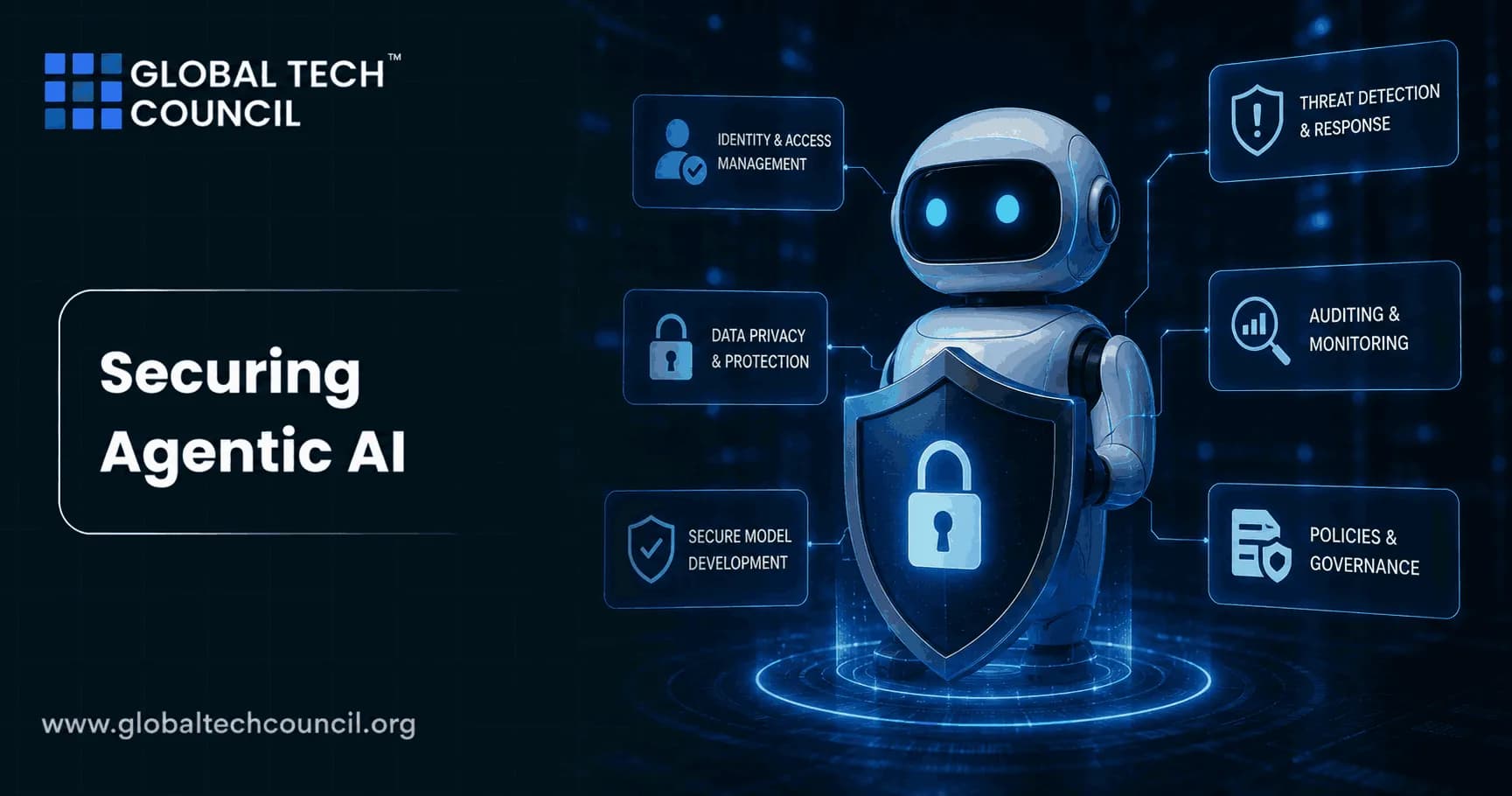
Securing agentic AI is rapidly becoming a distinct discipline within enterprise security. Unlike chatbots that produce text responses, agentic AI systems can observe, plan, call tools and APIs, write and execute code, and persist memory over time. This makes them behave like semi-autonomous digital insiders with real operational reach into corporate systems. Guidance from OWASP, Microsoft, IBM, the Cloud Security Alliance (CSA), and recent academic research points to a consistent conclusion: traditional application-centric threat models are not sufficient for AI agents, and prompt injection risks must be addressed through layered defensive architectures. Professionals looking to develop relevant expertise can explore Certified Agentic AI Expert as part of their learning pathway.
Why Agentic AI Changes Security Assumptions
Agentic AI introduces new security realities by combining natural-language instruction following with direct action capabilities. Across major frameworks, several shifts recur consistently:

Probabilistic behavior and instruction sensitivity: agents can be steered by language, and outcomes vary based on context and phrasing.
An expanded action layer: agents can read and write data, trigger workflows, run commands, and transact in external systems.
Persistent memory and long-lived context: state and memory create temporal attack surfaces, including delayed triggers and long-term backdoors.
Multi-agent environments: orchestration between agents creates new trust boundaries and lateral movement paths.
IBM and other industry observers describe this risk posture as comparable to insider threats. That framing is useful: you do not secure an insider by trusting their intent. You secure them by limiting privileges, segmenting access, monitoring behavior, and enforcing approvals for high-impact actions. Professionals focused on the development side of agentic AI can also explore Certified Agentic AI Developer to build relevant technical knowledge.
Threat Models for Agentic AI: What to Map and What to Protect
Threat modeling for AI agents must account for both technical controls and behavioral failure modes. Microsoft emphasizes continuous AI threat modeling rather than a one-time exercise, because agent behavior shifts with changes to prompts, tools, data sources, and workflows.
Core Assets and Security Objectives for AI Agents
Beyond confidentiality, integrity, and availability, agentic systems introduce agent-specific assets that require explicit protection:
Correctness and safety of actions (did the agent do the right thing, not just say the right thing?)
Integrity of tools, tool outputs, and tool routing
Integrity of memory and retrieval pipelines (vector stores, knowledge bases, scratchpads)
Policy alignment and governance enforceability
Auditability and attribution for every prompt, decision, and tool call
Architecture Mapping and Trust Boundaries
Effective agent threat models explicitly map the following components:
Prompt construction: system messages, developer prompts, user inputs, templating, and retrieval augmentation.
Tool invocation paths: what tools exist, what arguments the model can generate, and what side effects tools can produce.
Execution environments: sandboxes, CI/CD runners, notebooks, shells, containers, and network egress.
Memory systems: what is stored, who can write it, and how it is later retrieved and trusted.
Human approval points: where intervention is required and how it can be bypassed or manipulated.
Trust boundaries commonly include external web content, inbound emails, uploaded documents, ticket text, inter-agent messages, and identity or credential systems used for tool access.
Emerging Agent-Specific Threat Frameworks
Recent work is formalizing agentic AI risks into taxonomies that practitioners can apply in design reviews and security assessments:
ATFAA (academic research, 2025) groups agent threats into domains such as cognitive vulnerabilities, temporal persistence, operational execution abuse, trust boundary violations, and governance circumvention.
OWASP Agentic AI (2025) catalogs a broad set of agent threats and mitigations, extending earlier generative AI security work to tool-using and memory-enabled agents.
CSA MAESTRO (2025) focuses on multi-agent environments, modeling risk across orchestrator agents and specialized sub-agents with different exposure and permission profiles.
For teams standardizing their approach, these frameworks complement enterprise threat modeling programs by adding agent-specific patterns such as memory poisoning, tool abuse, and cross-agent influence.
Prompt Injection Risks for AI Agents: The Central Attack Class
Prompt injection is consistently identified as the leading attack vector against agentic systems because it targets the control plane, the instructions the agent follows. When model outputs are bound to actions, instruction hijacking translates directly into operational impact.
Direct vs. Indirect Prompt Injection
Direct prompt injection: an attacker provides malicious instructions directly through chat, forms, or an API, attempting to override system rules or extract secrets.
Indirect prompt injection: malicious instructions are embedded in content the agent reads, such as a web page, email, PDF, knowledge base article, or retrieved document. Security researchers have demonstrated proof-of-concept attacks where browsing or retrieval-augmented generation (RAG) agents are manipulated by hostile content they ingest.
Indirect injection is particularly dangerous in enterprise settings because it exploits normal workflows such as summarizing tickets, reading documentation, or scanning web sources.
Injection Against Tools, Workflows, and the Action Layer
Agentic AI expands the blast radius by connecting language outputs to tools. A successful injection can push an agent to:
Call sensitive tools to query or exfiltrate data.
Modify records or trigger workflows outside policy.
Generate and execute unsafe code or shell commands.
Rewrite its own configuration or store malicious instructions into long-term memory for later execution.
IBM highlights how small amounts of data poisoning can produce outsized effects, citing research where as few as five poisoned texts in a corpus of millions can manipulate responses with up to 90% success. The practical implication is that both runtime memory and ingested knowledge should be treated as high-risk inputs rather than trusted context.
Why Agents Are More Exposed Than Chatbots
Greater capabilities: tools and APIs translate model output into real-world actions.
Larger attack surface: every step in a multi-stage plan can be influenced, including retrieval, tool selection, argument generation, and memory writes.
Instruction-following bias: agents are optimized for helpfulness, which attackers exploit through carefully crafted prompts.
Defensive Architectures for Securing Agentic AI
Robust programs for securing agentic AI rely on layered controls that assume compromise at the prompt and data level. The objective is to constrain what an agent can do, validate what it attempts to do, and create strong accountability for every action taken. Professionals expanding their knowledge of AI security and related technologies can explore Deep Tech Certification as another learning resource.
1. Zero-Trust and Least Privilege for Agents and Tools
Treat agents as semi-trusted principals, consistent with how organizations approach insider risk:
Scoped tool permissions: grant only the minimum operations and resources required per task (for example, read-only access to specific tables rather than broad database credentials).
Just-in-time credentials: issue time-bound tokens only when needed, then revoke them immediately after use.
Step-up authentication and approvals: require human approval or strong confirmation for high-impact actions such as financial transfers, data deletion, access control changes, or code deployment.
This approach also aligns with enterprise identity and access management practices, including assigning distinct identities to agents and establishing clear ownership for each agent role.
2. Segmentation, Sandboxing, and Role-Separated Agent Hierarchies
Sandbox code execution: run agent-generated code in constrained environments with limited filesystem access, restricted network egress, and no direct production credentials.
Separate orchestration from execution: let orchestrator agents plan and coordinate, but route execution through constrained sub-agents or deterministic services with narrow permissions.
Compartmentalize by domain: HR agents, finance agents, and engineering agents should not share broad access by default.
This segmentation reduces lateral movement risk, a pattern specifically highlighted in multi-agent frameworks such as CSA MAESTRO.
3. Strong Separation of Instructions vs. Data
Many prompt injection failures stem from conflating untrusted data with trusted instructions. Defensive prompt construction should:
Mark external content as data and explicitly prohibit following instructions found within it.
Isolate retrieved documents from system policies using structured templates and clear delimiters.
Assume all external text is potentially hostile, including internal tickets and repository content.
This is a design discipline, not a single filter, and it must be validated through security testing.
4. Deterministic Validation Before Tool Execution
Do not rely on the model to self-police. Add deterministic guardrails between the model and its tools:
Allow lists for permitted commands, endpoints, and operations.
Schema validation for tool arguments, with strict typing, bounds, and required fields.
Policy checks that enforce business rules (for example, refund limits, account change requirements, or deployment gates).
High-risk tool hardening for shell execution, database writes, file operations, and network access.
5. Observability, Monitoring, and Governance
Because agentic systems are probabilistic and multi-step, monitoring is a baseline requirement rather than an optional enhancement:
Comprehensive logging: capture prompts, retrieved context references, tool calls, tool outputs, and final actions.
Attribution: tie actions to both the human requestor and the agent identity.
Anomaly detection: alert on unusual tool sequences, repeated sensitive queries, unexpected external domains, or excessive failures that may indicate probing activity.
Human-in-the-loop controls: enforce review for sensitive actions and ensure approvals cannot be bypassed through prompt manipulation.
Governance also includes change management for prompts, tools, and policies, as well as regular red-team exercises focused on indirect prompt injection and tool abuse.
6. Securing the Full AI Lifecycle: Data, Retrieval, and Memory
Runtime security must be paired with lifecycle controls:
Data provenance: validate sources for training, fine-tuning, and embedding pipelines.
Memory integrity: control who or what can write to long-term memory, and apply integrity checks and review processes for durable updates.
Vector store hygiene: sanitize and classify documents before ingestion, and apply access control to retrieval.
Secrets management: avoid placing API keys in prompts, rotate credentials regularly, and scope tokens to specific tools.
Assessing Candidates for Emerging AI Security Roles
Agentic AI systems can plan tasks, use tools, and execute multi-step workflows with varying degrees of autonomy. As organisations explore these capabilities, they also need professionals who can design, monitor, and evaluate such systems. HireValid can be explored by employers looking for structured ways to assess candidates for emerging technology roles.
Practical Checklist: Securing Agentic AI in Enterprise Deployments
Adopt an agent-aware threat model using OWASP Agentic AI, Microsoft AI threat modeling guidance, ATFAA-style domains, and CSA MAESTRO for multi-agent systems.
Map the action layer and enumerate every tool, permission, and potential side effect.
Design for least privilege with just-in-time credentials and step-up approvals.
Separate data from instructions in prompts and retrieval pipelines.
Validate tool calls deterministically before execution.
Instrument and audit everything with strong attribution.
Test with real attack paths, including indirect injection through documents, tickets, web pages, and knowledge bases.
Conclusion
Securing agentic AI requires a shift from protecting a conversational interface to securing a semi-autonomous operator. Threat modeling must expand to cover memory, tools, execution environments, and multi-agent trust boundaries. Prompt injection, especially indirect injection, should be treated as a default expectation rather than an edge case. The most robust programs combine zero-trust permissions, sandboxing, deterministic guardrails, and strong observability across the full agent lifecycle.
For professionals building and assessing these systems, the next step is to formalize skills in AI security engineering, agent threat modeling, and secure MLOps. Global Tech Council offers certification tracks in AI Security and Cybersecurity, along with hands-on courses in secure prompt engineering, threat modeling, and secure AI system design as structured pathways for implementing these controls in production environments. Professionals interested in developing broader business and promotional skills alongside emerging technology knowledge can also explore Marketing Certification.
FAQs
1. What is Agentic AI security?
Agentic AI security involves protecting autonomous AI systems that plan tasks, use tools, access data, and perform actions. It focuses on preventing unauthorized access, prompt injection, data leakage, unsafe tool execution, and other threats that could compromise an AI agent or the systems it interacts with.
2. What are the biggest security risks facing Agentic AI systems?
Major risks include prompt injection, excessive permissions, sensitive data exposure, compromised tools, insecure APIs, malicious external content, and unauthorized actions. Because agents can interact with external systems, a single reasoning error or successful attack may have consequences beyond an incorrect text response.
3. What is prompt injection in Agentic AI?
Prompt injection is an attack in which malicious instructions embedded in user input, documents, websites, emails, or other content attempt to manipulate an AI system's behavior. In agentic workflows, such attacks may cause an agent to reveal information, misuse tools, or take actions outside its intended purpose.
4. How does indirect prompt injection affect autonomous AI agents?
Indirect prompt injection occurs when an agent encounters malicious instructions within external content rather than directly in the user's request. For example, a webpage or document might instruct an agent to disclose confidential information. If the agent treats that content as trusted instructions, it may perform unauthorized actions.
5. What is a threat model for Agentic AI?
A threat model identifies the assets an AI agent can access, potential attackers, attack paths, vulnerabilities, and possible consequences. It helps developers prioritize security controls based on the agent's capabilities, data access, tool permissions, deployment environment, and level of autonomy.
6. How can developers prevent prompt injection attacks in Agentic AI?
Developers can reduce prompt injection risks by treating retrieved content as untrusted data, separating instructions from external information, limiting tool permissions, validating actions, and requiring approval for sensitive operations. Because no single defense reliably blocks every attack, layered security testing and monitoring are essential.
7. Why is the principle of least privilege important for AI agents?
The principle of least privilege gives an AI agent only the permissions required for its assigned task. For example, a research agent may need read-only access to selected documents but should not automatically receive permission to send emails, modify databases, or transfer funds.
8. How can businesses prevent data leakage from Agentic AI systems?
Businesses can reduce data leakage by restricting access to sensitive information, minimizing the data supplied to models, redacting confidential fields, and validating outbound content. They should also enforce permissions at the tool and application layers, monitor data transfers, and establish appropriate retention policies.
9. What is excessive agency in AI security?
Excessive agency occurs when an AI system has more autonomy or permissions than necessary for its task. An agent with unrestricted access to files, APIs, or financial operations may cause greater harm if manipulated or mistaken. Narrow permissions, action limits, and approval gates help reduce this risk.
10. How can developers secure tools and APIs used by AI agents?
Developers should authenticate every request, enforce authorization checks, validate input parameters, use scoped credentials, and apply rate limits. Tool interfaces should expose only necessary operations, while sensitive actions should require additional verification independent of the AI model's instructions.
11. What role does sandboxing play in Agentic AI security?
Sandboxing isolates an agent's execution environment from sensitive resources. It can restrict file access, network connections, code execution, and operating-system permissions. Sandboxing helps limit the impact of unsafe actions, but it should be combined with access controls and monitoring.
12. How can organizations protect AI agents from malicious websites and documents?
Organizations should treat external content as potentially hostile, restrict which websites and documents agents can access, and prevent retrieved instructions from overriding trusted system policies. Developers should also validate information before allowing it to trigger sensitive tool calls or external actions.
13. What are the security risks of multi-agent AI systems?
Multi-agent systems introduce risks such as malicious instructions passing between agents, compromised agents influencing other agents, excessive shared permissions, and confidential information spreading through shared memory. Clear role separation, authenticated communication, independent validation, and restricted access help reduce these risks.
14. How can human-in-the-loop controls improve Agentic AI security?
Human-in-the-loop controls require an authorized person to review selected actions before execution. They are particularly valuable for financial transfers, external communications, production deployments, access-control changes, and sensitive data operations. Approval workflows should display the intended action and its relevant consequences.
15. What is the difference between AI guardrails and security controls?
AI guardrails help enforce behavioral policies, validate outputs, and restrict inappropriate actions. Security controls protect identities, systems, data, and resources through authentication, authorization, network isolation, and monitoring. Effective Agentic AI security requires both because a model's behavioral safeguards alone cannot guarantee system security.
16. How should businesses monitor Agentic AI security threats?
Businesses should monitor tool calls, access attempts, policy violations, unusual data transfers, repeated failures, and unexpected changes to system state. Audit logs and alerts should support incident investigation without unnecessarily exposing sensitive user data. Security teams should also test defenses against emerging attack techniques.
17. What is a defensive architecture for secure Agentic AI?
A defensive architecture uses multiple independent security layers, including trusted instruction management, identity and access controls, isolated execution, validated tool interfaces, output inspection, monitoring, and human approval for high-impact actions. The goal is to prevent one compromised component from granting unrestricted control over the entire system.
18. How can developers test Agentic AI systems for security vulnerabilities?
Developers can perform threat modeling, adversarial testing, prompt injection simulations, permission-boundary checks, and API security testing. They should evaluate whether agents disclose protected information, execute unauthorized actions, or follow malicious instructions embedded in external content. Testing should continue after deployment.
19. Which security frameworks help organizations secure Agentic AI?
Organizations can use the NIST AI Risk Management Framework, the OWASP Top 10 for LLM Applications, and MITRE ATLAS to inform AI risk assessment and security testing. These resources provide complementary guidance on AI governance, application vulnerabilities, and adversarial threats; they should be adapted to the specific agent architecture.
20. What are the best practices for securing Agentic AI systems in production?
Best practices include applying least-privilege access, treating external content as untrusted, validating tool calls, protecting credentials, isolating execution environments, and requiring approval for consequential actions. Organizations should also maintain audit trails, conduct recurring security assessments, prepare incident response plans, and reassess risks whenever agent capabilities change.
Related Articles
View All
Agentic AI
Securing AI Agents: Threat Models, Prompt Injection Defenses, and Least-Privilege Tooling
Learn how securing AI agents works in practice: agent threat models, layered prompt injection defenses, and least-privilege tooling to reduce blast radius.
Agentic AI
From Chatbots to AI Agents: A Step-by-Step Roadmap to Deploying Agentic Automation in Business
A step-by-step roadmap for agentic automation, showing how businesses evolve from chatbots to AI agents, workflow orchestration, multi-agent systems, and governed scaling.
Agentic AI
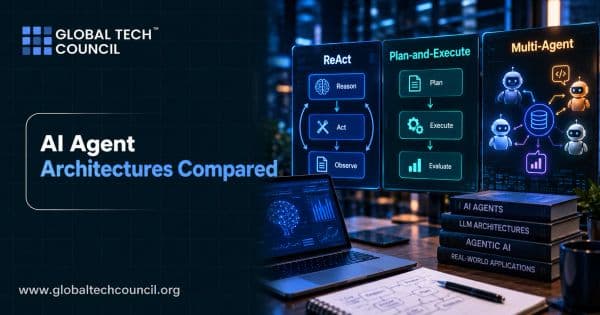
AI Agent Architectures Compared: ReAct vs Plan-and-Execute vs Multi-Agent Systems
Compare ReAct, Plan-and-Execute, and Multi-Agent systems with practical guidance on choosing by uncertainty, workflow structure, and cost or latency constraints.
Trending Articles
The Role of Blockchain in Ethical AI Development
How blockchain technology is being used to promote transparency and accountability in artificial intelligence systems.
AWS Career Roadmap
A step-by-step guide to building a successful career in Amazon Web Services cloud computing.
Top 5 DeFi Platforms
Explore the leading decentralized finance platforms and what makes each one unique in the evolving DeFi landscape.