

Multi-Agent Systems 101: How Agentic AI Teams Collaborate, Coordinate, and Resolve Conflicts
 Suyash Raizada
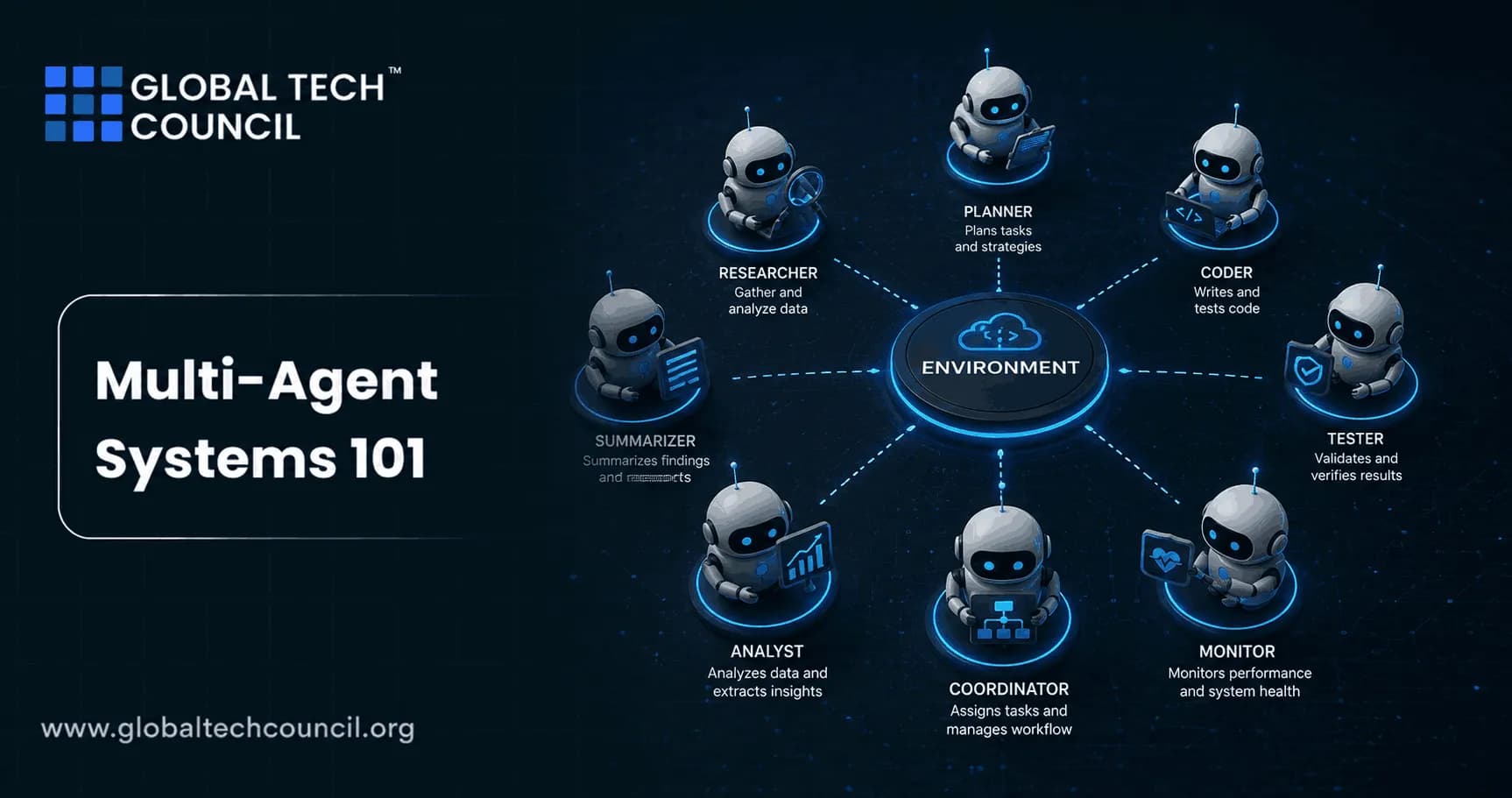
Multi-agent systems are rapidly moving from research prototypes to production-grade architectures, as organizations adopt agentic AI teams that can plan, act through tools, and adapt in complex environments. Rather than relying on a single generalist assistant, multi-agent systems distribute work across specialized agents that collaborate, coordinate, and resolve conflicts to complete workflows across tools, data sources, and organizations. Professionals interested in understanding and evaluating these systems can explore the Certified Agentic AI Expert certification as part of their learning journey.
This guide explains what multi-agent systems are, how agentic AI teams coordinate their work, and how they handle conflicts reliably enough for enterprise deployment.

What Are Multi-Agent Systems and Agentic AI Teams?
A multi-agent system (MAS) is an AI architecture where multiple autonomous agents interact in a shared environment to achieve goals that are difficult for a single agent to handle reliably. Each agent typically has a defined role, tool access, and a scoped knowledge domain.
In modern practice, these agents are often LLM-powered and agentic, meaning they can:
Reason about goals and plan steps
Take actions via tools, APIs, and workflows
Observe outcomes and revise strategy based on feedback
Multi-Agent vs. Single-Agent Systems
A single agent can be agentic if it plans and executes across multiple steps. It becomes a multi-agent system only when multiple agents collaborate, for example, a planner, researcher, executor, verifier, and compliance agent working as a coordinated team.
Core Properties of Multi-Agent Systems
Across enterprise and cloud implementations, multi-agent systems share several defining characteristics:
Autonomy: Agents operate without step-by-step human direction.
Social ability: Agents communicate, delegate, negotiate, and share intermediate results.
Reactivity and proactivity: Agents respond to changes in their environment while actively pursuing assigned goals.
Decentralization: Decision-making is distributed rather than controlled by a single monolithic component.
Leading cloud platforms define MAS as collections of autonomous agents that interact to solve problems exceeding the capabilities of any individual agent, with communication and coordination treated as foundational concerns.
For professionals who want to develop practical skills for creating and implementing these architectures, the Certified Agentic AI Developer certification may be relevant to their learning path.
How Agentic AI Teams Collaborate and Coordinate
In production settings, multi-agent systems succeed or fail based on coordination design. That design typically includes role definition, communication protocols, and mechanisms for scheduling work and handling disagreements.
Common Multi-Agent Architectures
Most agentic AI teams follow one of three architectural patterns:
Supervisor (hierarchical) architecture: A manager or orchestrator agent decomposes the goal, assigns tasks to specialists, monitors progress, and handles exceptions.
Network (peer-to-peer) architecture: Agents coordinate directly and decide dynamically which agent should act next. This approach works well in distributed environments.
Hybrid architectures: A central orchestrator sets high-level direction, while agents use peer-to-peer protocols for delegation and cross-system collaboration.
Enterprise platforms increasingly support hybrid configurations where orchestration and governance are centralized, while agent-to-agent communication can occur across services and vendors through open protocols.
Collaboration Mechanics in Real Systems
While implementations vary, most multi-agent systems rely on a recognizable set of collaboration mechanics.
1) Task Decomposition and Delegation
A planning or manager agent breaks a user goal into sub-tasks and routes each to the appropriate specialist. A workflow such as "produce a market brief" can be split into retrieval, analysis, drafting, and quality assurance steps, each handled by a dedicated agent.
2) Shared Memory and Context
Many agentic AI teams maintain a shared workspace, often called a blackboard, where agents post intermediate outputs, decisions, citations from internal data, and action logs. This reduces duplicated work and improves cross-agent awareness.
3) Structured Communication Protocols
Agents typically exchange messages in structured formats such as JSON. In enterprise ecosystems, agent-to-agent communication protocols allow one agent to delegate to another and receive status updates in a standard, auditable way. Adoption of these protocols is accelerating cross-agent delegation across business systems and data platforms.
4) Coordinated Tool and Data Access
Multi-agent systems derive much of their value from tool use, but that capability also creates coordination requirements:
Which agent is authorized to call which API?
What rate limits, budgets, or approval steps apply?
How are actions logged for auditability?
Production implementations typically connect agents to enterprise data stacks and orchestration layers that manage permissions and enforce least-privilege access.
Coordination Strategies: Centralized, Distributed, and Market-Based
Coordination can be implemented in several ways, depending on the use case and scale:
Centralized coordination: A manager agent allocates tasks and schedules execution. This is common in enterprise deployments because it simplifies policy enforcement and debugging.
Distributed coordination: Agents coordinate through consensus or negotiation without a single controller, improving robustness in large networks or cyber-physical systems.
Market or game-theoretic coordination: Agents bid for tasks or resources using auction-like mechanisms. This approach appears more frequently in research settings and optimization-heavy operational domains.
Rule and policy-based coordination: Governance controls determine which agents can perform which actions and under what conditions. In practice, these controls reside in the orchestration layer rather than solely within agent prompts.
How Multi-Agent Systems Resolve Conflicts
Conflicts are a normal part of multi-agent system operation, particularly when agents have different objectives, partial information, or overlapping responsibilities. Common conflict types include inconsistent recommendations, contention for limited resources, and disagreements over interpretations of user intent. Understanding the technical principles behind these architectures is also valuable for professionals exploring a Deep Tech Certification as part of their broader technology learning.
1) Supervisor or Arbiter Agents
A widely used approach is assigning a supervisor agent the authority to arbitrate. The supervisor reviews outputs from multiple agents, selects the best action, or synthesizes a combined answer. In hierarchical setups, the manager agent can also reroute work when one agent fails or produces low-quality results.
2) Critic, Verifier, and Safety Agents
To reduce hallucinations and prevent risky actions, many agentic AI teams include dedicated critic or verifier agents. These agents may:
Check factual consistency against internal databases or retrieval-augmented generation pipelines
Validate that outputs conform to style, policy, or regulatory constraints
Block or flag tool actions that appear unsafe or out of scope
This cross-checking is one reason multi-agent systems tend to be more robust than single-agent approaches for enterprise workflows.
3) Formal Policies, Guardrails, and Governance
Enterprise-grade multi-agent systems increasingly treat governance as a platform-level concern. Common controls include role-based access control, audit logging, and explicit boundaries for delegation. Several platforms now offer governance features specifically designed for multi-agent coordination and agent-to-agent delegation, reflecting growing operational maturity in this space.
4) Consensus, Negotiation, and Priority Rules
In distributed settings, agents can use consensus algorithms to agree on shared state or coordinated actions. Other systems use negotiation protocols where agents exchange proposals and counter-proposals until they converge on a solution.
In many practical deployments, conflict resolution is simplified through priority rules, such as:
Safety overrides productivity
Compliance approval is required for financial actions
Human approval is required above defined risk thresholds
Where Multi-Agent Systems Are Used Today
Multi-agent systems are gaining traction in domains where work is complex, distributed, and tool-driven.
Enterprise Knowledge Work and Automation
A common pattern is automated research and report production, where a manager agent coordinates a web researcher, trend analyst, writer, and proofreader. This maps directly to multi-agent orchestration frameworks that support hierarchical or network collaboration patterns.
Enterprise copilot ecosystems also increasingly support multi-agent composition, orchestrating agents across productivity suites, business applications, and data platforms, alongside open agent-to-agent protocols for cross-vendor delegation.
Cyber-Physical Systems and IoT
MAS patterns are well established in smart grids, traffic management, logistics, and robotics. In these environments, distributed consensus and formation control techniques help fleets of devices remain coordinated and resilient despite failures or changing conditions.
Finance and Trading
Multi-agent systems are used in algorithmic trading and market simulation, where agents represent different strategies or market participants. Negotiation and market-based coordination mechanisms are especially relevant in these domains.
Practical Guidance for Building Multi-Agent Systems
For teams evaluating multi-agent systems for production use, these practices appear consistently across platform providers and enterprise integrators:
Define roles and boundaries clearly: Specify what each agent knows, which tools it can access, and what success looks like. Avoid overlapping mandates that generate unnecessary conflict.
Start with a supervisor architecture: A manager agent pattern is easier to observe, test, and govern than a fully distributed system.
Build governance in from day one: Implement least privilege, audit trails, and policy checks at the orchestration layer, not only within prompts.
Design conflict resolution explicitly: Add an arbiter, include verifier agents, define escalation paths, and set priority rules for safety and compliance.
Use tool grounding and shared memory: Ground agent outputs in enterprise data sources and maintain a shared workspace so agents can collaborate without repeating work.
For professionals building these systems, foundational skills in AI engineering, data governance, and security are increasingly important. Global Tech Council certifications in Artificial Intelligence, Machine Learning, Data Science, Cybersecurity, and Cloud Security align with the core competencies required to design, deploy, and govern agentic AI teams in enterprise environments.
Assessing Candidates for Emerging AI Roles
Agentic AI systems can plan tasks, use tools, and execute multi-step workflows with varying degrees of autonomy. As organisations explore these capabilities, they also need professionals who can design, monitor, and evaluate such systems. HireValid can be explored by employers looking for structured ways to assess candidates for emerging technology roles.
Future Outlook: Interoperable Agent Ecosystems and Stronger Governance
The most significant near-term shift is that multi-agent systems are becoming mainstream within enterprise platforms. Multi-agent orchestration, coordination across data platforms, and open agent-to-agent protocols point toward a future where agents from different vendors and organizations collaborate under shared standards.
At the same time, expanded capabilities amplify risk. Expect stronger governance frameworks, more formal safety and compliance roles within agentic AI teams, and more rigorous testing and simulation requirements before MAS are deployed in critical domains such as energy, finance, and healthcare.
Conclusion
Multi-agent systems offer a practical path to building reliable, tool-using AI capable of handling complex, real-world workflows. By organizing work into agentic AI teams, organizations can scale specialization, improve robustness through cross-checking, and manage risk with governance-aware orchestration. The foundation for success is intentional design: clear roles, structured communication, explicit coordination strategies, and conflict resolution mechanisms that prioritize safety, compliance, and auditability.
As agent-based technologies continue to develop, professionals connecting technical expertise with business strategy may also explore Marketing Certification to broaden their understanding of how emerging technologies relate to business needs.
FAQs
1. What is a multi-agent system in AI?
A multi-agent system is an AI architecture in which multiple agents work within the same environment to achieve individual or shared goals. Each agent may have a specialized role, access to different tools, or its own responsibilities, allowing the system to handle complex tasks through collaboration and coordination.
2. How do multi-agent AI systems work?
Multi-agent AI systems divide a larger task into smaller subtasks and assign them to specialized agents. Agents exchange information, execute their assigned tasks, share results, and coordinate their next steps through a central controller or communication mechanism.
3. What is the difference between a single AI agent and a multi-agent system?
A single AI agent handles a task using its own reasoning, tools, and workflow. A multi-agent system distributes work across multiple agents that may operate in parallel or sequentially. Multi-agent systems can improve specialization and throughput, but they also introduce coordination complexity and additional costs.
4. How do AI agents collaborate in a multi-agent system?
AI agents collaborate by sharing task instructions, intermediate findings, structured messages, and completed outputs. For example, a research agent can gather information, an analysis agent can evaluate the findings, and a reporting agent can turn verified results into a final document.
5. What are the main components of a multi-agent AI architecture?
The main components include specialized agents, a communication mechanism, a task coordinator or orchestrator, shared or distributed memory, and access to external tools. Production systems also benefit from permission controls, monitoring, error handling, and evaluation mechanisms.
6. What is agent coordination in Agentic AI?
Agent coordination is the process of organizing multiple agents so their actions contribute to a shared objective. It involves assigning responsibilities, managing dependencies, synchronizing results, preventing duplicate work, and determining when tasks are complete.
7. How do multi-agent systems resolve conflicts between AI agents?
Multi-agent systems can resolve conflicts through predefined priority rules, centralized arbitration, evidence-based evaluation, voting, or designated reviewer agents. Critical decisions should use clear evaluation criteria and, where appropriate, human review rather than relying solely on agreement between AI agents.
8. What is the role of an orchestrator in a multi-agent system?
An orchestrator manages the overall workflow by assigning tasks, tracking progress, coordinating communication, and deciding when results should be combined. It can also detect failures, enforce execution limits, and route unresolved issues to another agent or a human supervisor.
9. What are the most common multi-agent system architectures?
Common architectures include centralized orchestration, hierarchical systems, decentralized collaboration, sequential agent pipelines, and parallel agent workflows. The right architecture depends on task complexity, communication requirements, latency constraints, reliability needs, and the level of control required.
10. How do AI agents communicate with each other?
AI agents can communicate through structured messages, shared state, APIs, task queues, or specialized communication protocols. Well-designed communication includes clear task definitions, relevant context, expected output formats, and error information to reduce misunderstandings between agents.
11. What is the difference between centralized and decentralized multi-agent systems?
In a centralized system, a coordinator assigns tasks and manages decisions, making oversight and workflow control easier. In a decentralized system, agents coordinate more independently, which can improve flexibility but may make conflict resolution, consistency, and debugging more challenging.
12. How do multi-agent systems divide complex tasks?
Multi-agent systems use task decomposition to break a large objective into smaller, manageable subtasks. Each subtask is assigned according to an agent's capabilities, available tools, and dependencies. The system then combines the outputs and validates the overall result.
13. What are the benefits of multi-agent AI systems?
Multi-agent systems can support specialized reasoning, parallel processing, modular development, and complex workflows that benefit from multiple perspectives. However, additional agents do not automatically improve accuracy; effective task allocation, verification, and communication are essential.
14. What are the biggest challenges of multi-agent AI systems?
Major challenges include conflicting outputs, communication overhead, duplicated work, inconsistent shared state, cascading errors, security risks, and increased computational costs. Developers must also prevent agents from entering repetitive loops or making decisions based on unverified information from other agents.
15. How can developers prevent conflicts in multi-agent AI workflows?
Developers can reduce conflicts by defining clear roles, assigning ownership of specific tasks, setting decision priorities, using structured output schemas, and maintaining a shared source of truth. They should also establish escalation rules for disagreements that cannot be resolved automatically.
16. How do multi-agent systems maintain consistency and accuracy?
Multi-agent systems can improve consistency by validating outputs against common rules, checking results against trusted data sources, and using independent verification steps. Shared state, version control, and explicit task dependencies help prevent agents from working with outdated or contradictory information.
17. What are real-world applications of multi-agent AI systems?
Multi-agent systems can support software development, research, customer service, cybersecurity analysis, supply chain planning, financial operations, and business intelligence. For example, agents can divide research, data analysis, fact-checking, and report preparation into coordinated stages.
18. How can businesses implement multi-agent AI systems?
Businesses should identify a complex workflow that benefits from specialization, define individual agent roles, and select an appropriate orchestration architecture. A small pilot with measurable outcomes, restricted permissions, logging, and human oversight helps establish whether multiple agents deliver more value than a simpler system.
19. How do you evaluate the performance of a multi-agent system?
Evaluation metrics may include task completion rate, factual accuracy, conflict frequency, tool-call success, execution time, cost per task, and recovery from failures. Businesses should compare the multi-agent approach against a single-agent baseline to determine whether the added complexity is justified.
20. What is the future of multi-agent systems in Agentic AI?
Multi-agent systems are likely to become more capable of coordinating specialized agents, sharing structured context, and completing complex workflows across applications. Future progress will depend on reliable communication, better orchestration, secure tool access, effective conflict resolution, and transparent accountability.
Related Articles
View All
Agentic AI
AI Agent Architectures Compared: ReAct vs Plan-and-Execute vs Multi-Agent Systems
Compare ReAct, Plan-and-Execute, and Multi-Agent systems with practical guidance on choosing by uncertainty, workflow structure, and cost or latency constraints.

Agentic AI
Building Safe Agentic AI Systems: Guardrails, Permissions, and Human-in-the-Loop Patterns
Learn how to build safe agentic AI systems with multi-layer guardrails, tool-scoped permissions, and human-in-the-loop patterns that scale, stay auditable, and reduce risk.
Agentic AI
From Chatbots to AI Agents: A Step-by-Step Roadmap to Deploying Agentic Automation in Business
A step-by-step roadmap for agentic automation, showing how businesses evolve from chatbots to AI agents, workflow orchestration, multi-agent systems, and governed scaling.
Trending Articles
The Role of Blockchain in Ethical AI Development
How blockchain technology is being used to promote transparency and accountability in artificial intelligence systems.
AWS Career Roadmap
A step-by-step guide to building a successful career in Amazon Web Services cloud computing.
Top 5 DeFi Platforms
Explore the leading decentralized finance platforms and what makes each one unique in the evolving DeFi landscape.