

AI Agent Architectures Compared: ReAct vs Plan-and-Execute vs Multi-Agent Systems
 Suyash Raizada
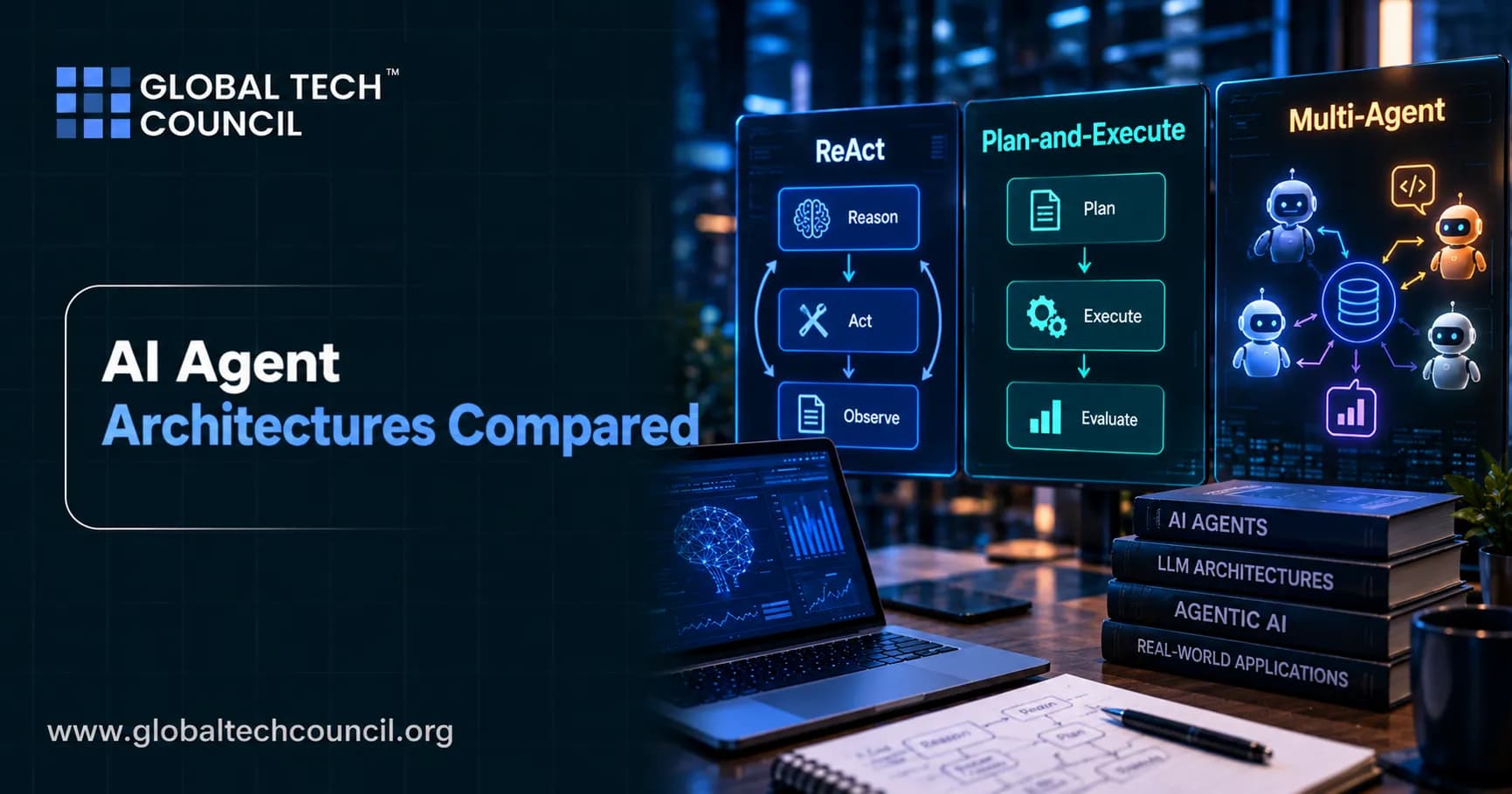
AI agent architectures compared is no longer a purely academic discussion. Most teams today evaluate agent designs through a practical lens: the tradeoff between adaptability and workflow control. ReAct tends to win when the path depends on intermediate tool outputs. Plan-and-Execute tends to win when the sequence is predictable and you want cost and latency discipline. Multi-Agent systems tend to win when role separation, parallelism, or specialized sub-agents materially improve outcomes. Professionals seeking to deepen their understanding of these approaches can explore the Certified Agentic AI Expert certification.
This guide breaks down what each architecture is, where it fits, and how to choose based on uncertainty, task structure, and runtime budget. If you are building or governing agentic workflows, these patterns also map naturally to skills in tool orchestration, evaluation, and secure automation.

Why Architecture Choice Matters in Agentic AI
Most production agent failures are not caused by model capability alone. They usually stem from mismatches between the task and the control structure:
Uncertainty mismatch: the agent needs to adapt to new evidence, but the workflow forces a rigid sequence.
Cost and latency mismatch: the agent loops excessively when a stable plan would have been sufficient.
Coordination mismatch: a single agent is asked to plan, research, implement, and critique, leading to shallow execution and weak verification.
Industry guidance across major platforms increasingly converges on a clear rule: use ReAct when intermediate observations change the next step, and use Plan-and-Execute when steps can be determined before execution begins. Multi-Agent systems add a third dimension: division of labor and orchestrated collaboration. Developers interested in implementing these architectures can also explore the Certified Agentic AI Developer certification.
ReAct Architecture: Adaptive Reasoning Plus Tool Use
ReAct interleaves reasoning, actions, and observations in a loop. The agent takes a small step, calls a tool (search, database query, ticket system, code runner), observes the result, then decides the next step. This pattern is widely recognized as a baseline approach for tool-using agents because it can loop until a final answer is reached or a loop limit is hit.
When ReAct Is the Best Fit
Dynamic troubleshooting: customer support or incident response where each tool call reveals new facts that change the next question or diagnostic step.
Iterative research assistants: search, read, refine queries, retrieve again, then synthesize only after enough evidence is collected.
Iterative RAG verification: retrieval that needs multiple passes to confirm claims, reconcile conflicting sources, or fill missing details.
Strengths
High adaptability when tool outputs are uncertain, incomplete, or surprising.
Stepwise interpretability because each action and observation can be logged and reviewed.
Natural fit for tool-heavy environments where each call can change the next best action.
Weaknesses and Engineering Considerations
Higher latency and cost due to iterative loops and multiple tool calls.
Loop risk if stop conditions and budgets are not enforced.
Harder governance when the agent is free to explore many branches without guardrails.
Practical mitigations include strict iteration limits, tool allowlists, budgeted retrieval, structured logging, and evaluation harnesses. These skills align with training in AI governance, prompt engineering, and applied machine learning operations.
Plan-and-Execute Architecture: Workflow Control and Efficiency
Plan-and-Execute separates upfront planning from step-by-step execution. This approach typically requires one planning call plus execution calls, which is often more efficient than repeated ReAct loops for structured tasks. A common implementation uses a planner agent that decomposes the goal into ordered steps and an executor agent that carries them out, sometimes using a constrained ReAct-style loop at the step level.
When Plan-and-Execute Is the Best Fit
Repeatable enterprise automation: onboarding, reporting, ticket routing, approvals, and other multi-step business processes.
Integration checklists: cases where the sequence is known and success depends on executing in the right order with the right validations.
Structured content production: templated reporting, compliance summaries, or operational runbooks where predictable ordering matters.
Strengths
Lower runtime overhead by avoiding repeated high-capability reasoning calls when the plan is stable.
Better governance because the plan can be reviewed, approved, or simulated before execution.
Clear separation of concerns between planning logic and execution logic.
Weaknesses and Engineering Considerations
Reduced flexibility if the environment changes unexpectedly mid-execution.
Plan brittleness when dependencies or data prerequisites were missed during planning.
False confidence if teams treat the plan as correct without validation gates.
To make Plan-and-Execute robust, teams often add step-level validation, rollback strategies, and conditional branches that trigger replanning. Secure-by-design automation is especially important here for enterprises, covering tool permissions, secrets handling, and least-privilege design in agent workflows. Broader technical learning, including Deep Tech Certification, can complement these skills for professionals exploring advanced technology systems.
Multi-Agent Systems: Specialization, Parallelism, and Checks and Balances
Multi-Agent systems use multiple collaborating agents with divided responsibilities, such as planner, researcher, coder, critic, and executor. They are increasingly adopted as an enterprise architecture for complex workflows where decomposition and parallel work reduce end-to-end time, or where internal review improves reliability.
When Multi-Agent Is the Best Fit
Role-separated workflows: research, implementation, and critique are handled by different agents with different policies or tool access.
Parallel subtasks: multiple research threads, dataset scans, or code module drafts can run concurrently.
High-stakes outputs: scenarios where cross-checking and adversarial review reduce errors.
Strengths
Specialization: agents can be tuned, prompted, and permitted differently for their roles.
Parallelism: meaningful throughput gains when tasks can be decomposed cleanly.
Quality control: critic or verifier agents can challenge claims and require evidence before finalization.
Weaknesses and Engineering Considerations
Coordination overhead: orchestration logic, routing, and shared state management become first-class problems.
Conflict resolution: agents can disagree, requiring arbitration rules and termination conditions.
System complexity: debugging, evaluation, and governance become more demanding across interacting components.
Multi-Agent systems benefit from disciplined interfaces, shared memory design, structured artifacts (plans, evidence lists, test results), and clear escalation paths. Relevant training areas include distributed systems thinking, evaluation methodologies, and security policy design.
Decision Framework: How to Choose the Right Architecture
The most repeated decision criteria across practitioner sources are uncertainty, task structure, and latency and cost budget. Use the following checklist to choose an appropriate pattern.
1. How Uncertain Is the Environment?
High uncertainty (tool outputs frequently change the next step): choose ReAct.
Low uncertainty (steps can be determined upfront): choose Plan-and-Execute.
Mixed uncertainty (stable high-level plan, local surprises): consider a hybrid with planning plus local ReAct loops.
2. Is the Task a Repeatable Workflow?
Repeatable and governed: Plan-and-Execute supports reviewable plans, audit trails, and predictable orchestration.
Exploratory or investigative: ReAct supports iterative discovery and branching.
3. Do You Benefit from Role Separation or Parallel Work?
Yes, roles differ (research vs implementation vs verification) or tasks parallelize well: choose Multi-Agent.
No, the work is linear and owned end-to-end: start with ReAct or Plan-and-Execute depending on uncertainty.
4. What Are Your Latency and Cost Constraints?
Tight budget with predictable steps: Plan-and-Execute typically reduces repeated reasoning loops.
Budget available for reliability in messy environments: ReAct can be worth the extra iterations.
Enterprise throughput goals: Multi-Agent may reduce wall-clock time via parallelism, but it can increase orchestration cost.
Hybrid Architectures Are Becoming the Default
A notable trend is that teams increasingly combine patterns rather than treating them as mutually exclusive. A common production design looks like this:
Global planner creates an ordered plan with explicit dependencies, tool choices, and success criteria.
Executor runs steps with local ReAct-style adaptation when tool outputs do not match expectations.
Critic or verifier checks evidence, tests outputs, and gates promotion to the next phase.
This approach reflects a broader shift from single-agent autonomy toward managed agentic workflows, where planners, executors, critics, and specialized sub-agents are composed intentionally and governed as a system.
Assessing Candidates for Emerging AI Roles
Agentic AI systems can plan tasks, use tools, and execute multi-step workflows with varying degrees of autonomy. As organisations explore these capabilities, they also need professionals who can design, monitor, and evaluate such systems. HireValid can be explored by employers looking for structured ways to assess candidates for emerging technology roles.
Conclusion: Match the Architecture to Uncertainty, Structure, and Scale
Use ReAct for tool-heavy work where intermediate observations determine what happens next. Use Plan-and-Execute for structured workflows where you can define the sequence upfront and want predictable cost and latency. Use Multi-Agent systems when specialization, parallelism, and internal checks improve outcomes enough to justify orchestration complexity.
For most real-world deployments, the best results come from hybrid systems: plan globally, execute with local adaptation, and verify with role-based reviewers. Building toward that level of maturity requires a solid foundation in planning, orchestration, evaluation, and secure automation, areas covered through Global Tech Council learning paths in Agentic AI, Machine Learning, Data Science, and Cybersecurity. Professionals interested in connecting emerging technology knowledge with business and marketing capabilities can also explore Marketing Certification.
FAQs
1. What are AI agent architectures?
AI agent architectures define how an AI system reasons, plans tasks, uses tools, and coordinates actions to achieve a goal. Common approaches include ReAct, Plan-and-Execute, and Multi-Agent Systems, each offering different advantages depending on task complexity, reliability requirements, and computational cost.
2. What is the ReAct architecture in AI agents?
ReAct stands for Reasoning and Acting. It is an approach in which an AI agent alternates between reasoning about a task, taking an action through a tool, and observing the result. This feedback loop helps the agent adapt its next step to new information.
3. How does the Plan-and-Execute architecture work?
Plan-and-Execute separates task planning from task execution. A planning component creates a sequence of steps to achieve a goal, and an execution component carries them out. The system may revise the plan when results change or unexpected problems occur.
4. What is a Multi-Agent System?
A Multi-Agent System consists of multiple AI agents that collaborate, delegate tasks, or exchange information to accomplish a shared objective. Each agent may have a specialized role, such as research, analysis, coding, validation, or workflow coordination.
5. What is the main difference between ReAct, Plan-and-Execute, and Multi-Agent Systems?
ReAct focuses on iterative reasoning and action, Plan-and-Execute emphasizes creating and following a structured plan, and Multi-Agent Systems distribute work among multiple agents. These architectures address different challenges and can also be combined within a single application.
6. When should developers choose ReAct for an AI agent?
ReAct is useful when tasks require frequent interaction with external tools, changing information, or feedback-driven decisions. Examples include troubleshooting, information retrieval, and interactive research where the next action depends on the latest observation.
7. When is Plan-and-Execute a better choice?
Plan-and-Execute is well suited to complex tasks with multiple identifiable steps, dependencies, and deliverables. It can help with project planning, research workflows, data analysis, and structured business processes where a clear sequence improves control and consistency.
8. When should businesses use Multi-Agent Systems?
Multi-Agent Systems can be useful when a task naturally divides into independent or specialized subtasks. For example, a market research workflow might use separate agents for competitor research, customer analysis, data validation, and report preparation, coordinated by a central agent.
9. Which AI agent architecture is the easiest to implement?
A basic ReAct architecture is often a practical starting point because it can use a single model with a limited set of tools and an iterative action loop. However, implementation difficulty depends on tool integration, state management, evaluation requirements, and the complexity of the task.
10. Which architecture is more cost-effective: ReAct, Plan-and-Execute, or Multi-Agent Systems?
ReAct may be cost-effective for straightforward tasks, while Plan-and-Execute can reduce unnecessary actions when a task benefits from structured planning. Multi-Agent Systems may improve throughput for suitable parallel tasks but introduce additional model calls, coordination overhead, and monitoring costs. Actual costs depend on implementation and workload.
11. How do these architectures handle unexpected results?
ReAct can respond to new observations at each step. Plan-and-Execute can replan when an execution step fails or the situation changes. Multi-Agent Systems can assign recovery tasks to specialized agents or a coordinator, provided that clear error-handling and communication mechanisms exist.
12. Which architecture is best for real-time applications?
ReAct may be suitable for interactive applications that require immediate responses and a small number of tool calls. Plan-and-Execute can work well when tasks require advance preparation, while Multi-Agent Systems may help with parallel processing. Latency depends on model inference, network calls, task dependencies, and coordination overhead.
13. How do ReAct and Plan-and-Execute differ in task planning?
ReAct typically selects its next action based on the current observation and reasoning process. Plan-and-Execute creates an explicit plan before execution begins, although it may update that plan later. The key distinction is the emphasis on step-by-step adaptation versus structured planning.
14. What are the main challenges of Multi-Agent Systems?
Multi-Agent Systems can face communication overhead, duplicated work, conflicting outputs, coordination failures, and inconsistent decisions. Developers can address these challenges through clear agent responsibilities, shared state management, message validation, task boundaries, and a reliable coordination strategy.
15. Can ReAct and Plan-and-Execute be combined?
Yes. A system can use Plan-and-Execute to create an overall task plan and ReAct loops to complete individual steps. This hybrid approach provides structure at the workflow level while allowing agents to adapt when interacting with tools or handling unexpected results.
16. Can Multi-Agent Systems use ReAct or Plan-and-Execute?
Yes. ReAct and Plan-and-Execute describe approaches to organizing an agent's reasoning and execution, while Multi-Agent Systems describe an arrangement involving multiple agents. Individual agents in a multi-agent workflow can use ReAct, Plan-and-Execute, or a combination of both.
17. Which architecture is best for enterprise AI automation?
The best architecture depends on the workflow. ReAct can support tool-driven tasks, Plan-and-Execute can manage structured business processes, and Multi-Agent Systems can coordinate specialized functions across complex workflows. Enterprises should prioritize reliability, security, auditability, and measurable business value over architectural complexity.
18. How do these architectures affect AI agent reliability?
Reliability depends on more than architecture. ReAct can adapt to observations but may repeat ineffective actions; Plan-and-Execute can improve structure but may follow a flawed initial plan; Multi-Agent Systems can provide specialized checks but may propagate errors between agents. Validation, bounded retries, testing, and human oversight are important across all approaches.
19. How should developers evaluate different AI agent architectures?
Developers should test each architecture on representative tasks and compare task completion rate, factual accuracy, tool-use success, latency, token consumption, operating cost, and failure recovery. Security, observability, and maintainability should also be evaluated before choosing an approach for production.
20. What is the future of AI agent architectures?
AI agent architectures are likely to become increasingly hybrid, combining dynamic reasoning, explicit planning, specialized agents, and external workflow controls. Rather than relying on one universal architecture, developers will select and combine approaches according to task requirements, risk levels, and performance constraints.
Related Articles
View All
Agentic AI
Multi-Agent Systems 101: How Agentic AI Teams Collaborate, Coordinate, and Resolve Conflicts
Multi-agent systems enable agentic AI teams to collaborate via roles, shared memory, and protocols. Learn coordination strategies and conflict resolution for enterprise-ready MAS.

Agentic AI
Meet Muse: Meta's New AI Agent That Can Book Trips, Send Emails, and Shop
Meet Muse, Meta’s new AI agent designed to help users book trips, send emails, shop online, and manage everyday digital tasks more efficiently.

Agentic AI
Securing Agentic AI: Threat Models, Prompt Injection Risks, and Defensive Architectures
Learn how securing agentic AI requires new threat models, prompt injection defenses, and layered architectures that constrain tools, memory, and autonomous actions.
Trending Articles
The Role of Blockchain in Ethical AI Development
How blockchain technology is being used to promote transparency and accountability in artificial intelligence systems.
AWS Career Roadmap
A step-by-step guide to building a successful career in Amazon Web Services cloud computing.
Top 5 DeFi Platforms
Explore the leading decentralized finance platforms and what makes each one unique in the evolving DeFi landscape.