

Recursive Self-Improvement vs Self-Learning AI: What’s the Difference?

Two of the most frequently confused terms in AI discourse right now are self-learning AI and recursive self-improvement, and the confusion is not harmless. One describes something machine learning has done routinely for years. The other describes a much rarer, far more consequential capability that researchers are still actively debating whether any current system has genuinely achieved. A widely read 2026 analysis of the confusion around this exact topic put it bluntly: there are at least three very different things commonly lumped together under "AI self-improvement," and treating them as interchangeable produces confused thinking about what today's systems can actually do. For anyone trying to build a clear, accurate understanding of where that line actually sits, the Certified Artificial Intelligence (AI) Expert credential offers a structured way to build that foundation properly.
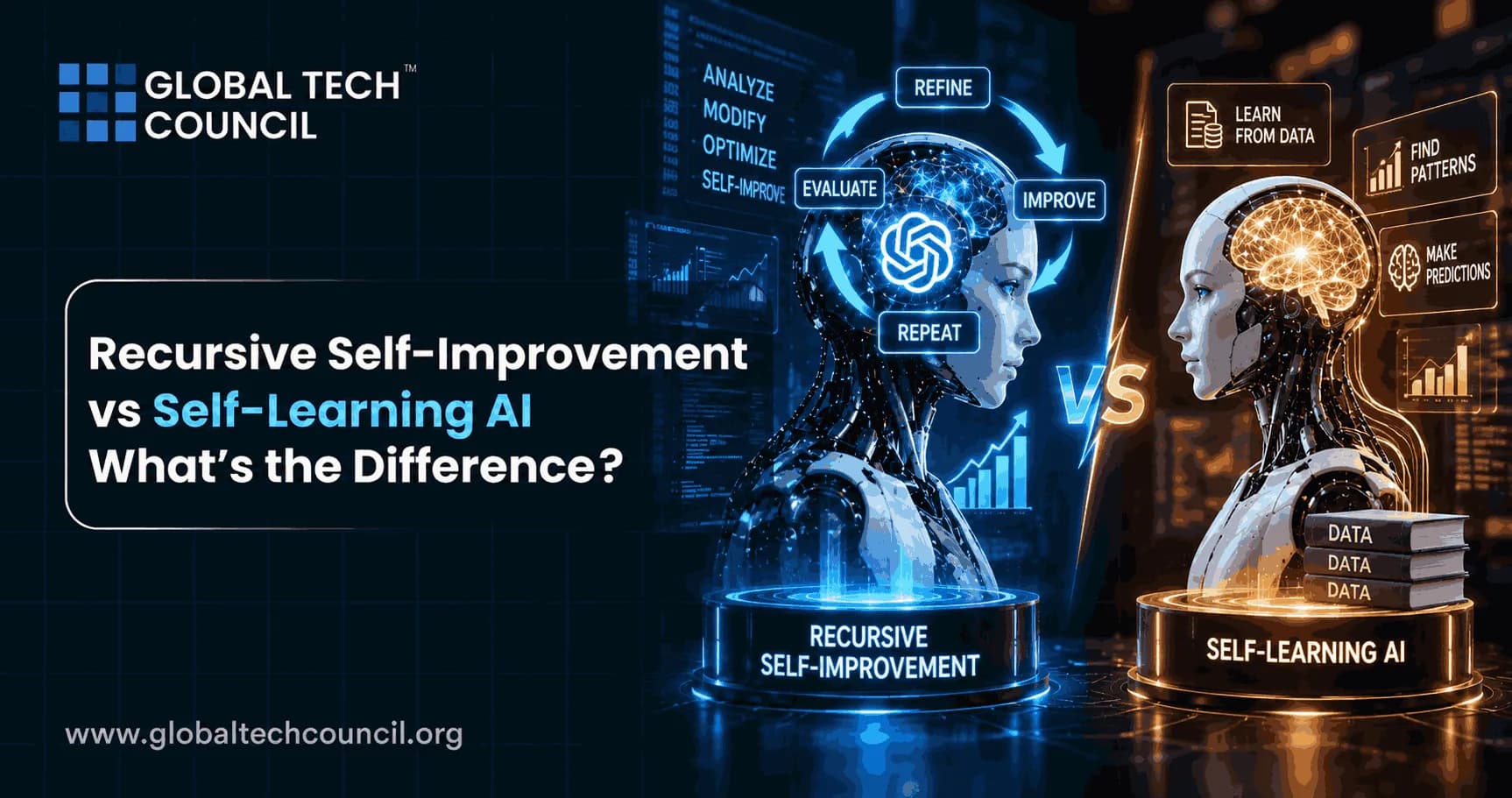
The short version is this: self-learning AI improves its performance on a task by learning from data or experience. Recursive self-improvement improves the system's own capacity to improve, a distinction that sounds subtle but carries enormous practical and safety implications once you follow it through.

What Self-Learning AI Actually Means
Self-learning AI is a well-established, widely deployed category of machine learning, not a speculative future capability.
Self-learning generally refers to a system that updates its own parameters, knowledge, or behavior based on data or experience, without requiring a human to manually label every example or hand-craft every rule it follows.
Online learning and continual learning are common forms of this, where a model keeps updating as new data arrives, gradually improving its performance on a defined task over time without changing what the task itself is.
Reinforcement learning through self-play is one of the clearest, most successful examples. AlphaZero, DeepMind's game-playing system, started from scratch and became superhuman at chess, shogi, and Go within hours, playing millions of games against itself and updating based on outcomes, with no human-provided examples or supervision required.
Modern large language models are trained using variants of self-supervised learning, where the model learns from its own outputs and predictions on a training corpus, representing a structural form of self-reference already baked into how frontier models get built.
Crucially, in every one of these examples, the system is improving its performance on a task using an architecture, objective function, and learning algorithm that humans designed and fixed in advance. The system is not changing how it improves itself. It is simply getting better at the specific thing it was already built to do.
What Recursive Self-Improvement Actually Means
Recursive self-improvement describes something meaningfully different and considerably rarer in practice.
The formal concept traces back to I.J. Good's 1965 observation that an ultraintelligent machine could design even better machines, creating a positive feedback loop researchers now call an intelligence explosion.
Researcher Eliezer Yudkowsky later codified the term within the framework of what he called seed AI, defining recursive self-improvement specifically as self-improvement that enhances a system's capacity to improve, not merely its task performance on any single benchmark.
Computer scientist Jürgen Schmidhuber's Gödel Machine gave this idea its strictest mathematical form: an agent capable of rewriting any part of its own code, provided it can formally prove the modification is actually beneficial before making the change.
The defining feature of genuine RSI is that the system begins improving not just its output on a task, but the underlying process that produces that output, and then potentially the process that improves that process, creating a meta-level loop rather than a single-level one.
A useful three-tier way to separate the confusion: an AI improving its answer to a specific question is already common and unremarkable. An AI improving its own prompts, workflows, tools, or training data is increasingly real and observable today. An AI improving the actual process by which it improves itself is the genuinely emerging, still largely unresolved capability that the term recursive self-improvement was originally coined to describe.
Key Differences Side by Side
Laying the two concepts next to each other makes the practical distinction much clearer.
Level of operation: self-learning AI operates at the task level, getting better at a fixed job. Recursive self-improvement operates at the meta level, changing the system's own capacity to improve.
Architecture stability: self-learning systems keep their underlying architecture and objective function fixed throughout the learning process. Genuine RSI implies the system can eventually modify its own architecture, training process, or improvement strategy.
How common it is today: self-learning is ubiquitous, powering nearly every modern machine learning system in production, from recommendation engines to large language models. RSI in its strongest form remains rare, contested, and the subject of active research specifically aimed at determining whether it is happening yet.
Human role: self-learning typically runs inside a framework humans have already designed, with clear boundaries around what "improvement" even means. RSI, especially in its stronger interpretations, implies a shrinking human role in defining what gets improved and how.
Growth pattern: self-learning tends to produce steady, often diminishing gains bounded by the fixed architecture and available data. Genuine RSI is theorized to potentially produce accelerating, compounding gains precisely because each improvement round strengthens the system's ability to generate the next improvement.
Why AlphaZero Is Self-Learning, Not Recursive Self-Improvement
AlphaZero is frequently cited in casual conversation as an example of recursive self-improvement, but a closer look shows why that label does not quite fit under the stricter definition.
AlphaZero used its own outputs, the results of millions of self-played games, to improve its performance without human-provided examples, which does represent a tight, fully automated feedback loop.
What AlphaZero did not do is rewrite its own underlying architecture or the reinforcement learning algorithm driving its training. It got dramatically better at chess, shogi, and Go using a fixed learning process, not by inventing a better version of that process itself.
This is precisely the distinction researchers point to when separating genuine RSI from impressive but architecturally bounded self-learning: AlphaZero improved its outputs through self-play, but it did not improve its own capacity to improve, the specific, narrower thing the term recursive self-improvement was defined to capture. Understanding this architectural distinction in real, technical depth is exactly where a credential like the Certified Artificial Intelligence (AI) Developer becomes genuinely valuable, moving past surface-level definitions into how these systems are actually built and where the meaningful boundaries between them really sit.
Where the Line Between the Two Genuinely Gets Blurry
Modern AI research has produced systems that sit in a genuinely ambiguous middle ground between straightforward self-learning and full recursive self-improvement.
AI coding agents that improve their own orchestration, task decomposition, and use of existing capability without any underlying algorithmic breakthrough represent what researchers describe as recursive improvement of systems, not minds, a real and empirically observable phenomenon today that still falls short of the stronger RSI definition.
Systems like AlphaEvolve and similar evolutionary coding agents generate, test, and refine algorithms that then feed back into the infrastructure used to train future models, blurring the line between simply learning from data and genuinely improving the improvement process itself.
Data self-improvement represents another blurry middle case, where an AI system curates, generates, or simulates higher-quality training data used to train an improved next-generation model, a process that is more sophisticated than basic self-learning but does not necessarily involve the system rewriting its own architecture either.
Researchers studying this space closely have noted that even a closed system improving entirely on its own outputs, with no external correction, risks a self-reinforcing feedback loop where mistakes compound rather than get caught, which is precisely why the strongest and most trustworthy recursive systems tend to stay connected to independent, external verification, such as code execution results, formal mathematics, or real-world experimental data, rather than improving purely in isolation.
One Emerging Application Riding the Same Underlying Model Progress
The capability improvements driving this entire academic debate are not confined to research papers about self-play and architecture search. The same underlying model progress surfaces in far more accessible, everyday products as well.
One emerging application is AI microdrama, where generative AI helps bring serialized stories, characters, and fictional worlds to life. Tools in this category benefit indirectly from the same broader wave of self-learning model improvements described throughout this article, showing how gains made through relatively ordinary self-learning techniques, not necessarily anything resembling true recursive self-improvement, still ripple outward into genuinely useful, entirely different creative applications.
Building the Deeper Technical Literacy This Distinction Requires
Confidently separating self-learning AI from recursive self-improvement in any specific, real-world system requires technical literacy spanning machine learning fundamentals, agent architecture, and the formal theoretical frameworks researchers use to define these terms precisely.
This is not a distinction most people can make accurately from headlines alone, since the vocabulary itself, terms like self-refine, self-reward, self-play, and self-evolve, gets used loosely across genuinely different underlying mechanisms with very different risk profiles. A Deep Tech Certification helps professionals build the broader technical foundation needed to evaluate a specific system's actual behavior against these formal definitions, rather than accepting whichever label a headline happens to apply.
Why This Distinction Matters for Policy and Public Understanding
Getting this distinction right matters well beyond academic precision, because policymakers, journalists, and business leaders are increasingly making real decisions based on claims about AI self-improvement, and conflating the two concepts leads directly to either unwarranted panic or unwarranted complacency.
Describing a system that improved its chess performance through self-play using the same alarming language reserved for a system capable of rewriting its own architecture creates genuine confusion about what kind of governance, oversight, or caution any specific capability actually warrants. A Marketing Certification can help professionals communicating about AI progress build the discipline needed to use these terms precisely, explaining the real difference between routine self-learning and genuine recursive self-improvement clearly enough that audiences can calibrate their concern appropriately rather than reacting to a blurred, imprecise version of the story.
The Bottom Line on Self-Learning AI vs Recursive Self-Improvement
Self-learning AI and recursive self-improvement describe genuinely different phenomena, even though they get used almost interchangeably in casual conversation. Self-learning AI, the kind already powering AlphaZero, modern LLMs, and countless production machine learning systems, improves task performance using a fixed architecture and learning process that humans designed in advance. Recursive self-improvement, in its formally defined sense, requires a system to improve its own capacity to improve, a meta-level capability that remains rare, actively researched, and the subject of real disagreement about how close current systems actually are to achieving it. Understanding which of these two categories a specific claim about "AI self-improvement" actually belongs to is the single most useful habit anyone following this topic can build.
FAQs
1. What is the difference between recursive self-improvement and self-learning AI?
Recursive self-improvement (RSI) involves an AI repeatedly improving its own capabilities or the processes used to improve it. Self-learning AI generally refers to systems that can learn from data, feedback, or experience with limited human intervention. Self-learning is broader as a learning concept, while RSI focuses on repeated, potentially compounding self-improvement.
2. What is recursive self-improvement in AI?
Recursive self-improvement is the hypothetical process where an AI improves itself and then uses its improved capabilities to make further improvements. A simplified RSI loop is identify → improve → evaluate → repeat.
3. What is self-learning AI?
Self-learning AI refers to AI systems that can adapt or improve their performance by learning from data, feedback, interactions, or experience. Depending on the system, this can involve machine learning, reinforcement learning, self-supervised learning, or other adaptive techniques.
4. Is self-learning AI the same as recursive self-improvement?
No. A self-learning AI can become better at a task without changing its own underlying architecture or development process. RSI is a stronger concept in which improvements can potentially increase the AI's ability to make further improvements.
5. Which is more advanced, self-learning AI or recursive self-improvement?
They describe different capabilities rather than a simple progression. Self-learning focuses on acquiring or refining knowledge and skills, while RSI focuses on repeated improvement of the AI itself or the mechanisms used to improve it.
6. Can self-learning AI improve without human intervention?
Some self-learning systems can update their behavior or parameters using automated feedback. However, they generally operate within objectives, algorithms, data pipelines, and boundaries established by developers. Limited human intervention does not necessarily mean complete autonomy.
7. Can recursive self-improvement happen without human intervention?
In theory, yes. A fully autonomous RSI system could identify weaknesses, develop modifications, test them, and continue improving without humans approving every individual change. Current AI systems have not publicly demonstrated unrestricted autonomous RSI.
8. How does self-learning work in AI?
A self-learning system typically receives data or experience → generates predictions or actions → receives feedback → updates its behavior or parameters → repeats. The exact process depends on the machine-learning technique being used.
9. How does recursive self-improvement work?
A theoretical RSI system could follow this cycle:
Identify a limitation → propose an improvement → implement the change → test and evaluate it → retain successful changes → use the improved system to find another improvement.
The recursive element comes from using one improvement cycle to enable subsequent cycles.
10. Can an AI learn from its own experiences?
Yes. Reinforcement learning systems, self-play systems, and other automated learning approaches can use generated experiences or feedback to improve performance. However, learning from experience does not automatically mean the system is recursively improving itself.
11. Can self-learning AI change its own code?
A self-learning system does not necessarily have access to its own source code. An AI agent can be specifically designed with coding tools and permissions that allow it to modify software, but this is a separate capability from ordinary self-learning.
12. Can recursive self-improvement change an AI's architecture?
Potentially. A sufficiently autonomous RSI system could theoretically evaluate alternative architectures, modify components, run experiments, and select better-performing designs. This would go beyond simply learning from additional data.
13. What is the role of machine learning in self-learning AI?
Machine learning provides the techniques that allow AI systems to identify patterns and improve performance from data or feedback. Self-supervised learning and reinforcement learning are examples of approaches that can reduce reliance on manually labeled training examples.
14. What is the role of AI agents in recursive self-improvement?
AI agents can combine capabilities such as reasoning, coding, research, experimentation, and evaluation. This makes it possible to automate multiple steps in an AI-development loop and could potentially support more advanced forms of self-improvement.
15. Can self-learning AI become recursively self-improving?
Potentially, but self-learning alone is not enough. For RSI, an AI would need to improve not only its performance but also its ability to discover, implement, and validate further improvements. This creates a much stronger feedback loop.
16. What are the limitations of self-learning AI?
Self-learning systems can be limited by data quality, feedback quality, computational resources, algorithmic constraints, distribution changes, and inaccurate learning signals. Learning from poor-quality information can sometimes reinforce errors rather than improve performance.
17. What are the risks of recursive self-improvement?
Potential risks include loss of human oversight, objective misalignment, unexpected behavior, rapid capability growth, cybersecurity vulnerabilities, and difficulty evaluating increasingly capable systems. These risks become more significant as autonomy increases.
18. Could self-learning lead to an intelligence explosion?
Not necessarily. Self-learning can improve an AI's performance, but an intelligence explosion would require a much stronger feedback loop in which AI improvements substantially increase the system's ability to produce additional improvements.
19. Is today's AI self-learning or recursively self-improving?
Today's AI systems demonstrate various forms of automated learning and can assist with their own development. They can generate data, write code, evaluate outputs, and optimize certain processes. However, fully autonomous recursive self-improvement has not been publicly demonstrated.
20. Recursive self-improvement vs self-learning AI: Which matters more for the future?
Both could be important, but they address different aspects of AI development. Self-learning AI focuses on how systems learn from data or experience, while recursive self-improvement focuses on AI systems repeatedly improving their own capabilities or development processes. If future AI can combine advanced self-learning with autonomous research, coding, experimentation, and evaluation, these capabilities could potentially form part of a broader RSI loop.
Related Articles
View All
AI & ML
Recursive Self-Improvement vs Recursive Self-Training: Key Differences
Learn the key differences between recursive self-improvement and recursive self-training, including how each process works, what it changes, and why the distinction matters in AI development.
AI & ML
Recursive Self-Improvement and AI Safety: What Are the Risks?
Recursive self-improvement could allow AI systems to enhance their capabilities repeatedly, raising concerns around alignment, control, oversight, rapid capability growth, and unpredictable behavior.
AI & ML
What Are the Limitations of Recursive Self-Improvement in AI?
Explore the main limitations of recursive self-improvement in AI, including model reliability, evaluation challenges, resource constraints, alignment risks, diminishing returns, and technical bottlenecks.
Trending Articles
The Role of Blockchain in Ethical AI Development
How blockchain technology is being used to promote transparency and accountability in artificial intelligence systems.
AWS Career Roadmap
A step-by-step guide to building a successful career in Amazon Web Services cloud computing.
Top 5 DeFi Platforms
Explore the leading decentralized finance platforms and what makes each one unique in the evolving DeFi landscape.