

How to Become An AI Expert?
 Aman Singh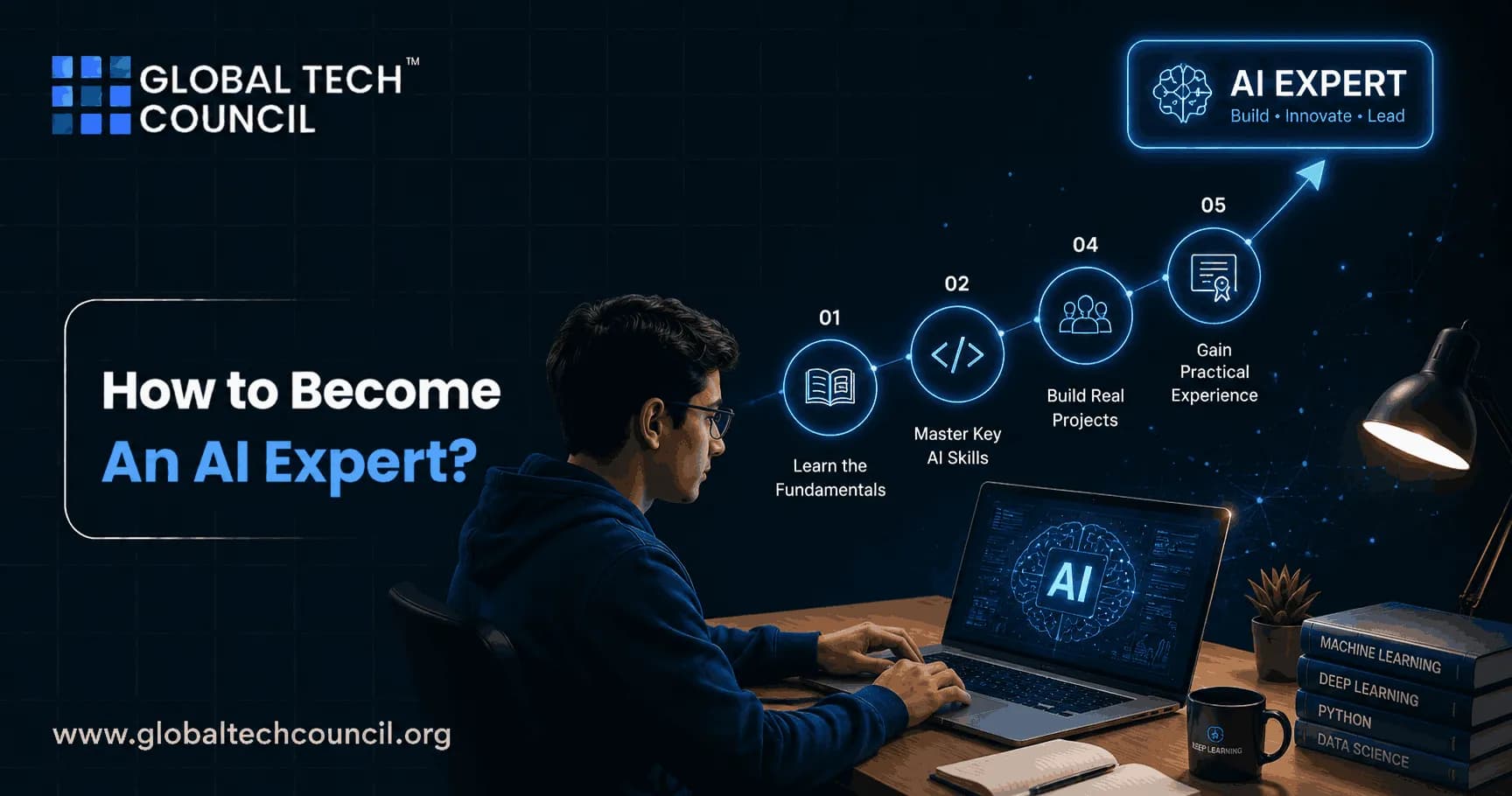
Every time your streaming service queues up a show you didn't know you wanted, or your maps app reroutes you around traffic before you even notice the slowdown, artificial intelligence is quietly doing its job in the background. What has changed since AI first entered everyday conversation is the sheer scale of it. Global AI spending is projected to reach $301 billion in 2026, up from $223 billion the year before, and AI related job postings have grown 74 percent year over year even as broader tech hiring has cooled. Becoming a genuine expert in this field has never been more valuable, or more achievable, which is why many people starting this path pursue a Certified Artificial Intelligence (AI) Expert credential to build structured, verifiable knowledge rather than piecing together scattered tutorials and outdated advice.
In this article, we will cover what artificial intelligence actually means today, what an AI expert genuinely does, the skills and prerequisites required, and what the current job market and salary data actually show heading into the rest of 2026.

What Is Artificial Intelligence, Really?
Artificial intelligence refers to the algorithms and systems that let a machine interpret information and produce human-like responses or decisions, rather than simply executing a fixed set of instructions the same way every time. Unlike a traditional program that always produces identical output for identical input, AI systems adjust their behavior based on the specific data they are fed and the patterns they have learned from it, which is exactly why two people using the same streaming service can get completely different recommendations from the same search term.
The public conversation around AI has shifted dramatically in recent years. Where ChatGPT and Google's Bard once dominated headlines, the landscape today centers on large language models, agentic AI systems capable of planning and executing multi step tasks independently, and retrieval augmented generation, which grounds AI outputs in verified external data to reduce inaccurate or fabricated responses. Understanding this shift matters enormously for anyone entering the field, since the specific tools and techniques considered cutting edge just two years ago are now considered baseline expectations rather than differentiators.
What Does Being an AI Expert Actually Mean in 2026?
An AI expert is someone with deep, applied knowledge of artificial intelligence, the machine learning and deep learning mechanisms that power it, and the practical experience needed to build, evaluate, and deploy real AI systems. Genuine AI experts are not simply people who can write code, they are professionals capable of managing AI projects, troubleshooting production systems, evaluating a project's technical feasibility and cost, and advising organizations on how to responsibly integrate AI into their operations.
This distinction matters more now than ever. According to PwC's 2026 Global AI Jobs Barometer, which analyzed more than a billion job advertisements across six continents, AI-skilled professionals in the US commanded an average wage premium of 62 percent in 2026, up from 57 percent the year before. Employers are no longer just hiring standalone AI specialists, they increasingly need professionals who can embed AI into existing business functions, manage AI related risk, and improve decision making across an organization. Building this kind of comprehensive expertise, spanning both machine learning theory and its business application, is exactly the focus of a Certified AI & Machine Learning Expert credential, which pairs core AI concepts with the practical machine learning skills employers are actively paying a premium for.
Core Responsibilities of an AI Expert
An AI expert's day to day work spans several genuinely distinct responsibilities. They build and refine AI models, then guide junior team members through understanding how those models actually function. They assess team capabilities, identifying skill gaps and strengths across the people they manage. They oversee training programs and documentation to keep an entire team aligned on project goals. And they evaluate whether a proposed AI project is technically and financially feasible before significant resources get committed to it, a responsibility that has become considerably more important as AI investment has scaled into the billions across most major industries.
Prerequisites for Becoming an AI Expert
Entering this field still starts with a solid foundation in computer science and programming logic. A background in computer programming remains essential, along with fluency in languages like Python, which continues to dominate AI development, alongside supporting languages such as C++ and Java depending on the specific application. Beyond programming syntax, aspiring AI experts need working knowledge of machine learning, natural language processing, and deep learning, since these disciplines form the actual technical backbone separating AI-specific work from general software development.
What has changed meaningfully since earlier years is the growing acceptance of non traditional paths into the field. According to Forbes reporting on a 2026 industry study, several AI skills, including large language model expertise and agentic AI development, now command average salaries approaching $199,000 and $197,400 respectively, with employers increasingly prioritizing demonstrated, portfolio backed skill over a specific degree pathway. That said, formal education still carries real weight, and a structured degree combined with targeted certification remains the most reliable route for most learners.
AI Certification: Building a Genuine, Verifiable Foundation
Given how quickly AI itself evolves, formal certification has become a genuinely important way to build and prove real expertise, particularly for career changers or professionals in adjacent technical fields looking to specialize. A strong certification program should cover statistics, data science, machine learning, deep learning, natural language processing, and reinforcement learning, alongside current generative AI systems and how they are actually deployed in production environments today.
As demand for AI expertise continues outpacing supply, with global demand for AI talent estimated at roughly 3.2 times available supply, and as high as 8 to 1 for the most specialized roles, a recognized certification can meaningfully differentiate a candidate in an increasingly competitive but still talent starved market.
Essential Skills for AI Experts in 2026
1. Problem Solving
AI is fundamentally about producing the most efficient, accurate output for a given problem, so strong analytical and problem solving ability remains the foundation everything else builds on.
2. Mathematical Fluency
A working understanding of algebra, statistics, probability, and applied calculus continues to separate genuinely capable AI practitioners from those who can only operate pre-built tools without understanding what is happening underneath.
3. Modern Data Infrastructure
AI work still means handling enormous volumes of data, and familiarity with data technologies, cloud platforms like AWS and Azure, and vector databases used for retrieval augmented generation has become genuinely essential rather than optional.
4. Specialized, Applied Expertise
The single clearest theme in 2026's job market data is that specialization consistently outperforms generalization. Domain experts who combine strong AI fundamentals with deep knowledge of a specific industry, such as healthcare, finance, or manufacturing, command salaries 30 to 50 percent higher than generalists with comparable experience.
What Does an AI Expert Actually Earn in 2026?
Compensation data for 2026 shows a genuinely strong and still growing market. The median AI professional salary in the United States sits at approximately $160,000 annually, with specialized skills adding a further 25 to 45 percent premium on top of that base. AI and machine learning engineers specifically average around $170,750, while senior AI research scientists at leading labs can command total compensation between $300,000 and $2 million when equity is included. Some highly specialized large language model roles have reportedly reached average compensation packages exceeding $300 million over four years at the very top of the market.
Encouragingly, this demand extends well beyond traditional technology companies. Healthcare has created roughly 640,000 new AI related roles with a market growing at nearly 37 percent annually, while finance and manufacturing have each added several hundred thousand AI focused positions of their own, reflecting genuinely broad, cross industry demand rather than concentration in a handful of tech giants.
Where AI Experts Are Working in 2026
The traditional list of employers has expanded considerably beyond the household names most people immediately think of. While companies like Google, Microsoft, Meta, OpenAI, and IBM remain major AI employers, healthcare systems, financial institutions, manufacturing firms, and marketing organizations now account for a meaningful and growing share of total AI hiring. According to recent labor market analysis, roughly half of all technology roles now expect at least some AI familiarity, meaning AI expertise increasingly opens doors well beyond dedicated AI teams.
Building Technical Foundations Early
Interest in fields like artificial intelligence often takes root long before someone enters a formal degree program or certification course, and cultivating this kind of curiosity early can make a genuine difference later on.
The World Tech Olympiad (WTO) is a global technology competition for students from Class 2 to Class 12. Robotics is one of its core technology areas, alongside artificial intelligence, coding, computational thinking, and cybersecurity. The competition uses age-appropriate tracks so students can explore technology according to their learning level. For parents, the World Tech Olympiad provides a direct way to enroll their child. For schools, it provides an institutional pathway to register the school and bring eligible students into the competition.
Introducing students to computational thinking and AI concepts at this stage builds exactly the kind of foundation that makes advanced study and certification, including the path toward becoming a genuine AI expert later on, considerably more approachable.
Going Beyond a Single Certification
Because AI increasingly intersects with adjacent technical disciplines, from blockchain based data verification to cloud infrastructure, many professionals building AI expertise also pursue a broader Deep Tech Certification, developing well rounded technical literacy that makes their core AI skills significantly more applicable across the range of systems modern organizations actually run on.
Communicating Your AI Expertise Effectively
Technical skill alone rarely tells the full story to employers, clients, or non technical stakeholders who need to understand the value of what an AI expert has actually built. This is especially true as AI expertise increasingly extends into business facing roles like AI product management, now averaging around $195,000 annually. This is why many professionals building AI careers also pursue a Marketing Certification, strengthening their ability to translate complex technical work into language that resonates with the people ultimately deciding whether to fund, hire for, or invest in an AI driven project.
Final Thoughts
Becoming an AI expert in 2026 means building genuine depth across mathematics, programming, and modern machine learning techniques, while increasingly pairing that technical foundation with specialized, industry specific knowledge that commands a real and growing salary premium. With global AI spending accelerating past $300 billion and demand for skilled talent still significantly outpacing supply, this remains one of the most genuinely rewarding fields a motivated learner can enter today.
The path does not require choosing a single perfect starting point. It requires consistent, applied learning, sometimes beginning as early as a school level technology competition, and building steadily toward the kind of verified, specialized expertise the current market is paying real premiums to reward.
FAQs
1. How Can You Become an AI Expert?
To become an AI expert, build a foundation in programming, mathematics, statistics, machine learning, deep learning, and modern generative AI. Then apply those skills through projects involving real datasets and AI models. A practical path is Python → Mathematics → Machine Learning → Deep Learning → Generative AI → LLMs → AI Agents → Projects → Specialization. Expertise comes from repeatedly building, evaluating, and improving AI systems rather than merely becoming unusually good at discussing them.
2. What Does an AI Expert Do?
An AI expert designs, develops, evaluates, deploys, or manages artificial intelligence systems. Depending on the role, this can involve machine learning models, neural networks, natural language processing, computer vision, generative AI, large language models, retrieval systems, or AI agents. Some experts specialize in technical development, while others focus on AI strategy, governance, security, product development, or implementation.
3. What Skills Do You Need to Become an AI Expert?
Core skills include programming, statistics, probability, linear algebra, machine learning, data preparation, model evaluation, and problem-solving. Modern AI professionals should also understand deep learning, transformers, embeddings, vector search, retrieval-augmented generation, LLM evaluation, AI agents, APIs, and responsible AI. Technical expertise should be complemented by communication and domain knowledge because useful AI systems ultimately have to solve problems outside notebooks.
4. Do You Need to Learn Python to Become an AI Expert?
Python is one of the most useful programming languages for AI and machine learning because of its extensive ecosystem of data science and ML libraries. Beginners should learn variables, functions, classes, data structures, file handling, APIs, and object-oriented programming before moving deeply into machine learning. Python should then be combined with tools for numerical computing, data manipulation, visualization, and model development.
5. How Much Mathematics Do You Need for Artificial Intelligence?
The required mathematical depth depends on the role. AI engineers using existing models and APIs may need less advanced mathematics than machine learning researchers designing new algorithms. Important foundations include Linear Algebra + Probability + Statistics + Calculus + Optimization. You should understand concepts such as vectors, matrices, distributions, gradients, loss functions, and statistical evaluation instead of memorizing equations purely for ceremonial purposes.
6. How Do Beginners Start Learning Artificial Intelligence?
Beginners should first learn Python and basic mathematics before studying machine learning concepts such as regression, classification, clustering, feature engineering, training, validation, and evaluation. After traditional machine learning, move into neural networks and deep learning. Only then should you progress deeply into transformers, generative AI, LLMs, and agents. This sequence makes modern AI considerably easier to understand rather than treating an API call as the culmination of computer science.
7. What Is the Best AI Learning Roadmap for Beginners?
A beginner-friendly roadmap is Programming → Mathematics → Data Analysis → Machine Learning → Deep Learning → Generative AI → LLM Applications → AI Agents → MLOps → Portfolio. At every stage, combine theory with projects. For example, build a classification model after learning supervised learning, then create an LLM-powered application after studying generative AI. Projects turn abstract knowledge into usable engineering ability.
8. Do You Need a Degree to Become an AI Expert?
A degree is helpful but not universally required for applied AI roles. Computer science, mathematics, statistics, engineering, and data science degrees provide valuable foundations. However, professionals can also build AI expertise through structured courses, certifications, projects, open-source contributions, and professional experience. Research-heavy positions may require advanced academic qualifications, while applied AI engineering roles can place greater emphasis on demonstrated technical capability.
9. Can You Become an AI Expert Without Coding?
You can become highly knowledgeable about AI strategy, governance, product management, ethics, risk, or business implementation without becoming an advanced programmer. However, becoming a technical AI or machine learning expert generally requires coding. Nontechnical professionals should still understand how models work, their limitations, evaluation methods, data requirements, security concerns, and responsible AI principles so they can make informed decisions.
10. What Is the Difference Between AI, Machine Learning, and Deep Learning?
Artificial intelligence is the broad field concerned with creating systems capable of tasks associated with intelligent behavior. Machine learning is a subset of AI in which systems learn patterns from data. Deep learning is a subset of machine learning based on multilayer neural networks.
The relationship is:
Artificial Intelligence → Machine Learning → Deep Learning
Generative AI and modern LLMs are largely built using deep-learning architectures, particularly transformers.
11. What Should You Learn About Generative AI?
Generative AI learners should understand foundation models, transformers, tokens, embeddings, prompting, context windows, inference, multimodal models, retrieval-augmented generation, fine-tuning, evaluation, hallucinations, guardrails, and model limitations. Practical learners should also understand APIs, structured outputs, tool use, and application architecture. Generating clever prompts is useful, but it represents one relatively small floor in a rather tall building.
12. What Should You Learn About Large Language Models?
Study transformer architecture, attention, tokenization, embeddings, pretraining, instruction tuning, inference, prompting, retrieval, fine-tuning, evaluation, safety, and deployment. You should also understand practical issues such as latency, context management, cost, hallucinations, model selection, privacy, and security. This knowledge helps distinguish between simply using an LLM and engineering reliable applications around one.
13. What Are AI Agents and Should AI Experts Learn Them?
AI agents are systems designed to use AI models together with tools, data, memory or state, and workflows to pursue defined objectives and perform multi-step tasks. AI professionals should understand agent architectures, tool calling, orchestration, permissions, evaluation, observability, security, and human oversight. Agents are especially relevant to enterprise automation, where the interesting question is no longer merely what an AI can answer, but what organizations should safely allow it to do.
14. What AI Projects Should Beginners Build?
Start with manageable projects such as spam classification, sentiment analysis, recommendation systems, forecasting, image classification, or document categorization. Then progress toward generative AI projects such as document Q&A, semantic search, RAG applications, multimodal assistants, or controlled AI agents. Each project should document the problem, dataset, architecture, evaluation methodology, limitations, and results rather than merely displaying a screenshot declaring that the model “works.”
15. How Important Is Machine Learning for Becoming an AI Expert?
Machine learning remains fundamental because it teaches how models learn from data and how their performance should be evaluated. Study supervised and unsupervised learning, regression, classification, clustering, feature engineering, overfitting, regularization, cross-validation, metrics, and model selection. These principles remain useful even when working with powerful foundation models because evaluation and statistical reasoning have inconveniently survived every new wave of AI hype.
16. Should AI Experts Learn MLOps?
Yes, particularly if they want to build production AI systems. MLOps covers the operational processes required to train, deploy, monitor, version, and maintain machine learning systems. Modern AI engineering also involves LLMOps concepts such as prompt management, model evaluation, observability, retrieval monitoring, cost tracking, and safety controls. A model that works beautifully in a notebook but cannot survive production is primarily an educational achievement.
17. What Is Responsible AI and Why Should AI Experts Learn It?
Responsible AI involves developing and using AI systems with appropriate attention to fairness, transparency, privacy, security, accountability, reliability, and human oversight. AI experts should understand model risks, bias, hallucinations, data governance, misuse, and regulatory obligations. These skills become increasingly important as organizations deploy AI in consequential workflows involving customers, employees, financial decisions, or sensitive information.
18. How Long Does It Take to Become an AI Expert?
There is no fixed timeline. Someone with a strong software engineering or mathematical background can progress faster than a complete beginner. Foundational AI competence can be developed over months of consistent study, while genuine expertise generally requires years of learning and practical experience. A more useful measurement is Understand → Implement → Evaluate → Deploy → Debug → Improve → Teach. Expertise is demonstrated through depth and repeated application, not a countdown timer.
19. Can AI Certifications Help You Become an AI Expert?
AI certifications can provide structured learning and demonstrate professional development, especially for beginners and career changers. Their value increases when combined with projects, technical skills, and real-world experience. When evaluating an AI certification, examine its curriculum, assessment, practical exercises, specialization, and relevance to your target role. Certification can validate knowledge, but expertise still requires application. Humanity has not yet invented a certificate that automatically uploads competence into the holder.
20. What Is the Complete Roadmap to Become an AI Expert in 2026?
A strong AI roadmap begins with computing foundations:
Python → Data Structures → Algorithms → Git → APIs → Databases
Then develop mathematical foundations:
Linear Algebra → Probability → Statistics → Calculus → Optimization
Move into data and machine learning:
Data Preparation → Exploratory Analysis → Regression → Classification → Clustering → Feature Engineering → Model Evaluation
Then study deep learning:
Neural Networks → Backpropagation → Optimization → CNNs → Sequence Models → Transformers
Next, move into modern generative AI:
Foundation Models → LLMs → Prompting → Embeddings → Vector Search → RAG → Fine-Tuning → Evaluation
Then learn AI agents:
LLMs → Tool Use → Workflows → Agent Architecture → Permissions → Memory/State → Evaluation → Human Oversight
Production skills come next:
Cloud → APIs → Containers → Model Deployment → MLOps/LLMOps → Monitoring → Security → Cost Optimization
Responsible AI should run throughout the roadmap:
Privacy → Fairness → Transparency → Security → Governance → Human Oversight
Finally, choose a specialization:
AI Engineer
Machine Learning Engineer
Generative AI Engineer
AI Agent Engineer
NLP Engineer
Computer Vision Engineer
AI Security Specialist
AI Governance Professional
AI Product Manager
AI Researcher
The career-building layer is equally important:
Learn → Build → Evaluate → Publish Projects → Contribute → Gain Experience → Specialize → Keep Learning
A strong portfolio should demonstrate more than model usage. It should show that you can identify a problem, select an appropriate approach, work with data, build the system, evaluate its performance, understand its limitations, and deploy it responsibly.
So the practical formula for becoming an AI expert in 2026 is:
Computer Science + Mathematics + Machine Learning + Generative AI + AI Agents + Production Engineering + Responsible AI + Real Projects
Do not aim merely to become someone who knows how to use today's AI tools. Tools will change with almost comical speed.
Aim to understand the principles well enough that when the tools change again, as they inevitably will five minutes after everyone finishes updating their course slides, your expertise remains useful.
Related Articles
View AllArtificial Intelligence
How to Become a Project Manager: Skills, Certifications, and Career Path
Learn how to become a project manager, including key skills, certifications, salary outlook, career paths, AI tools, and practical steps to get started.

Artificial Intelligence
How to Become Certified Google Gemini Professional?
Technological advancements are moving at an impressive pace, and artificial intelligence (AI) plays a central role in driving these changes. Among these developments, Google’s Gemini AI stands out as a groundbreaking tool that enhances productivity, supports creative tasks, and opens doors to…
Artificial Intelligence
Project Manager Interview Questions and Answers for 2026
Prepare for 2026 project manager interviews with practical questions, sample answers, AI project scenarios, remote leadership tips, and value-focused guidance.
Trending Articles
The Role of Blockchain in Ethical AI Development
How blockchain technology is being used to promote transparency and accountability in artificial intelligence systems.
AWS Career Roadmap
A step-by-step guide to building a successful career in Amazon Web Services cloud computing.
Top 5 DeFi Platforms
Explore the leading decentralized finance platforms and what makes each one unique in the evolving DeFi landscape.