

Building Safe Agentic AI Systems: Guardrails, Permissions, and Human-in-the-Loop Patterns
 Suyash Raizada
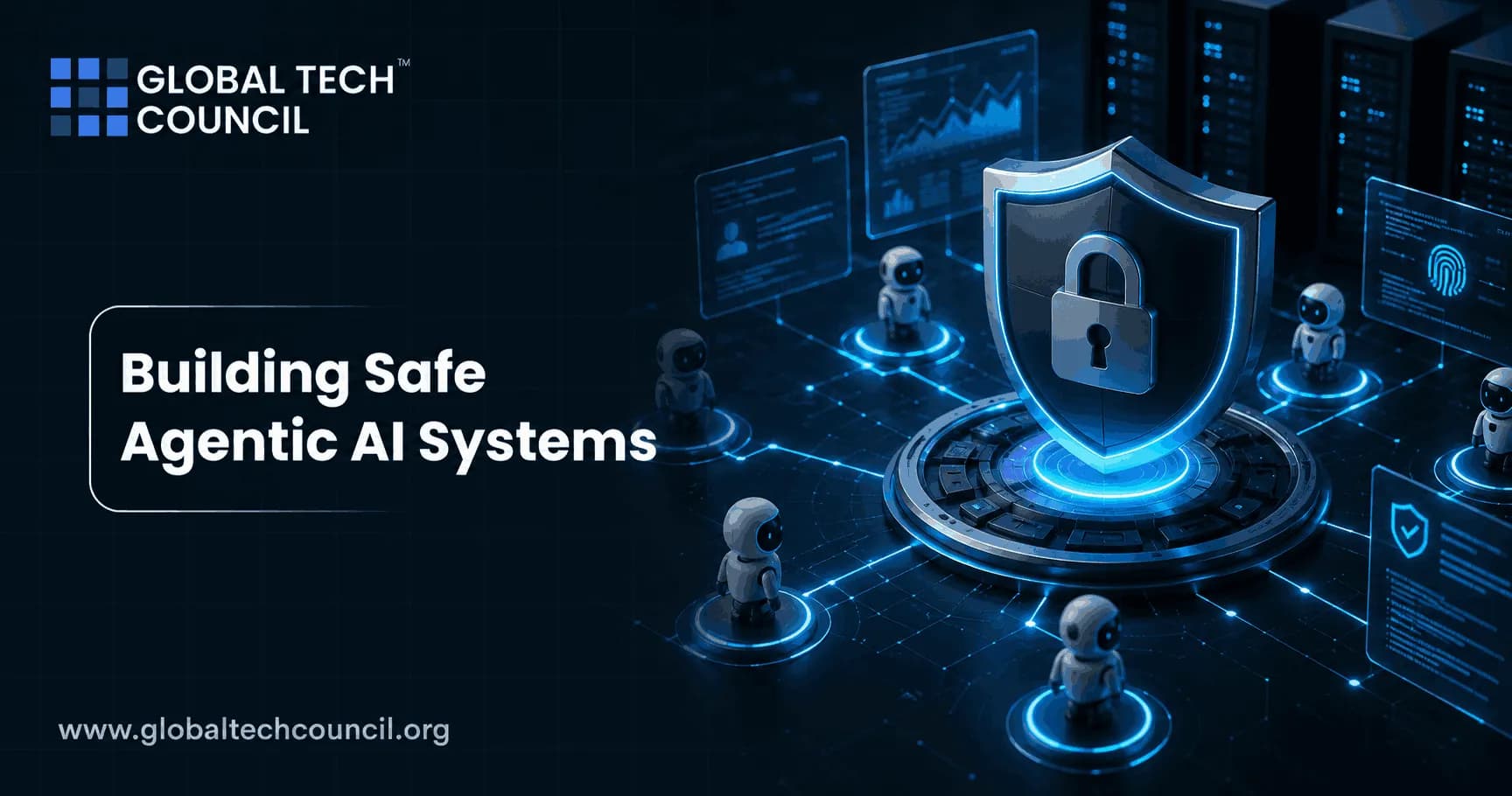
Building safe agentic AI systems is rapidly becoming a core engineering and governance requirement as organizations move beyond chatbots into AI that can plan, call tools, and take real actions in production environments. Unlike prompt-response systems, agentic AI expands the risk surface to include prompt injection, data exfiltration, privilege misuse, and unintended high-impact actions. The practical answer is not a single control, but a unified stack that combines technical guardrails, fine-grained permissions, and human-in-the-loop (HITL) design patterns that operate at machine speed while remaining auditable, reversible, and compliant. Professionals seeking to understand these challenges can explore Certified Agentic AI Expert to develop knowledge relevant to agentic AI systems and their responsible implementation.
Why Agentic AI Changes the Safety Equation
Agentic AI systems can decompose goals into steps, select tools, invoke APIs, write to databases, create tickets, modify code, and coordinate with other agents. This shift is already visible in real deployments:

Software engineering and code migration projects have reported substantial time savings, with some estimates measured in thousands of developer-years.
Financial workflows such as mortgage compliance and credit risk reporting have reduced error rates and shortened reporting cycles from days to hours.
Research automation in drug discovery has compressed multi-year research cycles through automated literature review and hypothesis generation.
These outcomes illustrate why organizations adopt agentic systems, and also why safety must be engineered from the start. In finance, healthcare, and critical enterprise operations, a single unauthorized tool call can cause more damage than an incorrect answer in a chat interface.
What Guardrails Mean for Agentic AI
Guardrails for agents are best understood as a security and governance layer that sits between users, models, tools, and external systems. They include both technical mechanisms and procedural controls that constrain, guide, and validate how an agent operates, covering what it can do, what it can access, and when it must escalate to a human. Developers working on the implementation side can explore Certified Agentic AI Developer to build relevant knowledge for developing and deploying agentic AI applications.
A key lesson from production deployments is that manual review alone does not scale. Guardrails must be embedded into the agent stack so they enforce safety automatically and consistently, with human attention reserved for the highest-risk decisions.
A Multi-Layer Architecture for Building Safe Agentic AI Systems
Safety is stronger when implemented as multiple independent layers. If one layer fails, another can still prevent harm.
1) Policy and Risk Modeling
Start by threat modeling the agent workflow. Identify likely failures and attack vectors such as prompt injection, data leakage, unsafe tool use, and privilege escalation. Then classify actions by risk level, for example:
Low risk: reversible actions like drafting internal summaries or creating a non-executed plan.
Medium risk: actions that affect internal systems but can be rolled back, such as creating a ticket or opening a pull request.
High risk: irreversible or externally visible actions such as sending external email, deleting data, changing production configurations, or initiating transactions.
This risk taxonomy becomes the decision backbone for permissions, guardrails, and HITL routing.
2) Input-Level Controls
Agents are particularly vulnerable to prompt injection because malicious instructions can be embedded in emails, documents, tickets, web pages, or database content. Effective input controls include:
Validation and sanitization of tool outputs and retrieved content before it enters the agent context.
Semantic detection that catches paraphrased injection attempts, not just keyword-based patterns.
Context minimization so the agent only receives the minimum data necessary for a given task.
3) Reasoning and Plan-Level Controls
In agentic workflows, the plan is often where things go wrong. Step-level controls inspect intermediate reasoning artifacts such as tool selection, ordering, and delegation. Patterns that work well in practice include:
Plan validation against policy rules before execution (for example, disallowing external communications in sandbox environments).
Goal and scope checks to prevent the agent from expanding beyond the user's original request.
Step-level evaluation in testing pipelines to detect regressions in tool choice and action sequencing.
This layer is also where many organizations formalize LLMOps practices, including automated evaluations, adversarial test sets, and continuous monitoring of agent behavior.
4) Tool and Action-Level Controls
The most important principle for agent permissions is straightforward: bind authority to tools, not to free-form model decisions. Rather than giving an agent broad credentials, expose narrow tools with explicit scopes. Common hardening controls include:
Tool-scoped permissions that enforce least privilege per action, per environment, and per dataset.
Distributed locks to prevent conflicting concurrent actions, such as duplicate charges or double writes.
Idempotency checks so retries do not repeat irreversible operations.
Rate limits and quota controls to reduce blast radius during anomalies.
5) Output-Level Controls
Output filters remain important, particularly for regulated domains. Typical output-level controls include:
PII and sensitive data detection with redaction where appropriate.
Compliance checks aligned to domain policy (for example, mortgage compliance language constraints).
Structured output validation for tool calls and machine-consumed responses to prevent malformed or unsafe actions.
6) Monitoring, Logging, and Auditability
Agent safety is an operational discipline, not just an architectural one. Production systems require:
Comprehensive audit logs of tool calls, access events, approvals, denials, and overrides.
Telemetry dashboards to track anomalies, error rates, latency spikes, and unusual action distributions.
Adversarial testing and red teaming using datasets that reflect production prompts and known attack patterns.
These controls support compliance, incident response, and iterative hardening as new failure modes emerge.
Fine-Grained Permissions for Agentic AI: Practical Patterns
Agentic AI must integrate with existing enterprise security models rather than bypass them. In practice, this means connecting with IAM, RBAC, API gateways, and service-to-service authorization frameworks.
RBAC with Tool-Scoped Access
RBAC remains foundational, but agents require additional discipline: each tool (query database, write file, send email, deploy code) should be exposed with explicit scopes and mapped to defined roles. The agent should never hold a root-level token that can be used arbitrarily.
Match the User's Privileges
A widely recommended safety constraint is that an agent acting on behalf of a user should have the same access that user holds in underlying systems. If a user cannot access a dataset or approve a payment, the agent should not be able to either.
Controlled Escalation and Sandboxing
Some workflows require elevated access. Handle this through explicit escalation paths:
Just-in-time elevation scoped to a single action and a short time window.
Mandatory approval before privilege changes or high-risk tool use.
Sandbox environments for testing high-risk workflows safely before production access is granted.
Human-in-the-Loop Patterns That Work in Production
HITL is most effective when it is systematic, measurable, and integrated into the orchestration layer so it cannot be bypassed. The goal is not to slow every action down, but to apply friction where it meaningfully reduces risk.
1) Confidence-Based Routing
Route tasks based on confidence signals and risk classification:
High confidence + low risk: auto-execute with logging and monitoring.
Low confidence or medium risk: require review of the proposed action or output.
High risk: require explicit approval and potentially multi-person review.
2) Pre-Approval of Plans
For multi-step workflows, require the agent to present a plan before execution. A reviewer can approve, edit, or reject before any tool calls occur. This pattern is particularly effective for agents with broad tool catalogs.
3) Inline Approvals for Specific Tools
Mark certain tools as always gated - for example, external email sending, production database modifications, account permission changes, and financial transactions. Other tools can remain autonomous where appropriate.
4) Post-Hoc Review and Sampling
For high-volume, lower-risk automation such as summaries, categorization, and content tagging, use sampling-based review. Feed reviewer feedback back into evaluation datasets and guardrail tuning to drive continuous improvement.
5) Operational Rituals and Metrics
Teams benefit from recurring reviews of agent telemetry and evaluation outcomes. These routines help detect behavioral drift, new attack patterns, and regressions introduced by model or prompt updates. Professionals exploring the wider technical foundations of secure autonomous systems can also consider Deep Tech Certification as a learning resource related to emerging technologies and their applications.
Applying the Stack to Real-World Deployments
Across industries, successful deployments follow a consistent blueprint:
Media workflows benefit from strict access controls over rights-sensitive archives, plus editor review for final outputs.
Code migration agents need repo-scoped permissions, CI/CD gates, test suites as guardrails, and human code review for critical components.
Mortgage compliance and credit risk reporting require policy-constrained outputs, detailed audit trails, and HITL for borderline or high-value decisions.
Drug discovery agents require controlled access to proprietary research data and scientific review processes to prevent overconfident outputs from influencing experiments.
Implementation Checklist for Building Safe Agentic AI Systems
Define risk tiers for actions and map them to autonomy levels.
Design multi-layer guardrails across input, reasoning, tools, and output.
Integrate IAM and RBAC, enforcing least privilege at the tool boundary.
Build HITL into orchestration with plan review and tool-level approvals.
Engineer for reversibility with locks, idempotency, and rollback paths.
Operationalize observability with audit logs, dashboards, and alerting.
Continuously evaluate using step-level tests and adversarial datasets.
For teams formalizing these practices, training can be aligned to specific role requirements. Certifications and courses in AI governance, machine learning, cybersecurity, data science, and DevSecOps are directly relevant, since safe agentic AI sits at the intersection of these disciplines.
Assessing Candidates for Agentic AI Roles
Agentic AI systems can plan tasks, use tools, and execute multi-step workflows with varying degrees of autonomy. As organisations explore these capabilities, they also need professionals who can design, monitor, and evaluate such systems. HireValid can be explored by employers looking for structured ways to assess candidates for emerging technology roles.
Conclusion: Hybrid Autonomy Is the Sustainable Path
Building safe agentic AI systems is ultimately about balancing speed with control. The most robust pattern emerging across the industry is hybrid autonomy: full automation for reversible, low-risk tasks under strong guardrails; human-on-the-loop oversight for medium-risk actions; and human-in-control approvals for high-risk, irreversible operations. Organizations that treat guardrails, permissions, and HITL as a unified engineering stack, integrated with existing security and compliance programs, are best positioned to deploy agentic AI that is effective, auditable, and resilient over time.
For organizations communicating the value of secure AI solutions and professionals building expertise in this area, Marketing Certification offers an additional learning pathway related to marketing and business communication.
FAQs
1. What is a safe Agentic AI system?
A safe Agentic AI system is an autonomous AI system designed to complete tasks while following defined rules, permissions, and security controls. It combines planning and tool use with guardrails, monitoring, and human oversight to reduce the risk of unauthorized actions, harmful outputs, and operational errors.
2. What are guardrails in Agentic AI?
Guardrails are technical and procedural controls that restrict an AI agent's behavior to approved actions. They can validate inputs and outputs, enforce business rules, block unsafe tool calls, protect sensitive information, and prevent an agent from operating outside its assigned responsibilities.
3. Why are permissions important for autonomous AI agents?
Permissions determine which data, tools, applications, and actions an AI agent can access. Proper permission management limits potential damage if an agent makes a mistake, follows malicious instructions, or is compromised. Agents should receive only the minimum access necessary to complete their assigned tasks.
4. What is human-in-the-loop AI?
Human-in-the-loop AI is an approach in which people review, approve, correct, or guide AI decisions at defined stages. In agentic systems, human involvement can be required before sending external communications, transferring funds, modifying sensitive records, or performing irreversible actions.
5. What are the best practices for building safe Agentic AI systems?
Best practices include defining clear task boundaries, applying least-privilege permissions, validating tool inputs, requiring approval for high-impact actions, monitoring execution, and maintaining audit logs. Developers should also test failure scenarios and establish procedures to stop or recover from unsafe behavior.
6. How does the principle of least privilege improve AI agent security?
The principle of least privilege gives an AI agent only the access it needs for a specific task. For example, an agent that summarizes customer records may need read-only access but should not automatically receive permission to delete records or change account settings.
7. What is the difference between AI guardrails and AI permissions?
AI guardrails enforce behavioral and operational constraints, such as validating outputs or blocking prohibited requests. Permissions control access to resources and actions, such as reading files, sending emails, or executing payments. Both are necessary because an agent can produce an inappropriate decision even when its access is restricted.
8. When should an AI agent require human approval?
Human approval is particularly important before financial transactions, account deletions, legal commitments, publication of sensitive content, access-control changes, and other consequential actions. Approval thresholds should reflect the potential impact, reversibility, and uncertainty of each action.
9. How can developers prevent prompt injection in Agentic AI systems?
Developers can reduce prompt-injection risks by treating external content as untrusted data, separating instructions from retrieved information, restricting tool permissions, validating tool arguments, and requiring confirmation for sensitive actions. No single defense is sufficient, so layered security testing and monitoring are essential.
10. How can AI agents protect sensitive data?
AI agents can protect sensitive data through access controls, data minimization, encryption, secure credential management, redaction, and carefully defined retention policies. Systems should also prevent unauthorized data transfers and ensure that connected tools enforce their own access restrictions.
11. What is a human-on-the-loop pattern in Agentic AI?
Human-on-the-loop means people supervise an AI agent while it operates, monitoring performance and intervening when necessary. Unlike human-in-the-loop workflows, where approval may be required before a particular action, human-on-the-loop systems can allow routine actions to proceed under predefined limits.
12. What is a human-in-command approach to AI safety?
A human-in-command approach keeps people responsible for defining the system's objectives, operating boundaries, and escalation policies. Humans retain the authority to pause, modify, or terminate agent operations and remain accountable for decisions that require human judgment.
13. How can developers safely allow AI agents to use APIs and external tools?
Developers should expose only approved APIs, validate every tool call, use scoped credentials, enforce rate limits, and verify results returned by external services. High-impact actions should use explicit approval workflows, while tool failures and unexpected responses should trigger safe fallback behavior.
14. How should developers monitor autonomous AI agents?
Developers should track tool calls, task outcomes, errors, permission violations, latency, resource usage, and policy violations. Structured logs and alerts help teams investigate unexpected behavior. Monitoring should avoid unnecessarily collecting sensitive information and should follow applicable privacy requirements.
15. What is the role of sandboxing in Agentic AI security?
Sandboxing isolates an AI agent's execution environment from sensitive systems and resources. It can restrict file access, network activity, code execution, and system permissions, reducing the potential impact of malicious instructions or unintended actions.
16. How can developers prevent AI agents from taking irreversible actions?
Developers can introduce confirmation gates, transaction limits, reversible intermediate steps, dry-run modes, and explicit authorization checks. For example, an agent can prepare a database update for review before committing the change, rather than modifying production records immediately.
17. How should businesses evaluate the safety of Agentic AI systems?
Businesses should test agents against realistic tasks, adversarial instructions, tool failures, unauthorized requests, and edge cases. Useful measures include task success, policy violations, unauthorized tool calls, human intervention frequency, and recovery performance. Regular evaluations should continue after deployment.
18. What are the biggest risks of deploying Agentic AI without guardrails?
Without appropriate guardrails, AI agents may expose confidential data, execute unauthorized transactions, modify important records, follow malicious instructions, or repeat incorrect actions. Excessive permissions and inadequate monitoring can increase the impact of these failures.
19. How can organizations implement safe Agentic AI in enterprise workflows?
Organizations should begin with a limited use case, map the agent's required permissions, define approval thresholds, and test its behavior in a controlled environment. They should integrate identity and access management, monitoring, audit logging, and incident response procedures before expanding deployment.
20. What is the future of guardrails and human oversight in Agentic AI?
As AI agents handle more complex workflows, safety engineering is likely to emphasize fine-grained permissions, continuous evaluation, policy enforcement, reliable audit trails, and risk-based human approval. The goal is to enable useful autonomy while preserving accountability and meaningful human control.
Related Articles
View All
Agentic AI
Human-in-the-Loop AI Agents: Guardrails, Approvals, and Audit Trails for Compliance
Learn how to design human-in-the-loop AI agents with enforceable guardrails, approval gates, and immutable audit trails to meet compliance and audit requirements.

Agentic AI
Multi-Agent Systems 101: How Agentic AI Teams Collaborate, Coordinate, and Resolve Conflicts
Multi-agent systems enable agentic AI teams to collaborate via roles, shared memory, and protocols. Learn coordination strategies and conflict resolution for enterprise-ready MAS.
Agentic AI
From Chatbots to AI Agents: A Step-by-Step Roadmap to Deploying Agentic Automation in Business
A step-by-step roadmap for agentic automation, showing how businesses evolve from chatbots to AI agents, workflow orchestration, multi-agent systems, and governed scaling.
Trending Articles
The Role of Blockchain in Ethical AI Development
How blockchain technology is being used to promote transparency and accountability in artificial intelligence systems.
AWS Career Roadmap
A step-by-step guide to building a successful career in Amazon Web Services cloud computing.
Top 5 DeFi Platforms
Explore the leading decentralized finance platforms and what makes each one unique in the evolving DeFi landscape.