

How Data Science is Changing Real Estate Industry?
 Aman Singh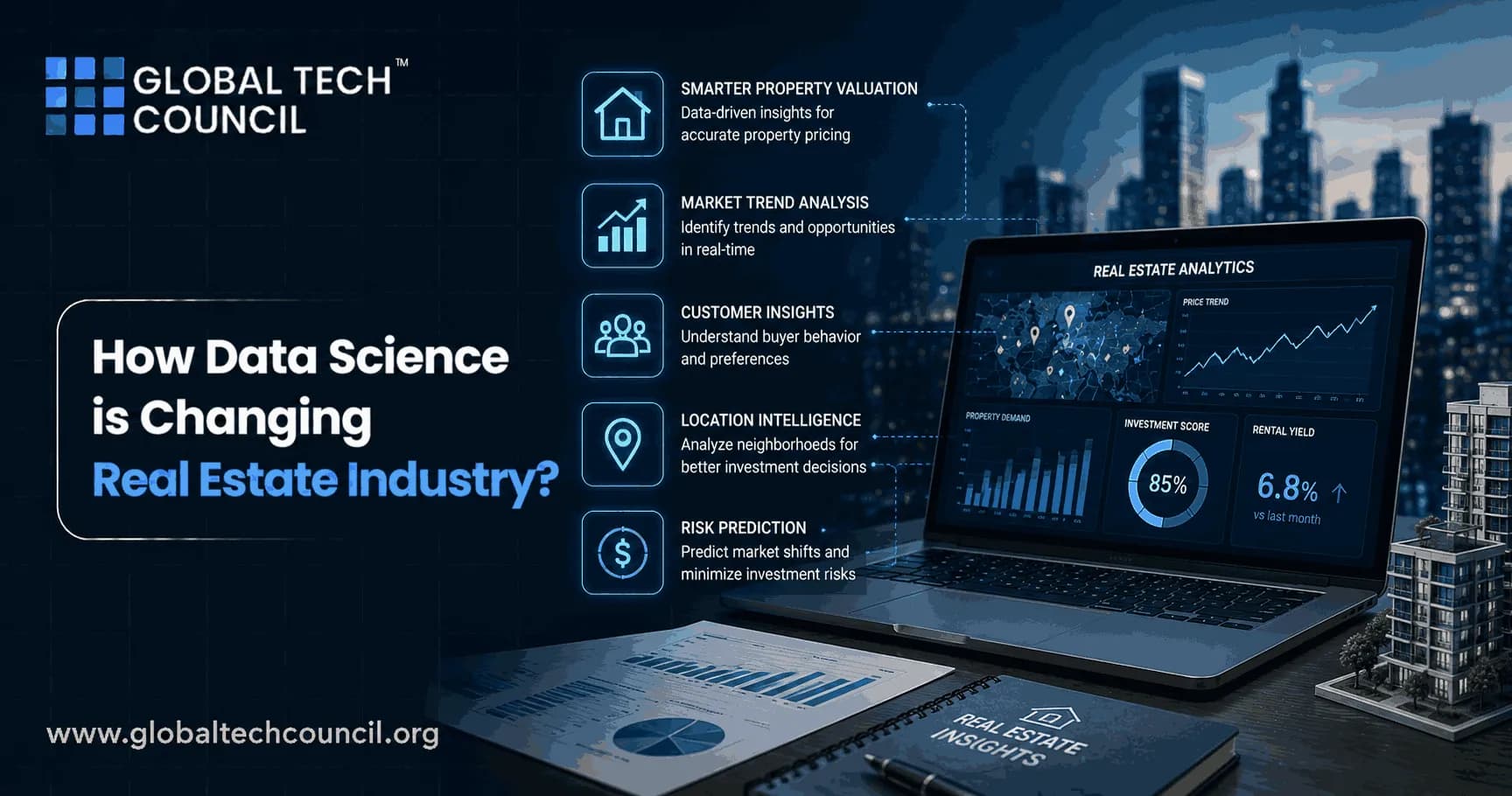
Data reigns supreme in today's dynamic world, driving innovation across industries. Real estate, too, benefits immensely from data science's power. By harnessing the potential of data, the real estate industry can navigate challenges and seize opportunities in ways previously unimaginable. As these tools become standard practice, more real estate professionals are formalizing their skills through a Certified Alteryx Data Science Expert credential, which builds the practical data preparation and analysis skills the industry now expects.
Data serves as the lifeblood of modern enterprises, guiding informed decision-making and strategy formulation. The era of "gut feeling" decisions has given way to data-driven insights that offer a competitive edge. Real estate, a sector heavily reliant on information, is ripe for a data-driven revolution.

The real estate landscape is complex, with market volatility and evolving customer preferences. Matching buyers with their dream properties and optimizing sales strategies are constant challenges. Yet, these challenges are coupled with immense opportunities for growth, innovation, and profitability. Data science is a transformative catalyst, enabling real estate professionals to make more accurate predictions.
Analyzing vast datasets helps anticipate market trends, guiding investors and agents to lucrative decisions. Data-driven insights streamline processes, from property valuation to personalized buyer recommendations. As we proceed, we will delve deeper into how data science reshapes real estate in 2026 and beyond.
The Power of Big Data in Real Estate
In real estate, big data continues to be a transformative force. Big data entails vast information streams, offering insights beyond human intuition. Data-driven decision-making thrives on big data's ability to uncover hidden patterns. Big data reshapes how stakeholders understand market dynamics and buyer behaviors in real estate.
Data collection tools capture diverse real estate information, from property prices to location trends. Analyzing colossal datasets yields precise market trends, minimizing uncertainty for investors and agents. Accurate predictions enhance decision-making quality, confidently guiding buyers, sellers, and investors. Professionals looking to work directly with these techniques are increasingly turning to a dedicated Certified AI & Machine Learning Expert certification to understand how the underlying models actually process and learn from this scale of information.
Real-life case studies exemplify big data's prowess in transforming real estate practices. In New York City, a brokerage used data to predict neighborhood gentrification, guiding investments. These projects underscore how data-driven insights redefine success in the real estate industry. Big data's continued infusion into real estate has ushered in an era of unprecedented insights and outcomes.
Predictive Analytics: Forecasting Property Trends
Data science continues to revolutionize how we predict property trends in the dynamic real estate landscape of 2026. Using historical data enables accurate forecasting that benefits buyers, sellers, and investors alike.
Historical property data, including sales, prices, and market trends, forms the foundation for predictive modeling. Data-driven algorithms analyze past patterns to identify insights that guide future predictions. Predictive models consider variables like location, property features, economic indicators, and more.
Data science empowers us to anticipate property price changes, giving buyers and sellers an edge. Market trends, influenced by factors like interest rates and demand-supply dynamics, are now more predictable. Investors gain insights into potential opportunities and risks, aiding strategic decision-making.
Buyers benefit from informed decisions, avoiding overpaying or missing out on good deals. Sellers can set competitive prices and time their listings for maximum profit. Investors optimize their portfolios with insights that align with market movements. In essence, predictive analytics in real estate enhances the industry's efficiency and effectiveness, reshaping how transactions occur.
Enhancing Property Valuation with Machine Learning
Property valuation has undergone a remarkable transformation in the realm of real estate.
Traditional vs. Data-Driven Property Valuation
Traditionally, property valuation heavily relied on manual assessment, comparable sales, and expert opinions. These methods were prone to human biases and subjectivity, leading to discrepancies in property values. In contrast, data-driven methods leverage vast datasets, encompassing property features, market trends, and historical data.
Role of Machine Learning Algorithms in Accurate Property Valuation
Machine learning algorithms play a pivotal role in enhancing property valuation accuracy. They analyze extensive data points and patterns that human appraisers might overlook. These algorithms learn from historical sales data, property characteristics, and market trends, resulting in more precise valuations.
Utilizing regression models, decision trees, and neural networks, machine learning algorithms can predict property values with minimal error rates. These models adapt to changing market dynamics, providing real-time insights and aligning property values with the current market reality.
Increasing Transparency and Reducing Human Biases in Valuations
One of the most significant advantages of using machine learning in property valuation is the reduction of human biases. Traditional methods were susceptible to appraiser biases, impacting property values. Machine learning models, however, remain objective and consistent, leading to fair and impartial valuations. Furthermore, the integration of machine learning enhances transparency. Property buyers, sellers, and investors can access the same data and insights used in valuation models. This transparency builds trust and confidence in the valuation process, fostering a healthier real estate ecosystem.
Beyond transactional data, high-fidelity spatial data is reshaping valuations. With an advanced point cloud scanner, agents can capture precise room dimensions, floor plans, and true square footage in minutes. These 3D datasets feed valuation models with verifiable measurements, reduce appraisal variance, and enable accurate renovation estimates and remote due diligence through realistic walkthroughs. Integrating point clouds into analytics pipelines creates a single source of truth that improves pricing decisions and client confidence.
Also Read- Top 5 Jobs in Data Science
Location Intelligence: Finding the Ideal Neighborhood
When it comes to real estate decisions, location holds paramount importance. The right neighborhood can significantly impact property value and your overall living experience. With the continued rise of data science, the way we analyze neighborhoods keeps evolving.
Location is not just about convenience, it is a critical factor affecting property value. The surrounding area influences lifestyle, amenities, and future growth potential. As buyers seek more than just a house, data science steps in to provide a deeper understanding of what makes a neighborhood appealing. Data science empowers real estate professionals to evaluate neighborhoods objectively.
It harnesses data from various sources, including crime rates, school quality, and accessibility, to create a comprehensive picture. By analyzing these factors together, data science helps identify trends and patterns that might not be apparent through traditional methods. Data-driven insights reveal hidden correlations between geography and property value. Proximity to schools, public transportation, parks, and even local businesses can significantly affect prices. As blockchain-backed property records and transaction platforms become more common alongside these location-based tools, some professionals are also exploring a broader Deep Tech Certification to understand how these emerging systems fit into the wider real estate data stack.
Personalized Recommendations for Buyers
In today's dynamic real estate landscape, data science continues to orchestrate a significant shift. One of its most impressive applications is the creation of personalized property recommendations for buyers. This innovative approach harnesses the power of data-driven insights to revolutionize the way people find their dream homes.
Gone are the days of sifting through countless property listings with little relevance to your preferences. Data science algorithms meticulously analyze a multitude of factors, from location and amenities to size and style. These insights enable the generation of tailored suggestions that align with your specific needs and desires. Imagine a process where your ideal property finds you.
Data science excels in precisely that. By assessing your past searches, interactions, and preferences, algorithms can match your profile with properties that resonate with your aspirations. This targeted approach not only saves time but also enhances the likelihood of finding your perfect home.
Buying a home can be overwhelming, but data science steps in as a guiding compass. Data-driven recommendations inject a layer of convenience and confidence. As you explore properties, algorithms adapt, learning from your reactions and preferences. This iterative process fine-tunes suggestions, enhancing your home-buying experience and making it a more enjoyable venture.
Also Read- Unleashing the Power: Top 10 ChatGPT Tools for R Programming
Seller Strategies Backed by Data
In today's dynamic real estate landscape, data science continues to reshape seller strategies in ways that would have seemed unimaginable a decade ago. With the power of data-driven insights, sellers are now equipped to make informed decisions that can significantly impact their success in the market.
Gone are the days of guesswork when it comes to setting the right price for a property. Data analytics enables sellers to analyze recent sales, market trends, and comparable properties, ensuring optimal pricing that attracts potential buyers. Data-driven insights allow sellers to identify their target audience accurately.
From demographic information to preferences, sellers can tailor their marketing efforts, ensuring that their property listings reach the right potential buyers. Advanced data science techniques offer predictive insights into pricing trends. Sellers can anticipate future market movements and position their properties accordingly. Analyzing buyer feedback and preferences helps sellers fine-tune their properties for improved market reception. As a result, it leads to quicker sales and higher satisfaction rates.
Risk Assessment and Mitigation in Real Estate
The real estate landscape continues to evolve, thanks to data science's transformative impact.
Identifying and evaluating investment risks using data analytics
Data science empowers real estate professionals to make informed decisions by analyzing extensive datasets. Through predictive analytics, they identify potential investment risks before they escalate. Data analytics reveals crucial patterns and trends that help assess risks accurately. By analyzing historical data, experts can predict potential challenges and roadblocks. These insights enable investors to proactively devise risk mitigation strategies.
Predicting market fluctuations and potential downturns
Data-driven models can forecast market fluctuations with remarkable precision. Historical and current market data are analyzed to anticipate future shifts. Predictive algorithms help in identifying early signs of market downturns. Market predictions enable investors to adjust strategies in response to upcoming changes. By knowing when a downturn might occur, investors can minimize losses.
Strategies for minimizing risks and maximizing returns
Data science equips investors with strategies to minimize risks and optimize returns. Diversification of investments is enhanced through data-backed insights. Risk allocation strategies are tailored based on predictive models. Real-time data monitoring enables quick responses to unexpected market shifts. Investors can implement proactive measures to safeguard investments. Strategies are adaptive, ensuring resilience in the face of changing market conditions.
Also Read- Introduction to Ai in Accounting
The Role of AI-powered Virtual Assistants
AI-driven virtual assistants are advanced software programs designed to mimic human interactions. They are now deeply integrated into real estate platforms to streamline processes and enhance customer engagement.
Imagine a world where clients' questions are answered instantly and property tours are available 24/7. AI-powered virtual assistants make this a reality. They can engage with potential buyers, answering queries promptly and providing property information. This automation ensures that clients receive timely responses, fostering a sense of reliability and trust. Traditional business hours no longer limit client support.
AI-driven virtual assistants operate round-the-clock, addressing inquiries, scheduling property visits, and even assisting in paperwork processes. This accessibility caters to the modern customer's fast-paced lifestyle, making interactions smoother and more convenient. Virtual assistants also free up valuable time for real estate professionals.
Routine tasks like data entry and appointment scheduling are handled by AI, allowing agents to focus on strategic aspects of their work. The result is increased efficiency, improved productivity, and the potential for higher customer satisfaction.
Future Trends in Data-Driven Real Estate
The landscape of real estate remains in transformation heading further into 2026. Emerging technologies are becoming pivotal in shaping how the industry operates. As data science continues to evolve, it brings forth a plethora of opportunities and advancements that are set to redefine the sector.
Artificial Intelligence (AI) and Machine Learning (ML) are rapidly becoming standard tools in real estate. They empower predictive analytics and automate processes. Blockchain technology enhances security and transparency in property transactions, reducing fraud and improving the efficiency of deals. Real estate agents transition into trusted data advisors, offering in-depth insights. Real estate professionals need to upskill to stay relevant, embracing the technological shift and leveraging data for competitive advantage.
Data can aid in identifying locations for affordable housing projects. City planning leverages data insights, optimizing land usage and fostering sustainable urban development.
As technology galvanizes the industry's evolution, these trends foreshadow a landscape marked by efficiency, empowerment, and innovation.
Also Read- R Vs. Python for Data Science: a Detailed Guide for Beginners
World Tech Olympiad: Building Tech Skills from School Onward
The same analytical mindset driving data science in real estate often begins forming much earlier in life. The World Tech Olympiad (WTO) is a global technology competition for students from Class 2 to Class 12. Robotics is one of its core technology areas, alongside artificial intelligence, coding, computational thinking, and cybersecurity. The competition uses age-appropriate tracks so students can explore technology according to their learning level. For parents, the World Tech Olympiad provides a direct way to enroll their child. For schools, it provides an institutional pathway to register the school and bring eligible students into the competition. Exposing students to data, coding, and computational thinking early on lays the groundwork for the kind of data literacy that industries like real estate increasingly depend on.
Conclusion
As we conclude this exploration of data science's transformative influence on the real estate industry, it is evident that we remain at the cusp of a new era in 2026. The integration of data science into real estate practices has already begun reshaping the landscape, and the potential for further evolution is immense.
Data-driven insights are altering how properties are valued, investments are made, and decisions are crafted. Predictive analytics provides foresight into market trends, enhancing risk assessment and empowering smarter choices. Data is the driving force behind these shifts, from personalized property recommendations to optimized rental market strategies.
The ripple effects extend to urban planning, policy frameworks, and even the roles of real estate agents. The synergy of AI, machine learning, and blockchain technology promises innovative solutions that can reshape entire cities and streamline transactions. However, this journey is not without challenges. The industry must navigate issues of data privacy, ethical considerations, and potential resistance from traditional players. Bridging the gap between data and human judgment remains a crucial endeavor, and for real estate professionals whose work increasingly touches branding and client outreach, pairing these data skills with a broader Marketing Certification can round out a more complete, future-ready skill set for the years ahead.
FAQs
1. How Is Data Science Changing the Real Estate Industry?
Data science is changing real estate by turning property, location, demographic, financial, and behavioral data into insights that support faster and more informed decisions. Real estate companies can use data science for property valuation, investment analysis, demand forecasting, site selection, pricing, lead scoring, portfolio management, and risk assessment. The industry is gradually shifting from Experience-Based Decisions → Data-Assisted Decisions → Predictive Real Estate Intelligence, although experienced professionals remain rather stubbornly useful.
2. What Is Data Science in Real Estate?
Data science in real estate involves collecting and analyzing large datasets to identify patterns, predict outcomes, and improve property-related decisions. Data can come from property transactions, listings, rental records, demographics, economic indicators, geographic information systems, building sensors, customer interactions, and market activity. Statistical analysis, machine learning, visualization, and AI can then transform this information into actionable insights for investors, developers, brokers, property managers, and lenders.
3. How Is Data Science Used for Property Valuation?
Data science can improve property valuation by analyzing variables such as location, property size, age, amenities, historical transactions, comparable properties, neighborhood characteristics, and market conditions. Machine learning models can identify relationships across thousands or millions of records and estimate property values automatically. These systems are often associated with automated valuation models, or AVMs. Professional appraisal remains important when individual property characteristics or regulatory requirements demand human judgment.
4. How Does Predictive Analytics Help Real Estate Investors?
Predictive analytics can estimate future property demand, rental performance, vacancy risk, market movement, and potential investment returns using historical and current data. Investors can compare locations and assets using quantitative indicators instead of relying entirely on intuition. Predictive models do not eliminate uncertainty, however. Interest rates, regulations, economic shocks, infrastructure projects, and buyer behavior have an inconvenient habit of refusing to obey historical spreadsheets.
5. How Is Machine Learning Used in Real Estate?
Machine learning can support property valuation, recommendation engines, lead scoring, fraud detection, investment analysis, demand forecasting, tenant-risk analysis, and predictive maintenance. Models learn relationships from historical data and use them to classify or predict future outcomes. For example, an ML model could estimate which leads are most likely to purchase a property or which buildings are at greater risk of maintenance problems.
6. How Can Data Science Improve Real Estate Investment Decisions?
Data science allows investors to compare properties using indicators such as acquisition price, rental income, occupancy, operating expenses, neighborhood growth, historical appreciation, transportation access, and market demand. Analytical models can rank investment opportunities or simulate different economic scenarios. This makes portfolio decisions more systematic and helps investors evaluate Return + Risk + Location + Demand + Liquidity + Market Conditions together.
7. How Does Data Science Help With Real Estate Market Forecasting?
Market forecasting models can analyze historical transactions, inventory, construction activity, mortgage conditions, employment, demographics, interest rates, and broader economic indicators. Data scientists can use these variables to estimate changes in prices, rents, demand, or transaction activity. Forecasts should be treated probabilistically rather than as guaranteed predictions. A model can estimate what is likely to happen; the housing market remains under no contractual obligation to cooperate.
8. How Is Big Data Used in Real Estate?
Big Data allows real estate companies to combine large and diverse datasets that would be difficult to analyze manually. These can include millions of listings, transaction histories, satellite information, mobility patterns, demographic statistics, customer behavior, and IoT sensor data. Analyzing these sources together can reveal patterns in neighborhood development, customer demand, property performance, and investment opportunities.
9. How Does Data Science Improve Real Estate Site Selection?
Developers and retailers can use data science to evaluate potential locations using population density, income, traffic, accessibility, competitors, infrastructure, property prices, zoning, employment, and consumer behavior. Geographic data can be particularly valuable because real estate performance is inherently connected to location. A data-driven site-selection model can compare hundreds of potential locations consistently before specialists conduct detailed due diligence.
10. What Is the Role of GIS and Geospatial Analytics in Real Estate?
Geographic Information Systems, or GIS, help professionals analyze spatial relationships between properties and their surroundings. Geospatial analytics can evaluate proximity to transportation, schools, hospitals, employment centers, retail areas, green spaces, infrastructure, and environmental risks. When combined with machine learning, location data can improve valuation, development planning, investment analysis, and site selection. Real estate has always been about “location, location, location”; data science merely insisted on quantifying all three locations.
11. How Can Data Science Improve Property Management?
Property managers can use data science to analyze occupancy, rent collection, maintenance requests, energy consumption, tenant behavior, operating expenses, and asset performance. Predictive analytics can help anticipate equipment failures or identify buildings with unusual maintenance costs. Better data can also improve staffing, budgeting, tenant communication, and portfolio planning, particularly for organizations managing hundreds or thousands of properties.
12. How Is Predictive Maintenance Used in Smart Buildings?
Buildings equipped with IoT sensors can continuously produce data about HVAC equipment, elevators, energy systems, temperature, occupancy, and other infrastructure. Machine learning models can analyze these signals to identify abnormal behavior and predict potential failures. Maintenance teams can then intervene before equipment breaks down. This can reduce downtime, emergency repair costs, and operational disruption while extending equipment life.
13. How Can Data Science Improve Real Estate Marketing?
Real estate companies can analyze website activity, search behavior, property preferences, demographics, campaign engagement, and previous transactions to understand prospective buyers and tenants. Machine learning can support audience segmentation, property recommendations, lead scoring, and marketing personalization. Instead of promoting every property to every lead, firms can match listings with users whose behavior suggests genuine interest, sparing everyone several unnecessary “luxury living redefined” advertisements.
14. How Does Data Science Improve Real Estate Lead Scoring?
Lead-scoring models estimate which prospects are most likely to rent, buy, sell, or respond to an agent. Models can analyze permitted information such as inquiry history, property preferences, engagement, previous interactions, and marketing activity. Sales teams can use these scores to prioritize follow-up. Organizations should establish appropriate privacy and fairness controls, particularly when models process personal or behavioral information.
15. How Can Data Science Help Commercial Real Estate?
Commercial real estate firms can use data science for investment analysis, tenant analytics, lease management, occupancy forecasting, site selection, portfolio optimization, and property valuation. Office, retail, industrial, logistics, hospitality, and multifamily assets each generate different datasets and performance indicators. Analytics can help investors understand which properties, tenants, and locations contribute most strongly to portfolio performance and risk.
16. How Can Data Science Help Identify Real Estate Risks?
Data science can support analysis of market, credit, vacancy, environmental, operational, and investment risks. Models can combine historical property performance with economic and geographic information to identify assets that may require additional scrutiny. Scenario analysis can also test how portfolios might perform under changes in interest rates, rents, occupancy, or economic conditions. Risk models should support professional judgment rather than becoming an automated excuse for avoiding it.
17. How Are AI and Data Science Connected in Real Estate?
Data science provides the data preparation, statistics, modeling, experimentation, and analytical foundation behind many AI applications. Machine learning can predict property values or demand, while generative AI can summarize market reports, answer property questions, create listing descriptions, or help professionals interact with large datasets.
A modern real estate AI stack can therefore look like:
Property Data → Data Engineering → Data Science → Machine Learning → Generative AI → Business Decision
18. What Are the Challenges of Using Data Science in Real Estate?
Major challenges include fragmented data, inconsistent property records, missing information, outdated datasets, privacy concerns, model bias, limited interoperability, and differences between local markets. Real estate data can also be difficult to standardize because individual properties possess unique characteristics. Organizations need strong data governance, quality controls, model validation, security, and human oversight before relying extensively on automated analytics.
19. Will Data Science Replace Real Estate Agents and Analysts?
Data science is more likely to transform these professions than eliminate them. Algorithms can automate valuation estimates, market analysis, recommendations, and routine research, but professionals still provide negotiation, local knowledge, relationship management, due diligence, strategy, and judgment. The more realistic future is Real Estate Professional + Data Analytics + AI, where technology handles more analysis while humans concentrate on complex decisions and client relationships.
20. What Is the Future of Data Science in the Real Estate Industry?
The future of real estate is likely to involve increasingly connected data, predictive models, geospatial intelligence, IoT systems, machine learning, and generative AI.
Traditional real estate decision-making often follows:
Property Information → Manual Research → Comparable Analysis → Professional Judgment → Decision
A data-driven model expands this into:
Property Data + Transaction Data + Demographics + Economic Data + Geospatial Data + Customer Data
↓
Data Engineering and Analytics
↓
Machine Learning and Predictive Models
↓
Valuation + Demand Forecasting + Risk Analysis + Investment Scoring
↓
Human Decision
Generative AI can add another layer:
Market Data + Property Records + Research + Predictive Outputs → Generative AI → Summaries + Explanations + Recommendations
Smart buildings extend the model further:
Building Sensors → Real-Time Data → Machine Learning → Anomaly Detection → Predictive Maintenance → Lower Operating Costs
For investors, the future workflow could become:
Market Screening → AI-Assisted Property Identification → Automated Valuation → Rental Forecast → Risk Modeling → Scenario Analysis → Human Due Diligence → Investment Decision
For brokers and real estate marketers:
Customer Data → Preference Analysis → Property Matching → Personalized Marketing → Lead Scoring → Agent Follow-Up
For developers:
Demographics + Land Data + Mobility + Infrastructure + Competition → Site Analysis → Demand Forecast → Development Scenario → Investment Decision
The broader transformation is therefore:
Traditional Real Estate
↓
Digitized Real Estate
↓
Data-Driven Real Estate
↓
Predictive Real Estate
↓
AI-Assisted Real Estate
The competitive advantage will increasingly come from combining high-quality proprietary data, analytical capability, domain expertise, and AI.
Data science will not remove uncertainty from real estate. Nothing quite so merciful is likely.
Instead, it can help companies replace a portion of “we think this property will perform well” with “here is the evidence, probability, risk profile, and scenario analysis supporting that decision.”
In an industry where a single decision can involve millions of dollars, that is a rather meaningful upgrade.
Related Articles
View All
Data Science
Data Science: What It Is, How It Works, and Where It Is Going
Data Science turns structured and unstructured data into insights, predictions, and products. Explore workflows, use cases, trends, and skills shaping the field.

Data Science
Building Hybrid AI + Human Teams for Data Science Success
Data science has always been about combining skill sets—statistics, engineering, domain knowledge. Now a new layer has entered the picture: artificial Intelligence. Companies are realizing that the best results come not from humans or AI working alone, but from hybrid teams where each strengthens…

Data Science
The Rise of Answer Engine Optimization (AEO) – Data Science Beyond SEO
Search is changing fast. Instead of clicking through pages, people now expect direct answers from Google’s AI Overviews, Bing Copilot, or chatbots. This shift is known as Answer Engine Optimization (AEO). It is the next step beyond SEO, where content is designed not just to rank, but to be selected…
Trending Articles
The Role of Blockchain in Ethical AI Development
How blockchain technology is being used to promote transparency and accountability in artificial intelligence systems.
AWS Career Roadmap
A step-by-step guide to building a successful career in Amazon Web Services cloud computing.
Top 5 DeFi Platforms
Explore the leading decentralized finance platforms and what makes each one unique in the evolving DeFi landscape.