

AI vs Machine Learning vs Deep Learning
 Suyash Raizada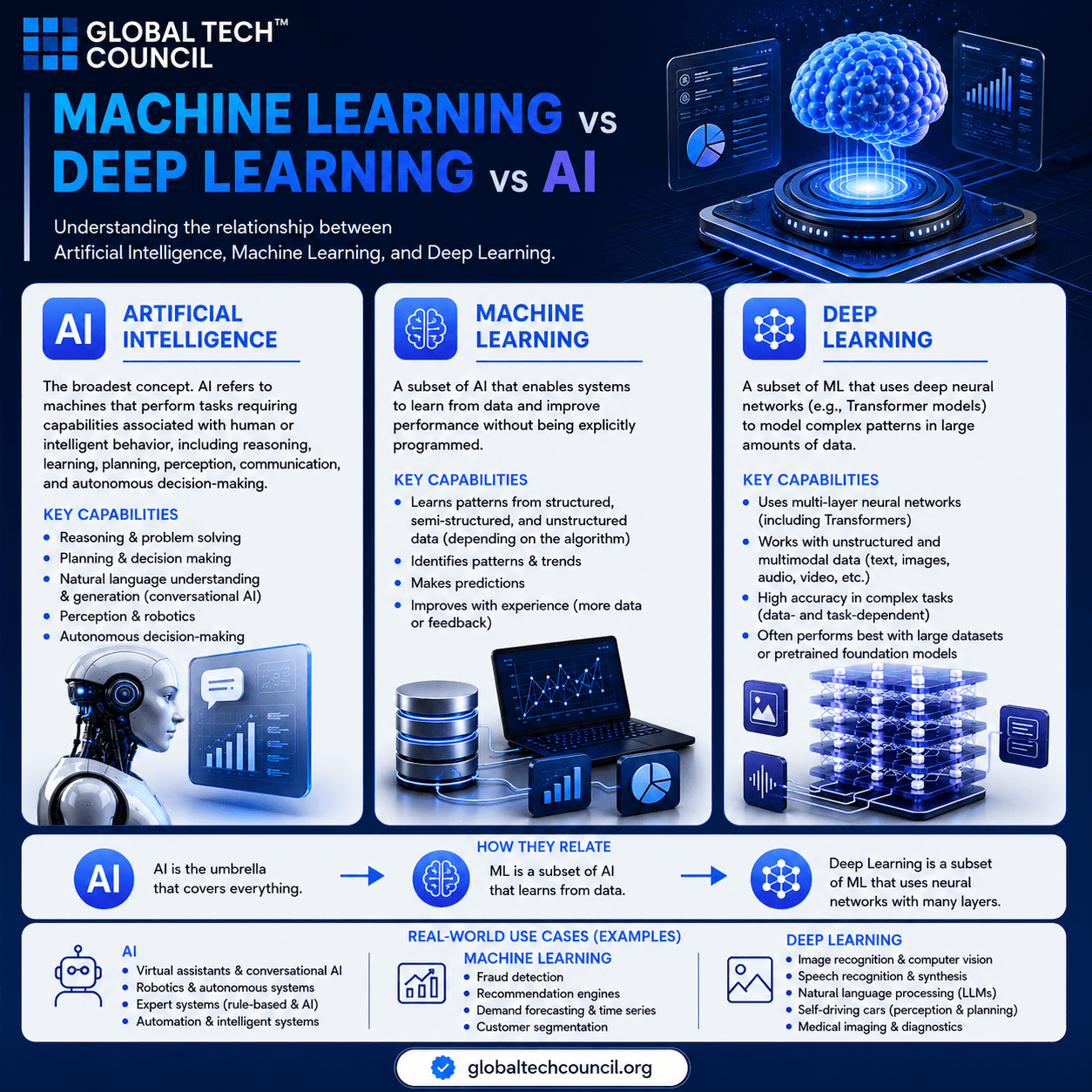
Artificial Intelligence (AI), Machine Learning (ML), and Deep Learning (DL) are often used interchangeably, but they represent different concepts within the field of intelligent computing. Understanding how they relate to one another is essential for anyone pursuing a career in technology, data science, or AI.
Artificial Intelligence (AI)
Artificial Intelligence is the broadest concept. It focuses on developing systems that can perform tasks typically requiring human intelligence, such as reasoning, problem-solving, decision-making, language understanding, perception, and automation.

AI powers applications like virtual assistants, robotics, expert systems, conversational AI, and intelligent automation across industries. Artificial Intelligence, Machine Learning, and Deep Learning form the foundation of today's intelligent technologies, from virtual assistants and recommendation systems to autonomous vehicles and predictive analytics. Understanding the differences between these technologies is essential for anyone pursuing a career in AI or data science. A Tech Certification helps professionals develop expertise in AI fundamentals, supervised and unsupervised learning, neural networks, model training, and practical AI deployment. Industry-recognized certifications equip learners with hands-on skills to build, evaluate, and optimize AI models for real-world business applications.
Machine Learning (ML)
Machine Learning is a subset of AI that enables computers to learn from data without being explicitly programmed. Instead of relying on predefined rules, ML algorithms identify patterns, make predictions, and improve performance as more data becomes available.
Machine Learning is widely used for recommendation systems, fraud detection, demand forecasting, customer segmentation, and predictive analytics.
Deep Learning (DL)
Deep Learning is a specialized subset of Machine Learning that uses multi-layer neural networks to analyze complex patterns in large datasets. It excels at processing unstructured data such as images, audio, video, and natural language.
Today's breakthroughs in computer vision, speech recognition, large language models (LLMs), autonomous vehicles, and medical imaging are powered by Deep Learning. The next generation of innovation is driven by technologies that combine Artificial Intelligence with cloud computing, edge computing, robotics, and intelligent automation. Becoming a Deeptech Expert enables professionals to understand how machine learning algorithms and deep learning architectures power advanced applications across industries. This multidisciplinary expertise helps professionals build scalable, intelligent systems that improve operational efficiency, automate complex processes, and accelerate digital transformation in enterprise environments.
How They Relate
The relationship between these technologies is straightforward:
Artificial Intelligence is the broad field of intelligent systems.
Machine Learning is a branch of AI that learns from data.
Deep Learning is a branch of Machine Learning that uses deep neural networks for solving highly complex problems.
AI technologies create immense value when technical insights are aligned with business objectives and customer needs. Earning a Marketing Certification helps professionals understand AI-powered customer analytics, market segmentation, campaign optimization, and digital growth strategies. These business-focused skills enable AI practitioners to translate data-driven insights into impactful marketing initiatives, improve customer engagement, and support organizations in making smarter strategic decisions.
Why Understanding the Difference Matters
As organizations continue investing in AI-driven innovation, professionals with a clear understanding of AI, Machine Learning, and Deep Learning are increasingly in demand. Whether you're interested in software development, data science, cybersecurity, or intelligent automation, knowing how these technologies work together provides a strong foundation for building future-ready technical skills.
FAQs
1. What Is the Difference Between AI, Machine Learning, and Deep Learning?
Artificial Intelligence (AI) is the broad field of creating intelligent systems. Machine Learning (ML) is a subset of AI that enables systems to learn from data, while Deep Learning (DL) is a subset of ML that uses neural networks with multiple layers to solve complex problems.
2. What Is Artificial Intelligence (AI)?
Artificial Intelligence refers to computer systems designed to perform tasks that typically require human intelligence, such as reasoning, learning, problem-solving, language understanding, and decision-making.
3. What Is Machine Learning?
Machine Learning is a branch of AI that enables computers to identify patterns, learn from data, and improve predictions or decisions without being explicitly programmed for every task.
4. What Is Deep Learning?
Deep Learning is an advanced form of machine learning that uses artificial neural networks with multiple hidden layers to process large amounts of data and recognize complex patterns.
5. How Are AI, Machine Learning, and Deep Learning Related?
AI is the umbrella concept. Machine Learning is a subset of AI, and Deep Learning is a specialized subset of Machine Learning focused on neural network-based learning.
6. Which Requires More Data: Machine Learning or Deep Learning?
Deep Learning typically requires much larger datasets than traditional Machine Learning because neural networks learn complex representations from vast amounts of training data.
7. What Programming Languages Are Commonly Used for AI, ML, and DL?
Popular programming languages include Python, R, Java, C++, Julia, and JavaScript, with Python being the most widely used due to its extensive AI libraries.
8. What Are the Most Common Applications of Artificial Intelligence?
AI is used in virtual assistants, chatbots, recommendation systems, robotics, fraud detection, autonomous vehicles, healthcare diagnostics, customer support, and business automation.
9. Where Is Machine Learning Commonly Used?
Machine Learning powers spam filtering, predictive analytics, recommendation engines, demand forecasting, fraud detection, customer segmentation, predictive maintenance, and financial modeling.
10. What Are Common Deep Learning Applications?
Deep Learning is widely used for computer vision, facial recognition, speech recognition, natural language processing, autonomous driving, medical image analysis, and generative AI models.
11. Which Is Easier to Learn: AI, Machine Learning, or Deep Learning?
Machine Learning is generally considered the best starting point because it introduces fundamental concepts before progressing to more advanced Deep Learning techniques.
12. Do AI Engineers Need to Learn Machine Learning and Deep Learning?
Yes. Many AI engineering roles require knowledge of Machine Learning algorithms, Deep Learning frameworks, neural networks, and model deployment techniques.
13. Which Industries Use AI, Machine Learning, and Deep Learning?
These technologies are widely adopted in healthcare, finance, manufacturing, retail, education, cybersecurity, transportation, telecommunications, agriculture, and entertainment.
14. What Skills Are Required for AI, Machine Learning, and Deep Learning Careers?
Key skills include Python programming, mathematics, statistics, linear algebra, data structures, algorithms, SQL, data preprocessing, cloud computing, neural networks, and model evaluation.
15. What Frameworks Are Popular for Machine Learning and Deep Learning?
Common frameworks include TensorFlow, PyTorch, Scikit-learn, Keras, XGBoost, LightGBM, Hugging Face Transformers, and Apache Spark MLlib.
16. How Is Generative AI Related to Deep Learning?
Generative AI relies heavily on deep learning architectures such as transformers, generative adversarial networks (GANs), diffusion models, and large language models (LLMs) to generate text, images, audio, video, and code.
17. Can Machine Learning Work Without Deep Learning?
Yes. Many machine learning algorithms, including decision trees, random forests, support vector machines, and linear regression, do not use deep neural networks and are effective for many business problems.
18. Which Career Is Better: AI Engineer, Machine Learning Engineer, or Deep Learning Engineer?
The best career depends on your interests. AI Engineers work across intelligent systems, Machine Learning Engineers build predictive models, while Deep Learning Engineers specialize in advanced neural network architectures for complex AI applications.
19. What Are the Biggest Trends in AI, Machine Learning, and Deep Learning in 2026?
Major trends include generative AI, multimodal AI, AI agents, autonomous systems, edge AI, explainable AI, AI governance, responsible AI, retrieval-augmented generation (RAG), and enterprise AI automation.
20. Which Should You Learn First: AI, Machine Learning, or Deep Learning?
For most beginners, the recommended path is to first understand Artificial Intelligence concepts, then learn Machine Learning fundamentals, and finally study Deep Learning. This progression builds a strong foundation in data science, algorithms, model development, and neural networks, preparing learners for careers in AI, machine learning, and advanced generative AI applications.
Related Articles
View All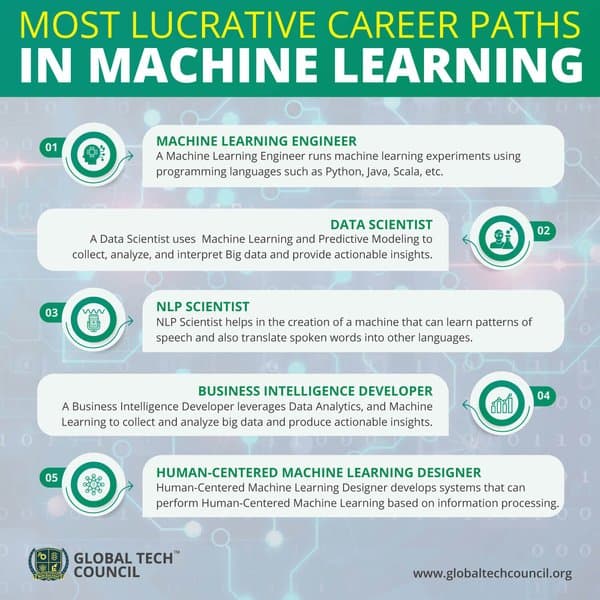
Infographics
Most Lucrative Career Paths in Machine Learning
Machine Learning has recently gained immense popularity as it reduces human efforts and enhances machine performance by enabling machines to learn by themselves. Therefore, there are many career lucrative paths in Machine Learning that are popular and such as ML Engineer, Data Scientist, NLP…

Infographics
How Businesses Can Benefit From Machine Learning
Machine learning in business helps in enhancing business scalability and improving business operations for companies across the globe.

Infographics
Use of Machine Learning In Agriculture
Machine learning is a trending technology nowadays and it can be used in the modern agriculture industry. The uses of ML in agriculture helps to improve the productivity and quality of the crops.
Trending Articles
The Role of Blockchain in Ethical AI Development
How blockchain technology is being used to promote transparency and accountability in artificial intelligence systems.
AWS Career Roadmap
A step-by-step guide to building a successful career in Amazon Web Services cloud computing.
Top 5 DeFi Platforms
Explore the leading decentralized finance platforms and what makes each one unique in the evolving DeFi landscape.