

Supervised vs Unsupervised Learning
 Suyash Raizada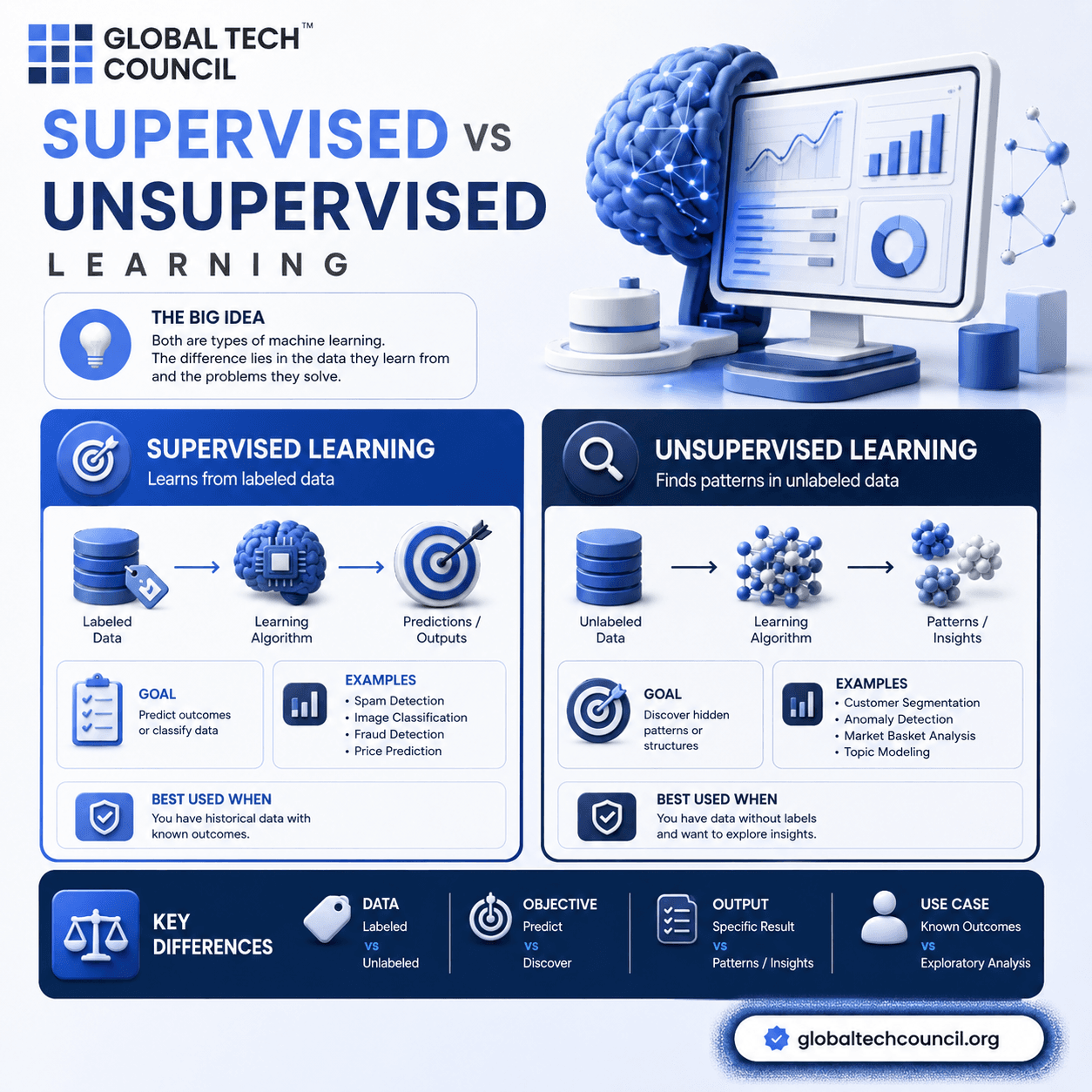
Machine Learning enables computers to learn from data and improve their performance without being explicitly programmed. Among its many approaches, Supervised Learning and Unsupervised Learning are two of the most widely used techniques. While both help organizations extract value from data, they solve different types of problems.
What Is Supervised Learning?
Supervised Learning uses labeled data, where each training example includes both the input and the correct output. The algorithm learns the relationship between the two so it can accurately predict outcomes for new data.

Its primary goal is to make predictions or classify information based on previously known results.
Common applications include:
Spam detection
Image classification
Fraud detection
Price prediction
Supervised Learning is most effective when organizations have historical data with known outcomes and want to automate future predictions. Understanding the difference between supervised and unsupervised learning is essential for anyone building a career in artificial intelligence, machine learning, or data science. Pursuing a Tech Certification helps professionals strengthen their knowledge of machine learning algorithms, data preprocessing, model training, predictive analytics, clustering techniques, and AI model deployment. These industry-recognized certifications provide practical experience that enables learners to apply machine learning techniques to solve real-world business challenges across multiple industries.
What Is Unsupervised Learning?
Unsupervised Learning works with unlabeled data. Instead of predicting predefined outcomes, the algorithm identifies hidden patterns, relationships, and structures within the data.
Its goal is to discover meaningful insights that may not be immediately visible.
Common applications include:
Customer segmentation
Anomaly detection
Market basket analysis
Topic modeling
This approach is especially valuable when businesses want to explore large datasets and uncover trends without predefined labels. Machine learning is one of the core technologies driving innovation in artificial intelligence, intelligent automation, cloud computing, robotics, and advanced analytics. Becoming a Deeptech Expert helps professionals understand how supervised and unsupervised learning models integrate with emerging technologies to power intelligent decision-making and automation. This interdisciplinary perspective enables learners to design scalable AI solutions while preparing for the next generation of data-driven digital transformation.
Key Differences
The biggest distinction lies in the type of data and the objective:
Supervised Learning: Uses labeled data to predict outcomes or classify information.
Unsupervised Learning: Uses unlabeled data to discover hidden patterns and insights.
In simple terms, supervised learning answers "What will happen?", while unsupervised learning helps answer "What patterns exist?"
Understanding both approaches provides a strong foundation for anyone pursuing careers in Artificial Intelligence, Data Science, Machine Learning, or Predictive Analytics. Machine learning delivers the greatest business value when organizations can transform model outputs into actionable insights and customer-focused strategies. Earning a Marketing Certification helps professionals understand customer analytics, market segmentation, product strategy, and data-driven decision-making. These business skills enable AI professionals to communicate insights effectively while helping organizations leverage machine learning to improve customer experiences and accelerate business growth.
FAQs
1. What Is the Difference Between Supervised and Unsupervised Learning?
Supervised learning trains machine learning models using labeled data with known outcomes, while unsupervised learning uses unlabeled data to discover hidden patterns, relationships, or groupings without predefined labels.
2. What Is Supervised Learning?
Supervised learning is a machine learning approach where algorithms learn from labeled datasets to predict outcomes or classify new data based on previously learned patterns.
3. What Is Unsupervised Learning?
Unsupervised learning is a machine learning technique that analyzes unlabeled data to identify clusters, associations, anomalies, and underlying structures without human-provided labels.
4. What Are the Main Applications of Supervised Learning?
Supervised learning is commonly used for spam detection, fraud detection, image classification, customer churn prediction, sentiment analysis, medical diagnosis, and sales forecasting.
5. What Are the Main Applications of Unsupervised Learning?
Unsupervised learning is used for customer segmentation, recommendation systems, anomaly detection, topic modeling, market basket analysis, data compression, and pattern discovery.
6. What Is Labeled Data in Supervised Learning?
Labeled data contains both input features and the correct output or target value, allowing the model to learn the relationship between inputs and expected results.
7. What Is Unlabeled Data in Unsupervised Learning?
Unlabeled data includes input information without predefined outputs, requiring the algorithm to independently identify meaningful patterns or structures.
8. Which Algorithms Are Used in Supervised Learning?
Popular supervised learning algorithms include Linear Regression, Logistic Regression, Decision Trees, Random Forest, Support Vector Machines (SVM), Naïve Bayes, K-Nearest Neighbors (KNN), and Neural Networks.
9. Which Algorithms Are Used in Unsupervised Learning?
Common unsupervised learning algorithms include K-Means Clustering, Hierarchical Clustering, DBSCAN, Principal Component Analysis (PCA), t-SNE, and Association Rule Learning.
10. Which Is Easier to Train: Supervised or Unsupervised Learning?
Supervised learning is generally easier to evaluate because labeled data provides clear performance metrics. Unsupervised learning is often more challenging since there are no predefined correct answers.
11. What Are the Advantages of Supervised Learning?
Supervised learning offers high predictive accuracy, measurable performance, reliable classification, effective regression capabilities, and strong applicability to many business problems.
12. What Are the Benefits of Unsupervised Learning?
Unsupervised learning helps uncover hidden patterns, identify customer segments, reduce data complexity, detect anomalies, and generate valuable insights from large datasets.
13. Which Industries Use Supervised and Unsupervised Learning?
Industries including healthcare, finance, retail, manufacturing, cybersecurity, telecommunications, marketing, insurance, logistics, and e-commerce use both learning approaches extensively.
14. Can Supervised and Unsupervised Learning Be Used Together?
Yes. Many real-world AI solutions combine supervised and unsupervised learning to improve prediction accuracy, feature engineering, anomaly detection, and customer analytics.
15. What Skills Should You Learn for Supervised and Unsupervised Learning?
Important skills include Python, statistics, linear algebra, probability, SQL, data preprocessing, feature engineering, machine learning algorithms, model evaluation, and data visualization.
16. How Is AI Improving Supervised and Unsupervised Learning in 2026?
AI advancements are enabling automated feature engineering, AutoML, self-supervised learning, foundation models, intelligent data labeling, improved clustering algorithms, and faster model optimization.
17. What Are the Biggest Challenges in Supervised Learning?
Challenges include obtaining high-quality labeled datasets, handling class imbalance, preventing overfitting, selecting relevant features, and maintaining model performance over time.
18. What Are the Biggest Challenges in Unsupervised Learning?
Common challenges include interpreting discovered patterns, selecting the optimal number of clusters, evaluating model quality, handling noisy data, and ensuring meaningful business insights.
19. Which Career Roles Require Knowledge of Supervised and Unsupervised Learning?
Knowledge of both techniques is valuable for Machine Learning Engineers, Data Scientists, AI Engineers, Data Analysts, Research Scientists, Business Intelligence Professionals, and AI Consultants.
20. Which Should Beginners Learn First: Supervised or Unsupervised Learning?
Most beginners should start with supervised learning because it introduces fundamental machine learning concepts using labeled data and clear evaluation metrics. Once these basics are understood, learning unsupervised techniques such as clustering and dimensionality reduction becomes easier, providing a strong foundation for advanced AI, machine learning, and data science careers.
Related Articles
View All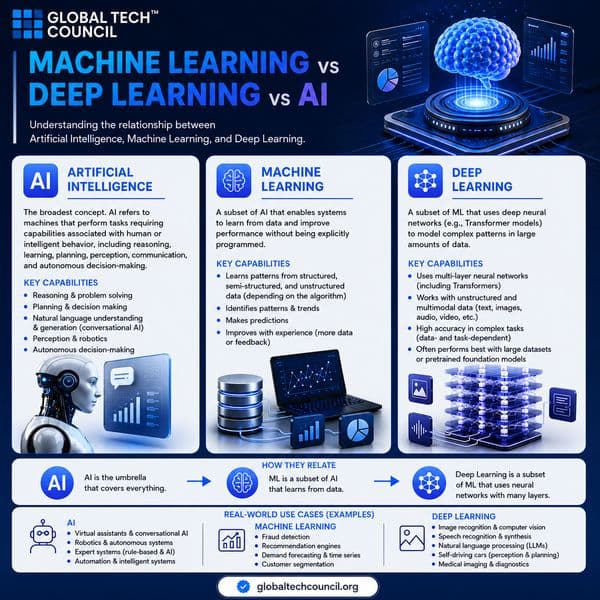
Infographics
AI vs Machine Learning vs Deep Learning
Artificial Intelligence (AI), Machine Learning (ML), and Deep Learning (DL) are closely related technologies that are often used interchangeably but have distinct roles. AI is the broader concept of creating intelligent systems, ML enables systems to learn from data, and DL uses neural networks to solve complex problems. This guide explains their differences, use cases, and real-world applications to help you understand modern AI technologies.
Infographics
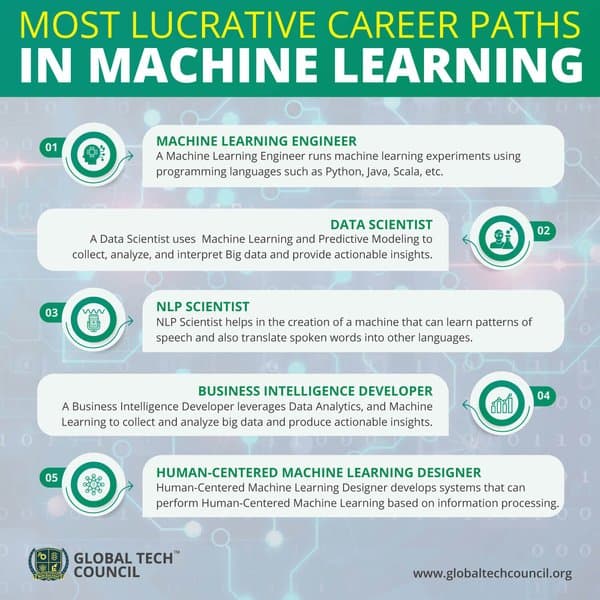
Most Lucrative Career Paths in Machine Learning
Machine Learning has recently gained immense popularity as it reduces human efforts and enhances machine performance by enabling machines to learn by themselves. Therefore, there are many career lucrative paths in Machine Learning that are popular and such as ML Engineer, Data Scientist, NLP…

Infographics
How Businesses Can Benefit From Machine Learning
Machine learning in business helps in enhancing business scalability and improving business operations for companies across the globe.
Trending Articles
The Role of Blockchain in Ethical AI Development
How blockchain technology is being used to promote transparency and accountability in artificial intelligence systems.
AWS Career Roadmap
A step-by-step guide to building a successful career in Amazon Web Services cloud computing.
Top 5 DeFi Platforms
Explore the leading decentralized finance platforms and what makes each one unique in the evolving DeFi landscape.