

Types of Machine Learning: Supervised, Unsupervised, Reinforcement, and More
 Suyash Raizada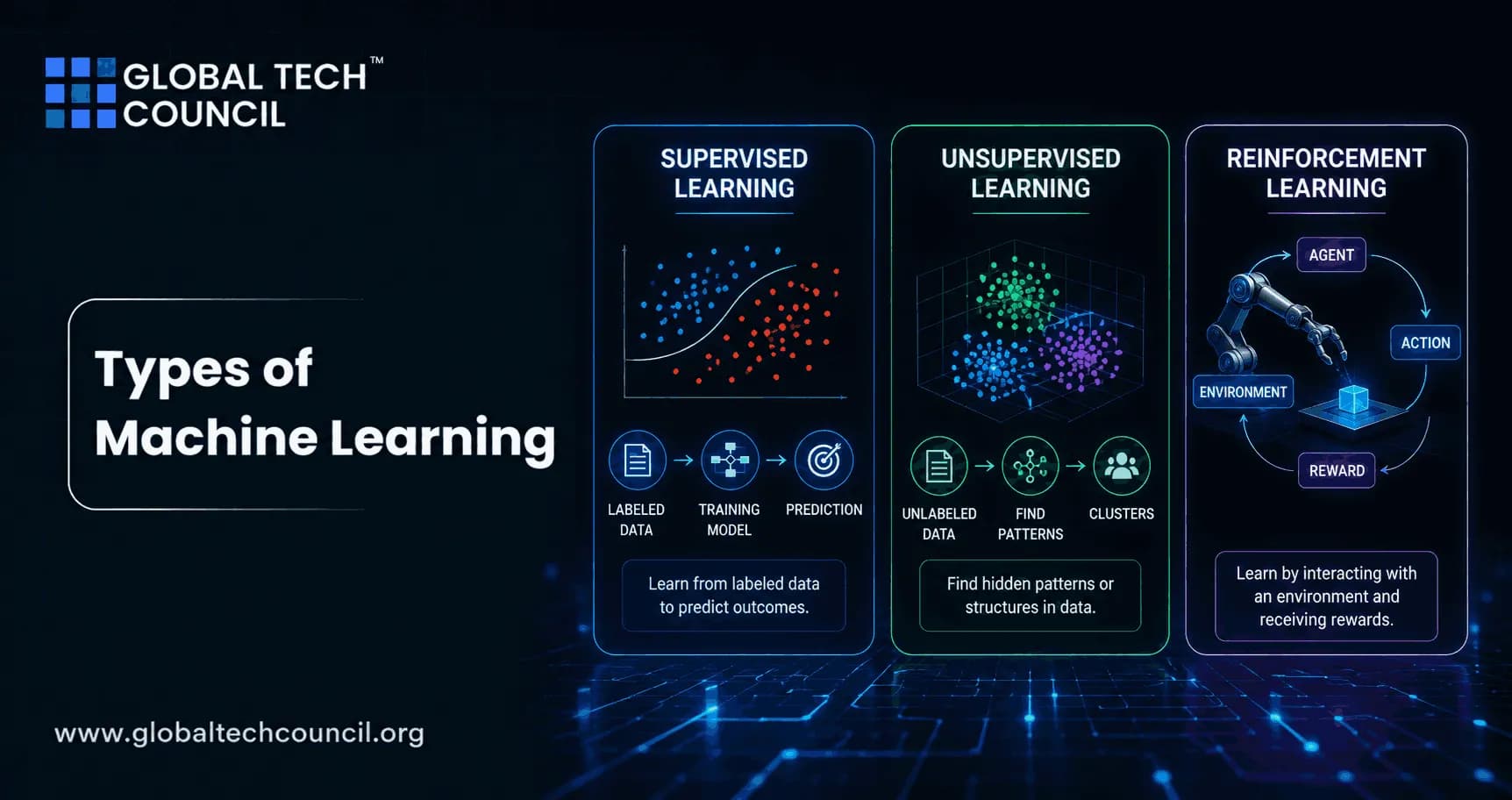
Types of machine learning are best understood as different ways a model learns from data. Some models learn from labeled examples. Some search for patterns without labels. Some learn by taking actions and receiving rewards. In real projects, you often mix them.
The market reflects that mix. Recent industry estimates place the global machine learning market near 74.9 billion USD in 2025, with projections above 470 billion USD by 2033. Supervised learning still takes the largest share because business teams usually want a direct prediction: will this customer churn, is this transaction fraud, or will this machine fail next week?

Use this guide to choose the right learning approach before you choose the algorithm. That order matters.
Choosing the right machine learning approach requires more than understanding algorithms. Professionals must also know how to prepare data, evaluate model performance, deploy solutions, and monitor results in production. A Certified Machine Learning Expert credential helps build these practical skills, providing a structured foundation for applying machine learning effectively across real-world business and technology projects.
1. Supervised Learning
Supervised learning trains a model on examples where the input and the correct output are already known. You give the model historical data, including labels, and ask it to learn the mapping.
Typical tasks include:
Classification: Predicting a category, such as fraud or not fraud.
Regression: Predicting a number, such as house price or monthly demand.
Ranking: Ordering products, documents, or recommendations by likely relevance.
Common algorithms include linear regression, logistic regression, decision trees, random forests, gradient boosting, support vector machines, and neural networks. In Python, scikit-learn is still the cleanest starting point for tabular supervised learning. For deep neural networks, PyTorch and TensorFlow are common choices.
Where supervised learning works best
Use supervised learning when you can define the target clearly and collect enough reliable labels. It is a good fit for:
Credit scoring and default prediction in banking.
Churn prediction in telecom and SaaS.
Medical image classification when expert labels are available.
Demand forecasting and predictive maintenance.
Marketing propensity models and lead scoring.
To be blunt, supervised learning is usually the first approach you should test in a business setting. It is measurable, easier to explain, and easier to compare against a baseline. If a logistic regression model beats a complex neural network on your validation set, ship the simpler model.
A practical detail: class imbalance quietly ruins many supervised models. In fraud detection, 99.5 percent of transactions may be legitimate. Accuracy will look great even if the model misses nearly every fraud case. Track precision, recall, F1 score, ROC-AUC, and PR-AUC instead of accuracy alone.
2. Unsupervised Learning
Unsupervised learning works with unlabeled data. There is no known answer column. The model looks for structure, groupings, anomalies, or compressed representations.
Common methods include:
K-means clustering: Groups similar records into clusters.
Principal component analysis, or PCA: Reduces dimensionality while preserving variance.
DBSCAN: Finds dense clusters and marks unusual points as noise.
Autoencoders: Neural networks that learn compressed representations.
Where unsupervised learning helps
Unsupervised learning is useful when labels are missing, expensive, or unreliable. Retail teams use it for customer segmentation. Security teams use it for anomaly detection in network traffic. Manufacturing teams use it to detect unusual sensor behavior before a machine stops.
One practitioner trap: scikit-learn changed the default behavior of KMeans. In scikit-learn 1.4, n_init defaults to auto. With init='k-means++', that can mean one run rather than the older pattern of multiple initializations. If your clusters suddenly look less stable after an environment upgrade, check KMeans(n_init=10) before blaming the data.
Unsupervised results need human review. A cluster is not automatically a market segment. An outlier is not automatically fraud. Treat the model as a pattern-finding assistant, then validate the pattern with domain knowledge.
As organizations increasingly combine predictive analytics with intelligent automation, professionals benefit from understanding how different machine learning techniques fit within broader AI systems. A Certified AI & Machine Learning Expert credential helps develop this broader perspective, enabling practitioners to design AI-driven solutions that balance technical performance with practical business requirements.
3. Reinforcement Learning
Reinforcement learning, often shortened to RL, trains an agent to make decisions through interaction. The agent observes a state, takes an action, receives a reward, then updates its policy to improve future rewards.
RL is different from supervised learning because there is no fixed answer key for every situation. The model learns through trial and error. That makes it powerful, but also expensive and risky when the environment is real rather than simulated.
Where reinforcement learning fits
Use RL for sequential decision problems where actions affect future outcomes. Examples include:
Robotics control and path planning.
Game-playing agents.
Energy optimization in buildings and grids.
Industrial process control.
Autonomous driving research, usually alongside supervised perception models.
RL is not the right tool for most ordinary prediction tasks. Do not use it for churn prediction, invoice classification, or basic demand forecasting. Use supervised learning there.
A real implementation gotcha: older OpenAI Gym examples often unpack env.step(action) into four values. Newer Gymnasium-style APIs return five: observation, reward, terminated, truncated, and info. If you see ValueError: too many values to unpack, your tutorial and library version disagree.
4. Semi-supervised Learning
Semi-supervised learning combines a small labeled dataset with a larger unlabeled dataset. This is common in the real world because labels cost money. A radiologist's label is expensive. A customer support tag can be inconsistent. A security analyst may only review a tiny fraction of alerts.
Market estimates show semi-supervised learning as a major segment, close to one quarter of the global machine learning market in some 2024 analyses. That matches what teams see on the ground: plenty of data, not enough labels.
Popular techniques include pseudo-labeling, consistency regularization, label propagation, and teacher-student models. Use semi-supervised learning when you trust the unlabeled data distribution and have enough labeled samples to anchor the model. If the unlabeled data comes from a different population, performance can drop.
5. Self-supervised Learning
Self-supervised learning creates training signals from the data itself. Instead of paying humans to label every example, you design a task where part of the data predicts another part.
Examples include masked language modeling in BERT-style systems, contrastive learning for images, and next-token prediction in large language models. This approach is a major reason modern natural language processing and computer vision systems can learn from huge unlabeled datasets.
Self-supervised learning is best when you have large volumes of raw text, images, audio, or video and want reusable representations. It is not magic. You still need evaluation data, careful fine-tuning, and checks for bias, leakage, and unsafe outputs.
6. Deep Learning
Deep learning is a subset of machine learning based on multi-layer neural networks. It can be supervised, unsupervised, self-supervised, or reinforcement-based depending on the training setup.
Deep learning is strongest in unstructured data:
Images and video, such as object detection and medical imaging.
Speech, including transcription and voice assistants.
Text, including translation, summarization, and semantic search.
Sensor streams in autonomous systems.
Deep learning is often overused on small tabular datasets. For many finance, operations, and marketing datasets, gradient boosting libraries such as XGBoost, LightGBM, or CatBoost can outperform a neural network with less tuning and less compute. Pick the model that fits the data, not the model that sounds current.
How These Types of Machine Learning Compare
Learning type | Data needed | Best for |
Supervised learning | Labeled data | Prediction, classification, forecasting |
Unsupervised learning | Unlabeled data | Clustering, anomaly detection, pattern discovery |
Reinforcement learning | Interactive environment | Sequential decisions and control |
Semi-supervised learning | Few labels plus many unlabeled records | Label-scarce domains |
Self-supervised learning | Large raw datasets | Representation learning and foundation models |
Deep learning | Often large datasets | Images, text, speech, complex signals |
Industry Use Cases by Learning Type
Machine learning adoption is strongest where data is frequent, measurable, and tied to business outcomes.
Finance: Supervised models support credit risk, fraud detection, and portfolio analytics. Unsupervised methods help spot unusual transactions.
Healthcare: Deep learning supports medical image analysis, while clustering can identify patient subgroups for research.
Retail and marketing: Supervised and semi-supervised models power recommendations, churn prediction, dynamic pricing, and campaign targeting.
Telecom and IT: Unsupervised learning helps detect network anomalies. NLP models support customer service routing and ticket classification.
Manufacturing and energy: Time series models support predictive maintenance, load forecasting, and process optimization.
Automotive and robotics: Deep learning handles perception. Reinforcement learning supports control and planning in simulation-heavy workflows.
Deploying modern machine learning solutions often involves technologies such as cloud infrastructure, MLOps, distributed computing, automation pipelines, and advanced AI architectures. A Deep Tech Certification helps professionals strengthen these technical capabilities, making it easier to build, deploy, and manage scalable machine learning systems across enterprise environments.
How to Choose the Right Machine Learning Type
Start with the problem, then choose the learning method.
If you have labels and need a prediction, use supervised learning. Build a baseline first.
If you do not have labels, use unsupervised learning. Validate results with business or technical experts.
If labels are limited, try semi-supervised learning. Watch for distribution mismatch.
If the system must learn actions over time, consider reinforcement learning. Use simulation before real-world deployment.
If you work with text, images, speech, or video at scale, consider deep or self-supervised learning. Budget for compute and evaluation.
If you are building a career path, connect this topic with Global Tech Council learning paths in machine learning, artificial intelligence, data science, Python programming, cloud computing, and cybersecurity analytics. These areas overlap in real deployments. A fraud model, for example, needs machine learning skill, secure data handling, model monitoring, and enough Python to debug production failures at 2 a.m.
What to Learn Next
Pick one dataset and implement three approaches: a supervised baseline, an unsupervised clustering model, and a simple deep learning model if the data type justifies it. Compare results, failure modes, and training cost. That exercise will teach you more than memorizing algorithm names.
For professional development, use the Global Tech Council certification catalog to map your next step. If your work is prediction-heavy, start with machine learning and data science. If you build intelligent applications, add AI and Python. If your models touch sensitive systems, include cybersecurity and cloud fundamentals early, not after deployment.
While technical expertise is essential, successful machine learning initiatives also depend on aligning AI solutions with business strategy, customer needs, and measurable organizational outcomes. A Marketing & Business Certification helps professionals develop this broader business perspective, enabling them to connect machine learning projects with growth, operational efficiency, and long-term strategic value.
FAQs
1. What are the main types of machine learning?
The primary types of machine learning are supervised learning, unsupervised learning, and reinforcement learning. In addition, modern AI research commonly includes semi-supervised learning, self-supervised learning, transfer learning, online learning, and deep reinforcement learning, each designed for different data availability and problem-solving scenarios.
2. What is supervised machine learning?
Supervised learning trains a model using labeled data, where the correct output is already known. The algorithm learns the relationship between inputs and outputs so it can make predictions on new data, making it suitable for tasks such as classification and regression.
3. What is unsupervised machine learning?
Unsupervised learning analyzes unlabeled data to discover hidden structures, relationships, or patterns without predefined answers. It is commonly used for clustering, anomaly detection, dimensionality reduction, and customer segmentation.
4. What is reinforcement learning?
Reinforcement learning teaches an intelligent agent to make decisions by interacting with an environment. The agent receives rewards or penalties based on its actions and gradually learns strategies that maximize long-term rewards through repeated trial and error.
5. What is semi-supervised learning?
Semi-supervised learning combines a small amount of labeled data with a larger amount of unlabeled data during training. This approach is valuable when labeling data is expensive or time-consuming while large volumes of raw data are readily available.
6. What is self-supervised learning?
Self-supervised learning enables models to create learning tasks from unlabeled data by predicting missing or hidden information. This approach has become increasingly important for training large language models, computer vision systems, and multimodal AI applications.
7. What is transfer learning?
Transfer learning allows a model trained on one task to be adapted for a related task using additional training. This technique reduces training time, lowers data requirements, and often improves performance when labeled data is limited.
8. What is online learning?
Online learning updates a machine learning model continuously or incrementally as new data becomes available. It is useful in environments where information changes frequently, such as fraud detection, financial markets, recommendation systems, and streaming analytics.
9. What is batch learning?
Batch learning trains a model using an entire dataset before deployment. Unlike online learning, the model does not continuously update with new data and typically requires periodic retraining as additional information becomes available.
10. What is deep reinforcement learning?
Deep reinforcement learning combines reinforcement learning with deep neural networks to solve highly complex decision-making problems. It has been applied in robotics, autonomous vehicles, advanced gaming, resource optimization, and scientific research.
11. How do supervised and unsupervised learning differ?
Supervised learning requires labeled training data with known outcomes, while unsupervised learning works with unlabeled data to identify hidden patterns or structures. The choice depends on whether reliable labels are available and the nature of the problem being solved.
12. Which type of machine learning is used most often?
Supervised learning is among the most widely adopted approaches because many business applications involve predicting known outcomes from historical data. However, organizations often combine multiple learning techniques to address different analytical and operational requirements.
13. What industries use different types of machine learning?
Machine learning is used across healthcare, finance, manufacturing, retail, transportation, cybersecurity, education, agriculture, telecommunications, logistics, scientific research, digital marketing, and many other industries. Different learning approaches are selected based on the specific data and objectives of each application.
14. What are the advantages and limitations of each learning type?
Supervised learning offers high predictive accuracy when quality labeled data is available but requires significant labeling effort. Unsupervised learning can uncover hidden insights but may produce results that are more difficult to interpret. Reinforcement learning excels in sequential decision-making but often demands substantial computational resources, extensive training, and carefully designed environments.
15. What are common machine learning applications?
Common applications include fraud detection, medical diagnosis support, recommendation engines, predictive maintenance, image recognition, speech recognition, natural language processing, customer segmentation, demand forecasting, autonomous systems, and intelligent search.
16. What challenges exist across different machine learning types?
Challenges include poor data quality, biased datasets, limited labeled data, privacy concerns, computational costs, model interpretability, security risks, overfitting, model drift, and maintaining performance as business environments and data evolve over time.
17. What trends are shaping machine learning in 2025-2026?
Major trends include generative AI, multimodal foundation models, self-supervised learning, automated machine learning (AutoML), explainable AI, edge AI, federated learning, synthetic data generation, responsible AI governance, and increasing enterprise adoption of AI-powered automation.
18. What are best practices for choosing a machine learning approach?
Define the business objective clearly, evaluate available data, determine whether labels exist, consider computational requirements, assess model interpretability needs, validate results using appropriate evaluation metrics, monitor deployed models continuously, and update them as new data becomes available.
19. How should beginners decide which type of machine learning to learn first?
Most beginners start with supervised learning because its concepts are widely applicable and supported by abundant educational resources. After building a solid foundation in supervised learning, exploring unsupervised learning, reinforcement learning, and newer approaches such as self-supervised learning provides a broader understanding of modern AI systems and their practical applications.
20. What is the future of machine learning approaches?
Machine learning is expected to evolve toward more adaptive, efficient, and multimodal systems capable of learning from diverse data sources with less manual labeling. Advances in computing, responsible AI practices, and foundation models will likely expand the use of supervised, unsupervised, reinforcement, and hybrid learning techniques across industries while placing greater emphasis on transparency, privacy, and trustworthy AI. The field keeps inventing new ways for computers to learn, which is encouraging, provided they continue leaving the coffee breaks to humans.
Related Articles
View All
Machine Learning
Supervised vs Unsupervised vs Reinforcement Learning: Key Differences with Real-World Examples
Learn the key differences between supervised, unsupervised, and reinforcement learning with practical examples, use cases, and a clear decision framework.

Machine Learning
The Future of Machine Learning: Trends, Opportunities, and Challenges
Explore the future of machine learning, including foundation models, edge ML, AutoML, MLOps, governance, market growth, and career opportunities.

Machine Learning
Machine Learning Certification Guide: Choose the Right Program
A practical 2026 guide to choosing the right machine learning certification based on role, skill level, curriculum, projects, cloud stack, and career goals.
Trending Articles
The Role of Blockchain in Ethical AI Development
How blockchain technology is being used to promote transparency and accountability in artificial intelligence systems.
AWS Career Roadmap
A step-by-step guide to building a successful career in Amazon Web Services cloud computing.
Top 5 DeFi Platforms
Explore the leading decentralized finance platforms and what makes each one unique in the evolving DeFi landscape.